
Articles | Volume 33, issue 2
https://doi.org/10.5194/npg-33-313-2026
© Author(s) 2026. This work is distributed under
the Creative Commons Attribution 4.0 License.
the Creative Commons Attribution 4.0 License.
https://doi.org/10.5194/npg-33-313-2026
© Author(s) 2026. This work is distributed under
the Creative Commons Attribution 4.0 License.
the Creative Commons Attribution 4.0 License.
Research article
| 
19 Jun 2026
Research article |
| 19 Jun 2026
| 19 Jun 2026
Quantitative comparison of causal inference methods for climate tipping points
Niki Lohmann
CORRESPONDING AUTHOR

Center for Critical Computational Studies (C3S), Goethe University Frankfurt, Frankfurt am Main, Germany
Potsdam Institute for Climate Impact Research (PIK), Member of the Leipniz Association, Potsdam, Germany
David Strahl
Institute of Environmental Science and Geography, University of Potsdam, Potsdam, Germany
Annika Högner
International Institute for Applied Systems Analysis (IIASA), Laxenburg, Austria
Geography Department, Humboldt-Universität zu Berlin, Berlin, Germany
Willem Huiskamp
Potsdam Institute for Climate Impact Research (PIK), Member of the Leipniz Association, Potsdam, Germany
Matthias Boehm
Technische Universität Berlin, Berlin, Germany
Berlin Institute for the Foundations of Learning and Data (BIFOLD), Berlin, Germany
Nico Wunderling
CORRESPONDING AUTHOR
Center for Critical Computational Studies (C3S), Goethe University Frankfurt, Frankfurt am Main, Germany
Potsdam Institute for Climate Impact Research (PIK), Member of the Leipniz Association, Potsdam, Germany
Senckenberg Research Institute and Natural History Museum, Frankfurt am Main, Germany
Related authors
No articles found.
Anna Höse, Moritz Kreuzer, Willem Huiskamp, Stefan Petri, and Georg Feulner
Earth Syst. Dynam., 17, 1025–1059, https://doi.org/10.5194/esd-17-1025-2026, https://doi.org/10.5194/esd-17-1025-2026, 2026
Short summary
Short summary
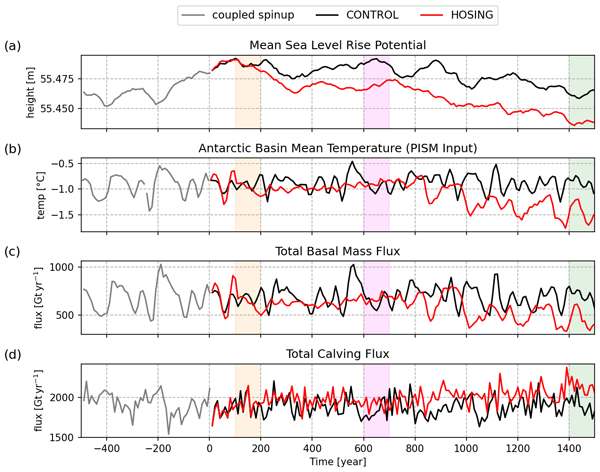
This research investigates the interactions between the Atlantic Meridional Overturning Circulation (AMOC) and the Antarctic Ice Sheet, which are both recognized as critical climate tipping elements in the Earth system. We conduct a computer simulation with artificial freshwater input in the North Atlantic to collapse the AMOC for 1500 years. Our findings show no destabilization of the Antarctic Ice Sheet induced by changes in the Southern Ocean during this period.
Niklas Schwind, Mahé Perrette, Edward Byers, Annika Högner, Quentin Lejeune, Tessa Möller, Zebedee Nicholls, Peter Pfleiderer, Sarah Schöngart, Michaela Werning, and Carl-Friedrich Schleussner
Geosci. Model Dev., 19, 6797–6828, https://doi.org/10.5194/gmd-19-6797-2026, https://doi.org/10.5194/gmd-19-6797-2026, 2026
Short summary
Short summary
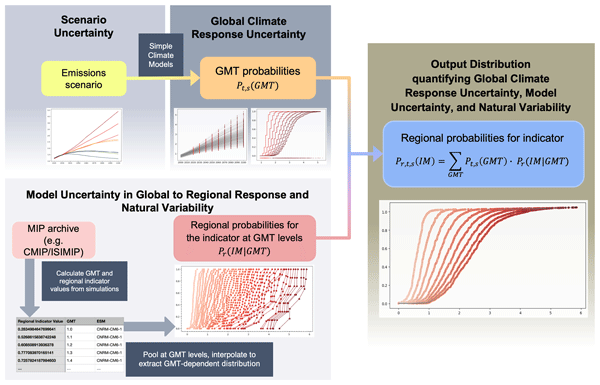
We study how regional climate and climate impact indicators may respond to different emissions scenarios. Their possible outcomes are shaped by uncertainties in future emissions, global warming, regional effects of global warming, and the chaotic climate system. We introduce RIME-X (Rapid Impact Model Emulator Extended), an emulator that combines multiple tools and datasets to estimate probabilistically how any emissions path may influence regional outcomes.
Jakob Harteg, Nico Wunderling, and Jonathan F. Donges
Earth Syst. Dynam., 17, 673–686, https://doi.org/10.5194/esd-17-673-2026, https://doi.org/10.5194/esd-17-673-2026, 2026
Short summary
Short summary
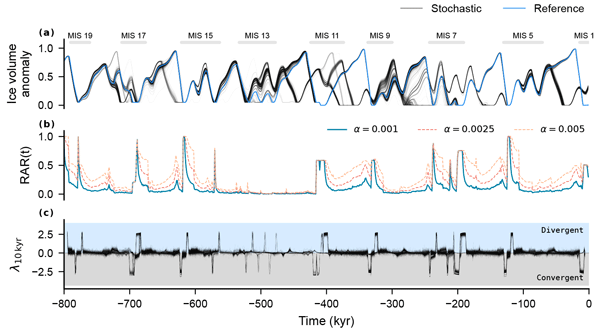
We investigate how resilient Earth’s climate system is to disturbances by analysing glacial-interglacial cycles using a simple climate model. By simulating small and large shocks to ice volume, we show that Earth’s climate more easily returns to its natural path during warm periods. These results improve our understanding of how Earth resilience varies over time in systems driven by external forces.
Sasha Roewer, Lukas Fiedler, Marius Årthun, Willem Huiskamp, and Stefan Rahmstorf
Ocean Sci., 22, 1195–1211, https://doi.org/10.5194/os-22-1195-2026, https://doi.org/10.5194/os-22-1195-2026, 2026
Short summary
Short summary
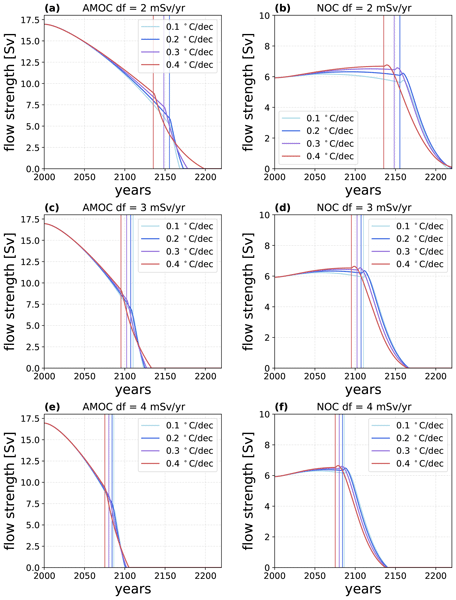
The Atlantic Meridional Overturning Circulation (AMOC) is weakening in response to global warming, while the Nordic Seas Overturning Circulation (NOC) is projected to strengthen. We suggest a feedback mechanism in which a weakened AMOC leads to reduced salt transport into the North Atlantic, decreasing the density in that region and potentially strengthening the NOC.
Jacques Bara, Nico Wunderling, and Wolfram Barfuss
Earth Syst. Dynam., 17, 333–352, https://doi.org/10.5194/esd-17-333-2026, https://doi.org/10.5194/esd-17-333-2026, 2026
Short summary
Short summary
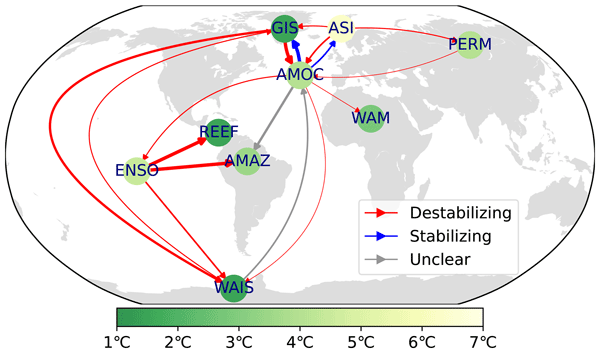
When one tipping element collapses the likelihood of another collapsing may be significantly affected. Using our simplified network model, we find that on the whole these interactions destabilise the Earth system, both in the short term and at equilibrium, though the effects are most noticeable after the year 2100. We find that to minimise tipping risks, it is essential to keep temperatures as close as possible to 1.5 °C in the short term and below 1 °C in the longer run.
Detlef P. Van Vuuren, Brian C. O'Neill, Claudia Tebaldi, Benjamin M. Sanderson, Louise P. Chini, Pierre Friedlingstein, Tomoko Hasegawa, Keywan Riahi, Bala Govindasamy, Nico Bauer, Veronika Eyring, Cheikh M. N. Fall, Katja Frieler, Matthew J. Gidden, Laila K. Gohar, Annika Högner, Andrew D. Jones, Jarmo Kikstra, Andrew King, Reto Knutti, Elmar Kriegler, Peter Lawrence, Chris Lennard, Jason Lowe, Camilla Mathison, Shahbaz Mehmood, Zebedee Nicholls, Luciana F. Prado, Qiang Zhang, Steven K. Rose, Alex C. Ruane, Marit Sandstad, Carl-Friedrich Schleussner, Roland Seferian, Jana Sillmann, Chris Smith, Anna A. Sörensson, Swapna Panickal, Kaoru Tachiiri, Naomi Vaughan, Saritha S. Vishwanathan, Tokuta Yokohata, Marco Zecchetto, and Tilo Ziehn
Geosci. Model Dev., 19, 2627–2656, https://doi.org/10.5194/gmd-19-2627-2026, https://doi.org/10.5194/gmd-19-2627-2026, 2026
Short summary
Short summary
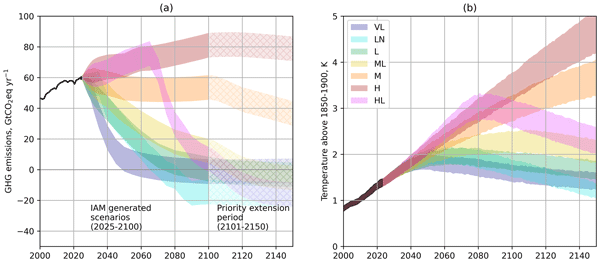
We propose a set of seven plausible 21st century emission scenarios, and their multi-century extensions, that will be used by the international community of climate modeling centers to produce the next generation of climate projections. These projections will support climate, impact and mitigation researchers, provide information to practitioners to address future risks from climate change, and contribute to policymakers’ considerations of the trade-offs among various levels of mitigation.
Nils Bochow, Jonathan Krönke, Julius Garbe, and Nico Wunderling
EGUsphere, https://doi.org/10.5194/egusphere-2026-614, https://doi.org/10.5194/egusphere-2026-614, 2026
Short summary
Short summary
We provide a simple, updateable tool that turns comprehensive simulations into fast dynamical models for the three major tipping elements; the Greenland Ice Sheet, the West Antarctic Ice Sheet, and the Atlantic Meridional Overturning circulation. By fitting our framework to existing comprehensive simulations, it matches both short-term change and long-term stable states. This helps produce more consistent, policy-ready risk estimates as new simulations arrive.
John M. Anderies, Max Bechthold, Jonathan F. Donges, Ingo Fetzer, Nico Wunderling, Wolfram Barfuss, and Johan Rockström
EGUsphere, https://doi.org/10.5194/egusphere-2025-6345, https://doi.org/10.5194/egusphere-2025-6345, 2026
Short summary
Short summary
This paper explores a new approach to understanding human-Earth system resilience. It introduces a measure that estimates how likely a system is to reach a safe and just state. Available knowledge about how the system works, its boundaries, and potential disruptions centrally constrain the measure. It could help decision-makers strike a balance between gaining knowledge, building capacity to act, and taking practical measures to improve resilience in many different types of systems.

Florian Ulrich Jehn, James Mulhall, Simon Blouin, Łukasz G. Gajewski, and Nico Wunderling
Earth Syst. Dynam., 17, 151–166, https://doi.org/10.5194/esd-17-151-2026, https://doi.org/10.5194/esd-17-151-2026, 2026
Short summary
Short summary
Large crop failures happen regularly around the world, threatening food security. We analyzed sixty years of global crop production data and found that every country has experienced major crop losses. Climate events like droughts cause most severe disruptions, with some African nations losing up to eighty percent of production. While global crop shocks above five percent are rare, regional disruptions occur frequently. These findings show our food system faces regular large-scale threats.
E. Keith Smith, Carl Folke, Niklas Kitzmann, Manjana Milkoreit, Per Olsson, Ricarda Winkelmann, Anne-Sophie Crépin, Christina Eder, Niklas Harring, Jobst Heitzig, Alexia Katsanidou, Timothy M. Lenton, Franz Mauelshagen, Kelton Minor, Ilona M. Otto, Armon Rezai, Jürgen Scheffran, Isabelle Stadelmann-Steffen, Rick van der Ploeg, Nico Wunderling, and Jonathan F. Donges
EGUsphere, https://doi.org/10.5194/egusphere-2026-177, https://doi.org/10.5194/egusphere-2026-177, 2026
This preprint is open for discussion and under review for Earth System Dynamics (ESD).
Short summary
Short summary
Achieving climate and sustainability goals requires rapid, large-scale change. We introduce criticality – the likelihood a system is near a social tipping point – and critical agency – the capacity to shape those conditions. Our framework shows how coalitions and policies can trigger desired shifts and avoid harmful ones, linking complex systems theory with evidence to guide policymakers and practitioners.
Florian Ulrich Jehn, Łukasz G. Gajewski, Johanna Hedlund, Constantin W. Arnscheidt, Lili Xia, Nico Wunderling, and David Denkenberger
Earth Syst. Dynam., 16, 1585–1603, https://doi.org/10.5194/esd-16-1585-2025, https://doi.org/10.5194/esd-16-1585-2025, 2025
Short summary
Short summary
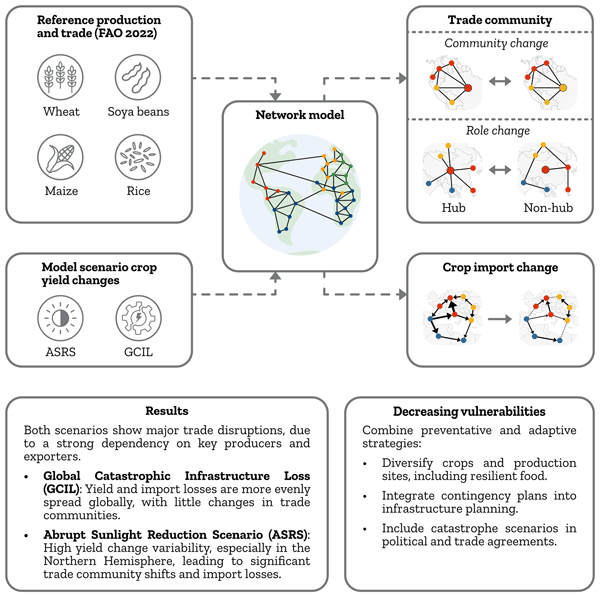
The global food trade system can handle small disturbances, but large disasters could cause major disruptions. We looked at how nuclear war or severe infrastructure loss would affect global trade in key crops. Both would be catastrophic, but a nuclear war would cause more severe disruptions, with many countries losing most of their food imports. Both scenarios highlight the need for better preparation to protect global food security.
Nico Wunderling, Anna S. von der Heydt, Yevgeny Aksenov, Stephen Barker, Robbin Bastiaansen, Victor Brovkin, Maura Brunetti, Victor Couplet, Thomas Kleinen, Caroline H. Lear, Johannes Lohmann, Rosa Maria Roman-Cuesta, Sacha Sinet, Didier Swingedouw, Ricarda Winkelmann, Pallavi Anand, Jonathan Barichivich, Sebastian Bathiany, Mara Baudena, John T. Bruun, Cristiano M. Chiessi, Helen K. Coxall, David Docquier, Jonathan F. Donges, Swinda K. J. Falkena, Ann Kristin Klose, David Obura, Juan Rocha, Stefanie Rynders, Norman Julius Steinert, and Matteo Willeit
Earth Syst. Dynam., 15, 41–74, https://doi.org/10.5194/esd-15-41-2024, https://doi.org/10.5194/esd-15-41-2024, 2024
Short summary
Short summary
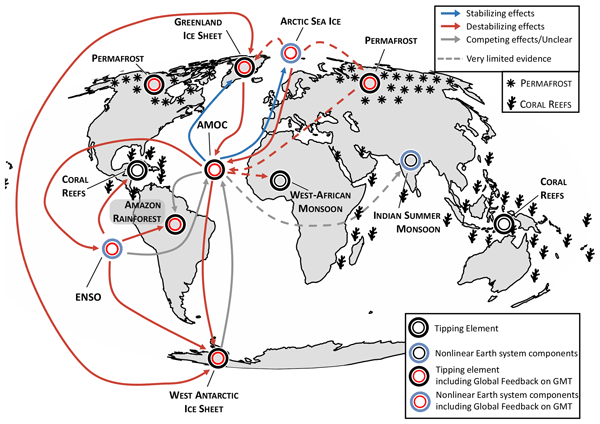
This paper maps out the state-of-the-art literature on interactions between tipping elements relevant for current global warming pathways. We find indications that many of the interactions between tipping elements are destabilizing. This means that tipping cascades cannot be ruled out on centennial to millennial timescales at global warming levels between 1.5 and 2.0 °C or on shorter timescales if global warming surpasses 2.0 °C.
Willem Huiskamp and Shayne McGregor
Clim. Past, 17, 1819–1839, https://doi.org/10.5194/cp-17-1819-2021, https://doi.org/10.5194/cp-17-1819-2021, 2021
Short summary
Short summary
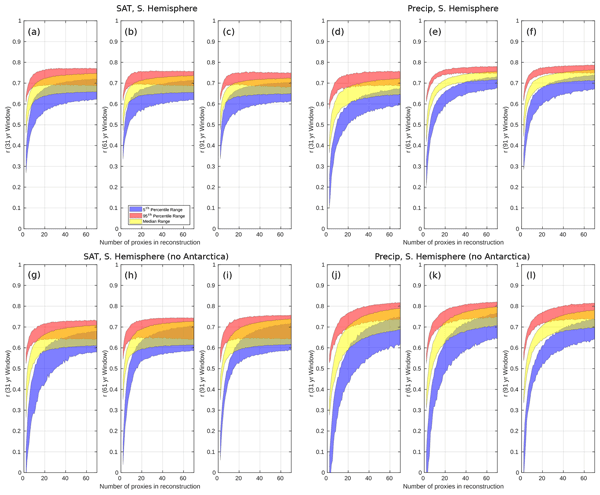
This study investigates the reliability of paleo-reconstructions of the Southern Annular Mode (SAM) using climate model data. We find that reconstructions are able to capture ~ 60 % of the SAM variability at best, with poorer reconstructions managing only 35 %. Reconstructions perform best when they use more proxies sourced from the entire Southern Hemisphere land mass. Future reconstructions should endeavour to address both sampling and proxy–SAM correlation stability uncertainties.
Cited articles
Angevaare, J. R. and Drijfhout, S. S.: Catalogue of Strong Nonlinear Surprises in ocean, sea-ice, and atmospheric variables in CMIP6, EGUsphere [preprint], https://doi.org/10.5194/egusphere-2025-2039, 2025. a
Armstrong McKay, D. I., Staal, A., Abrams, J. F., Winkelmann, R., Sakschewski, B., Loriani, S., Fetzer, I., Cornell, S. E., Rockström, J., and Lenton, T. M.: Exceeding 1.5 °C Global Warming Could Trigger Multiple Climate Tipping Points, Science, 377, eabn7950, https://doi.org/10.1126/science.abn7950, 2022. a, b
Ashwin, P., Wieczorek, S., Vitolo, R., and Cox, P.: Tipping Points in Open Systems: Bifurcation, Noise-Induced and Rate-Dependent Examples in the Climate System, Philos. T. R. Soc. A, 370, 1166–1184, https://doi.org/10.1098/rsta.2011.0306, 2012. a
Assaad, C. K., Devijver, E., and Gaussier, E.: Survey and Evaluation of Causal Discovery Methods for Time Series, J. Artif. Intell. Res., 73, 767–819, https://doi.org/10.1613/jair.1.13428, 2022. a, b
Barnett, L.: Ssgc, GitHub [code], https://github.com/lcbarnett/ssgc (last access: 10 June 2026), 2020. a
Barnett, L. and Seth, A. K.: Granger Causality for State-Space Models, Phys. Rev. E, 91, 040101, https://doi.org/10.1103/PhysRevE.91.040101, 2015. a, b
Barnett, L. and Seth, A. K.: Detectability of Granger Causality for Subsampled Continuous-Time Neurophysiological Processes, J. Neurosci. Meth., 275, 93–121, https://doi.org/10.1016/j.jneumeth.2016.10.016, 2017. a, b
Barnett, L. and Seth, A. K.: Inferring the Temporal Structure of Directed Functional Connectivity in Neural Systems: Some Extensions to Granger Causality, in: 2019 IEEE International Conference on Systems, Man and Cybernetics (SMC), 4395–4402, https://doi.org/10.1109/SMC.2019.8914556, 2019. a
Bdolach, T., Kurths, J., and Yanchuk, S.: Tipping in an Adaptive Climate Network Model, Chaos, 35, 053157, https://doi.org/10.1063/5.0256156, 2025. a
Binns, T. S., Köhler, R. M., Vanhoecke, J., Chikermane, M., Gerster, M., Merk, T., Pellegrini, F., Busch, J. L., Habets, J. G. V., Cavallo, A., Beyer, J.-C., Al-Fatly, B., Li, N., Horn, A., Krause, P., Faust, K., Schneider, G.-H., Haufe, S., Kühn, A. A., and Neumann, W.-J.: Shared Pathway-Specific Network Mechanisms of Dopamine and Deep Brain Stimulation for the Treatment of Parkinson's Disease, Nat. Commun., 16, 3587, https://doi.org/10.1038/s41467-025-58825-z, 2025. a
Boers, N.: Observation-Based Early-Warning Signals for a Collapse of the Atlantic Meridional Overturning Circulation, Nat. Clim. Change, 11, 680–688, https://doi.org/10.1038/s41558-021-01097-4, 2021. a
Boers, N. and Rypdal, M.: Critical Slowing down Suggests That the Western Greenland Ice Sheet Is Close to a Tipping Point, P. Natl. Acad. Sci. USA, 118, e2024192118, https://doi.org/10.1073/pnas.2024192118, 2021. a
Caesar, L., Rahmstorf, S., Robinson, A., Feulner, G., and Saba, V.: Observed Fingerprint of a Weakening Atlantic Ocean Overturning Circulation, Nature, 556, 191–196, https://doi.org/10.1038/s41586-018-0006-5, 2018. a, b, c, d
Camps-Valls, G., Gerhardus, A., Ninad, U., Varando, G., Martius, G., Balaguer-Ballester, E., Vinuesa, R., Diaz, E., Zanna, L., and Runge, J.: Discovering Causal Relations and Equations from Data, Phys. Rep., 1044, 1–68, https://doi.org/10.1016/j.physrep.2023.10.005, 2023. a
Carvalho, K. S. and Wang, S.: Sea Surface Temperature Variability in the Arctic Ocean and Its Marginal Seas in a Changing Climate: Patterns and Mechanisms, Global Planet. Change, 193, 103265, https://doi.org/10.1016/j.gloplacha.2020.103265, 2020. a
Chicco, D. and Jurman, G.: The Advantages of the Matthews Correlation Coefficient (MCC) over F1 Score and Accuracy in Binary Classification Evaluation, BMC Genomics, 21, 6, https://doi.org/10.1186/s12864-019-6413-7, 2020. a
Debeire, K., Bock, L., Nowack, P., Runge, J., and Eyring, V.: Constraining uncertainty in projected precipitation over land with causal discovery, Earth Syst. Dynam., 16, 607–630, https://doi.org/10.5194/esd-16-607-2025, 2025. a
Delforge, D., de Viron, O., Vanclooster, M., Van Camp, M., and Watlet, A.: Detecting hydrological connectivity using causal inference from time series: synthetic and real karstic case studies, Hydrol. Earth Syst. Sci., 26, 2181–2199, https://doi.org/10.5194/hess-26-2181-2022, 2022. a
Di Capua, G., Coumou, D., van den Hurk, B., Weisheimer, A., Turner, A. G., and Donner, R. V.: Validation of boreal summer tropical–extratropical causal links in seasonal forecasts, Weather Clim. Dynam., 4, 701–723, https://doi.org/10.5194/wcd-4-701-2023, 2023. a
Di Capua, G., Tyrlis, E., Matei, D., and Donner, R. V.: Tropical and Mid-Latitude Causal Drivers of the Eastern Mediterranean Etesians during Boreal Summer, Clim. Dynam., 62, 9565–9585, https://doi.org/10.1007/s00382-024-07411-y, 2024. a
Ditlevsen, P. and Ditlevsen, S.: Warning of a Forthcoming Collapse of the Atlantic Meridional Overturning Circulation, Nat. Commun., 14, 4254, https://doi.org/10.1038/s41467-023-39810-w, 2023. a
Docquier, D. and Koenigk, T.: A Review of Interactions between Ocean Heat Transport and Arctic Sea Ice, Environ. Res. Lett., 16, 123002, https://doi.org/10.1088/1748-9326/ac30be, 2021. a, b
Docquier, D., Vannitsem, S., Ragone, F., Wyser, K., and Liang, X. S.: Causal Links Between Arctic Sea Ice and Its Potential Drivers Based on the Rate of Information Transfer, Geophys. Res. Lett., 49, e2021GL095892, https://doi.org/10.1029/2021GL095892, 2022. a, b, c
Drijfhout, S., Angevaare, J., Mecking, J. V., Van Westen, R., and Rahmstorf, S.: Shutdown of Northern Atlantic Overturning after 2100 Following Deep Mixing Collapse in CMIP6 Projections, Environ. Res. Lett., https://doi.org/10.1088/1748-9326/adfa3b, 2025. a, b
E.U. CMEMS (Copernicus Marine Service Information): Arctic Sea and Sea Ice Surface Temperature Anomaly Time Series Based on Reprocessed Observations, Marine Data Store, https://doi.org/10.48670/mds-00323, 2024a. a, b
E.U. CMEMS (Copernicus Marine Service Information): Arctic ocean sea ice reanalysis, Marine Data Store (MDS) [data set], https://doi.org/10.48670/mds-00336, 2024b. a, b
Everitt, B. S. and Skrondal, A.: The Cambridge Dictionary of Statistics, Cambridge University Press, ISBN 978-0-521-76699-9, 2010. a
Falkena, S. K. J., Dijkstra, H. A., and von der Heydt, A. S.: Causal mechanisms of subpolar gyre variability in CMIP6 models, Earth Syst. Dynam., 16, 1833–1844, https://doi.org/10.5194/esd-16-1833-2025, 2025. a
Frajka-Williams, E., Ansorge, I. J., Baehr, J., Bryden, H. L., Chidichimo, M. P., Cunningham, S. A., Danabasoglu, G., Dong, S., Donohue, K. A., Elipot, S., Heimbach, P., Holliday, N. P., Hummels, R., Jackson, L. C., Karstensen, J., Lankhorst, M., Le Bras, I. A., Lozier, M. S., McDonagh, E. L., Meinen, C. S., Mercier, H., Moat, B. I., Perez, R. C., Piecuch, C. G., Rhein, M., Srokosz, M. A., Trenberth, K. E., Bacon, S., Forget, G., Goni, G., Kieke, D., Koelling, J., Lamont, T., McCarthy, G. D., Mertens, C., Send, U., Smeed, D. A., Speich, S., van den Berg, M., Volkov, D., and Wilson, C.: Atlantic Meridional Overturning Circulation: Observed Transport and Variability, Front. Marine Sci., 6, https://doi.org/10.3389/fmars.2019.00260, 2019. a
Hersbach, H., Bell, B., Berrisford, P., Biavati, G., Horányi, A., Muñoz Sabater, J., Nicolas, J., Peubey, C., Radu, R., Rozum, I., Schepers, D., Simmons, A., Soci, C., Dee, D., Thépaut, J.-N.: ERA5 monthly averaged data on single levels from 1940 to present, Copernicus Climate Change Service (C3S) Climate Data Store (CDS) [data set], https://doi.org/10.24381/cds.f17050d7, 2023. a, b
Hirahara, S., Ishii, M., and Fukuda, Y.: Centennial-Scale Sea Surface Temperature Analysis and Its Uncertainty, J. Climate, 27, 57–75, https://doi.org/10.1175/JCLI-D-12-00837.1, 2014. a
Högner, A., Di Capua, G., Donges, J. F., Donner, R. V., Feulner, G., and Wunderling, N.: Causal Pathway from AMOC to Southern Amazon Rainforest Indicates Stabilising Interaction between Two Climate Tipping Elements, Environ. Res. Lett., 20, 074026, https://doi.org/10.1088/1748-9326/addb62, 2025. a, b, c, d, e
Huang, B., Thorne, P. W., Banzon, V. F., Boyer, T., Chepurin, G., Lawrimore, J. H., Menne, M. J., Smith, T. M., Vose, R. S., and Zhang, H.-M.: Extended Reconstructed Sea Surface Temperature, Version 5 (ERSSTv5): Upgrades, Validations, and Intercomparisons, J. Climate, 30, 8179–8205, https://doi.org/10.1175/JCLI-D-16-0836.1, 2017. a
Huo, Y., Zhang, R., Wang, H., Sweeney, A., Fu, Q., Rasch, P. J., Zou, Y., Wang, M., and Ma, W.: Changes in Sea Ice Concentration Explain Half of the Winter Warming of the Arctic Surface, Communications Earth & Environment, 6, 775, https://doi.org/10.1038/s43247-025-02548-y, 2025. a
Jackson, L. C., Kahana, R., Graham, T., Ringer, M. A., Woollings, T., Mecking, J. V., and Wood, R. A.: Global and European Climate Impacts of a Slowdown of the AMOC in a High Resolution GCM, Clim. Dynam., 45, 3299–3316, https://doi.org/10.1007/s00382-015-2540-2, 2015. a
Jahn, A., Holland, M. M., and Kay, J. E.: Projections of an Ice-Free Arctic Ocean, Nat. Rev. Earth Environ., 5, 164–176, https://doi.org/10.1038/s43017-023-00515-9, 2024. a
Jenkins, M. T. and Dai, A.: Arctic Climate Feedbacks in ERA5 Reanalysis: Seasonal and Spatial Variations and the Impact of Sea-Ice Loss, Geophys. Res. Lett., 49, e2022GL099263, https://doi.org/10.1029/2022GL099263, 2022. a, b
Kaufhold, C., Willeit, M., Talento, S., Ganopolski, A., and Rockström, J.: Interplay between Climate and Carbon Cycle Feedbacks Could Substantially Enhance Future Warming, Environ. Res. Lett., 20, 044027, https://doi.org/10.1088/1748-9326/adb6be, 2025. a
Kennedy, J. J., Rayner, N. A., Atkinson, C. P., and Killick, R. E.: An Ensemble Data Set of Sea Surface Temperature Change From 1850: The Met Office Hadley Centre HadSST.4.0.0.0 Data Set, J. Geophys. Res.-Atmos., 124, 7719–7763, https://doi.org/10.1029/2018JD029867, 2019. a
Klose, A. K., Karle, V., Winkelmann, R., and Donges, J. F.: Emergence of Cascading Dynamics in Interacting Tipping Elements of Ecology and Climate, Roy. Soc. Open Sci., 7, 200599, https://doi.org/10.1098/rsos.200599, 2020. a
Klose, A. K., Donges, J. F., Feudel, U., and Winkelmann, R.: Rate-induced tipping cascades arising from interactions between the Greenland Ice Sheet and the Atlantic Meridional Overturning Circulation, Earth Syst. Dynam., 15, 635–652, https://doi.org/10.5194/esd-15-635-2024, 2024. a, b
Kretschmer, M., Coumou, D., Donges, J. F., and Runge, J.: Using Causal Effect Networks to Analyze Different Arctic Drivers of Midlatitude Winter Circulation, J. Climate, 29, 4069–4081, https://doi.org/10.1175/JCLI-D-15-0654.1, 2016. a
Kromer, J. D. and Trusel, L. D.: Identifying the Impacts of Sea Ice Variability on the Climate and Surface Mass Balance of West Antarctica, Geophys. Res. Lett., 50, e2023GL104436, https://doi.org/10.1029/2023GL104436, 2023. a
Laridon, A., Couplet, V., Gérard, J., Thiery, W., and Crucifix, M.: Connecting Complex and Simplified Models of Tipping Elements: A Nonlinear Two-Forcing Emulator for the Atlantic Meridional Overturning Circulation, Open Res. Eur., 5, 87, https://doi.org/10.12688/openreseurope.19479.1, 2025. a
Lenton, T. M., Held, H., Kriegler, E., Hall, J. W., Lucht, W., Rahmstorf, S., and Schellnhuber, H. J.: Tipping Elements in the Earth's Climate System, P. Natl. Acad. Sci. USA, 105, 1786–1793, https://doi.org/10.1073/pnas.0705414105, 2008. a
Lenton, T. M., Milkoreit, M., Willcock, S., Abrams, J. F., Armstrong McKay, D. I., Buxton, J. E., Donges, J. F., Loriani, S., Wunderling, N., Alkemade, F., Barrett, M., Constantino, S., Powell, T., Smith, S. R., Boulton, C. A., Pinho, P., Dijkstra, H., Pearce-Kelly, P., Roman-Cuesta, R. M., and Dennis, D.: Global Tipping Points Report 2025, University of Exeter, Zenodo, https://doi.org/10.5281/zenodo.18163976, 2025. a, b
Li, H., Fedorov, A., and Liu, W.: AMOC Stability and Diverging Response to Arctic Sea Ice Decline in Two Climate Models, J. Climate, 34, 5443–5460, https://doi.org/10.1175/JCLI-D-20-0572.1, 2021. a, b, c, d
Liang, H., Wang, W., Liu, D., Chen, B., Guo, L., Liu, H., Yu, S., and Zhang, D.: Inferring Causal Associations in Hydrological Systems: A Comparison of Methods, Stoch. Env. Res. Risk A., 39, 2427–2448, https://doi.org/10.1007/s00477-025-02977-3, 2025. a, b, c
Liang, X. S.: Normalized Multivariate Time Series Causality Analysis and Causal Graph Reconstruction, Entropy, 23, 679, https://doi.org/10.3390/e23060679, 2021. a, b, c, d
Liu, W. and Fedorov, A.: Interaction between Arctic Sea Ice and the Atlantic Meridional Overturning Circulation in a Warming Climate, Clim. Dynam., 58, 1811–1827, https://doi.org/10.1007/s00382-021-05993-5, 2022. a, b, c, d
Lohmann, N.: Quantitative Comparison of Causal Inference Methods for Climate Tipping Points, Zenodo [code], https://doi.org/10.5281/zenodo.17864596, 2025. a
Mahajan, S., Zhang, R., and Delworth, T. L.: Impact of the Atlantic Meridional Overturning Circulation (AMOC) on Arctic Surface Air Temperature and Sea Ice Variability, J. Climate, 24, 6573–6581, https://doi.org/10.1175/2011JCLI4002.1, 2011. a, b, c
Morice, C. P., Kennedy, J. J., Rayner, N. A., Winn, J. P., Hogan, E., Killick, R. E., Dunn, R. J. H., Osborn, T. J., Jones, P. D., and Simpson, I. R.: An Updated Assessment of Near-Surface Temperature Change From 1850: The HadCRUT5 Data Set, J. Geophys. Res.-Atmos., 126, e2019JD032361, https://doi.org/10.1029/2019JD032361, 2021. a, b
Morlighem, M., Williams, C. N., Rignot, E., An, L., Arndt, J. E., Bamber, J. L., Catania, G., Chauché, N., Dowdeswell, J. A., Dorschel, B., Fenty, I., Hogan, K., Howat, I., Hubbard, A., Jakobsson, M., Jordan, T. M., Kjeldsen, K. K., Millan, R., Mayer, L., Mouginot, J., Noël, B. P. Y., O'Cofaigh, C., Palmer, S., Rysgaard, S., Seroussi, H., Siegert, M. J., Slabon, P., Straneo, F., van den Broeke, M. R., Weinrebe, W., Wood, M., and Zinglersen, K. B.: BedMachine v3: Complete Bed Topography and Ocean Bathymetry Mapping of Greenland From Multibeam Echo Sounding Combined With Mass Conservation, Geophys. Res. Lett., 44, 11051–11061, https://doi.org/10.1002/2017GL074954, 2017. a
Nogueira, A. R., Pugnana, A., Ruggieri, S., Pedreschi, D., and Gama, J.: Methods and Tools for Causal Discovery and Causal Inference, WIREs Data Min. Knowl., 12, e1449, https://doi.org/10.1002/widm.1449, 2022. a
Nowack, P., Runge, J., Eyring, V., and Haigh, J. D.: Causal Networks for Climate Model Evaluation and Constrained Projections, Nat. Commun., 11, 1415, https://doi.org/10.1038/s41467-020-15195-y, 2020. a
Olonscheck, D., Mauritsen, T., and Notz, D.: Arctic Sea-Ice Variability Is Primarily Driven by Atmospheric Temperature Fluctuations, Nat. Geosci., 12, 430–434, https://doi.org/10.1038/s41561-019-0363-1, 2019. a, b
Orihuela-Pinto, B., England, M. H., and Taschetto, A. S.: Interbasin and Interhemispheric Impacts of a Collapsed Atlantic Overturning Circulation, Nat. Clim. Change, 12, 558–565, https://doi.org/10.1038/s41558-022-01380-y, 2022. a
Petit, T., Lozier, M. S., Josey, S. A., and Cunningham, S. A.: Atlantic Deep Water Formation Occurs Primarily in the Iceland Basin and Irminger Sea by Local Buoyancy Forcing, Geophys. Res. Lett., 47, e2020GL091028, https://doi.org/10.1029/2020GL091028, 2020. a, b
Rong, Y.: Lkif, GitHub [code], https://github.com/YinengRong/LKIF (last access: 10 June 2026), 2024. a
Runge, J.: Discovering Contemporaneous and Lagged Causal Relations in Autocorrelated Nonlinear Time Series Datasets, in: Proceedings of the 36th Conference on Uncertainty in Artificial Intelligence (UAI), 1388–1397, PMLR, https://proceedings.mlr.press/v124/runge20a.html (last access: 10 June 2026), 2020. a, b, c, d
Runge, J., Petoukhov, V., Donges, J. F., Hlinka, J., Jajcay, N., Vejmelka, M., Hartman, D., Marwan, N., Paluš, M., and Kurths, J.: Identifying Causal Gateways and Mediators in Complex Spatio-Temporal Systems, Nat. Commun., 6, 8502, https://doi.org/10.1038/ncomms9502, 2015. a, b
Runge, J., Bathiany, S., Bollt, E., Camps-Valls, G., Coumou, D., Deyle, E., Glymour, C., Kretschmer, M., Mahecha, M. D., Muñoz-Marí, J., Van Nes, E. H., Peters, J., Quax, R., Reichstein, M., Scheffer, M., Schölkopf, B., Spirtes, P., Sugihara, G., Sun, J., Zhang, K., and Zscheischler, J.: Inferring Causation from Time Series in Earth System Sciences, Nat. Commun., 10, 2553, https://doi.org/10.1038/s41467-019-10105-3, 2019a. a
Sévellec, F., Fedorov, A. V., and Liu, W.: Arctic Sea-Ice Decline Weakens the Atlantic Meridional Overturning Circulation, Nat. Clim. Change, 7, 604–610, https://doi.org/10.1038/nclimate3353, 2017. a, b
Shao, Y., Hagan, D. F. T., Li, S., Zhou, F., Zou, X., and Cabral, P.: The Many Shades of the Vegetation–Climate Causality: A Multimodel Causal Appreciation, Forests, 15, 1430, https://doi.org/10.3390/f15081430, 2024. a
Sinet, S., von der Heydt, A. S., and Dijkstra, H. A.: West Antarctic Meltwater Can Prevent an AMOC Collapse, arXiv [preprint], https://doi.org/10.48550/arXiv.2502.17104, 2025. a
Stoerk, T., Rising, J., Shindell, D., and Dietz, S.: Global Methane Action Pays for Itself at Least Six Times Over, Science, 390, eadu7392, https://doi.org/10.1126/science.adu7392, 2025. a
Stroeve, J. and Notz, D.: Changing State of Arctic Sea Ice across All Seasons, Environ. Res. Lett., 13, 103001, https://doi.org/10.1088/1748-9326/aade56, 2018. a
Swingedouw, D., Houssais, M.-N., Herbaut, C., Blaizot, A.-C., Devilliers, M., and Deshayes, J.: AMOC Recent and Future Trends: A Crucial Role for Oceanic Resolution and Greenland Melting?, Front. Clim., 4, https://doi.org/10.3389/fclim.2022.838310, 2022. a, b
Terpstra, S., Falkena, S. K. J., Bastiaansen, R., Bathiany, S., Dijkstra, H. A., and von der Heydt, A. S.: Assessment of Abrupt Shifts in CMIP6 Models Using Edge Detection, AGU Adv., 6, e2025AV001698, https://doi.org/10.1029/2025AV001698, 2025. a
Thorne, P. W., Nicklas, J. M., Kennedy, J. J., Calvert, B., Fox-Kemper, B., Richardson, M. T., Simmons, A., Hawkins, E., Rhode, R., Cowtan, K., Abram, N. J., Andersson, A., Noone, S., Marbaix, P., Lenssen, N., Olonscheck, D., Walsh, T., Outten, S., Bethke, I., Samset, B. H., Smith, C., Pirani, A., Fuglestvedt, J., Rajamani, L., Betts, R. A., Kent, E. C., Trewin, B., Morice, C., Osborn, T., Burgess, S. N., Geden, O., Parnell, A., Forster, P. M., Hewitt, C., Hausfather, Z., Masson-Delmotte, V., Marotzke, J., Gillett, N., Seneviratne, S. I., Schmidt, G. A., Chan, D., Brönnimann, S., Reisinger, A., Menne, M., Rojas Corradi, M., Kadow, C., Huybers, P., Stephenson, D. B., Wallis, E., Rogelj, J., Schurer, A., McKinnon, K., Zhai, P., Driouech, F., Moufouma Okia, W., Vazifehkhah, S., Szopa, S., Merchant, C. J., Hirahara, S., Ishii, M., Engelbrecht, F. A., Li, Q., Lee, J.-Y., Cannon, A. J., Cassou, C., von Schuckmann, K., Delju, A. H., and Murtagh, E.: How well can we quantify when 1.5 °C of global warming has been exceeded?, Earth Syst. Sci. Data Discuss. [preprint], https://doi.org/10.5194/essd-2025-825, in review, 2026. a
Trust, S., Saye, L., Bettis, O., Bedenham, G., Hampshire, O., Lenton, T. M., and Abrams, J. F.: Planetary Solvency – Finding Our Balance with Nature, Institute and Faculty of Actuaries, https://actuaries.org.uk/planetary-solvency (last access: 10 June 2026), 2025. a
van Westen, R. M., Jacques-Dumas, V., Boot, A. A., and Dijkstra, H. A.: The Role of Sea Ice Insulation Effects on the Probability of AMOC Transitions, J. Climate, 37, 6269–6284, https://doi.org/10.1175/JCLI-D-24-0060.1, 2024a. a, b
van Westen, R. M., Kliphuis, M., and Dijkstra, H. A.: Physics-Based Early Warning Signal Shows That AMOC Is on Tipping Course, Sci. Adv., 10, eadk1189, https://doi.org/10.1126/sciadv.adk1189, 2024b. a, b, c
van Westen, R. M., Vanderborght, E., Kliphuis, M., and Dijkstra, H. A.: Physics-Based Indicators for the Onset of an AMOC Collapse Under Climate Change, J. Geophys. Res.-Oceans, 130, e2025JC022651, https://doi.org/10.1029/2025JC022651, 2025. a
Vanderborght, E., van Westen, R. M., and Dijkstra, H. A.: Feedback Processes Causing an AMOC Collapse in the Community Earth System Model, J. Climate, 38, 5083–5102, https://doi.org/10.1175/JCLI-D-24-0570.1, 2025. a
Weijer, W., Cheng, W., Drijfhout, S. S., Fedorov, A. V., Hu, A., Jackson, L. C., Liu, W., McDonagh, E. L., Mecking, J. V., and Zhang, J.: Stability of the Atlantic Meridional Overturning Circulation: A Review and Synthesis, J. Geophys. Res.-Oceans, 124, 5336–5375, https://doi.org/10.1029/2019JC015083, 2019. a
Weijer, W., Siddiqui, A., Cheng, W., Veneziani, M., and Kurtakoti, P.: Interactions between the Arctic Mediterranean and the Atlantic Meridional Overturning Circulation: A Review, Oceanography, https://doi.org/10.5670/oceanog.2022.130, 2022. a, b, c
Willeit, M., Ilyina, T., Liu, B., Heinze, C., Perrette, M., Heinemann, M., Dalmonech, D., Brovkin, V., Munhoven, G., Börker, J., Hartmann, J., Romero-Mujalli, G., and Ganopolski, A.: The Earth system model CLIMBER-X v1.0 – Part 2: The global carbon cycle, Geosci. Model Dev., 16, 3501–3534, https://doi.org/10.5194/gmd-16-3501-2023, 2023. a
Williams, T., Korosov, A., Rampal, P., and Ólason, E.: Presentation and evaluation of the Arctic sea ice forecasting system neXtSIM-F, The Cryosphere, 15, 3207–3227, https://doi.org/10.5194/tc-15-3207-2021, 2021. a
Wu, Y., Stevens, D. P., Renfrew, I. A., and Zhai, X.: The Response of the Nordic Seas to Wintertime Sea Ice Retreat, J. Climate, 34, 6041–6056, https://doi.org/10.1175/JCLI-D-20-0932.1, 2021. a, b, c
Wunderling, N., Donges, J. F., Kurths, J., and Winkelmann, R.: Interacting tipping elements increase risk of climate domino effects under global warming, Earth Syst. Dynam., 12, 601–619, https://doi.org/10.5194/esd-12-601-2021, 2021. a
Wunderling, N., von der Heydt, A. S., Aksenov, Y., Barker, S., Bastiaansen, R., Brovkin, V., Brunetti, M., Couplet, V., Kleinen, T., Lear, C. H., Lohmann, J., Roman-Cuesta, R. M., Sinet, S., Swingedouw, D., Winkelmann, R., Anand, P., Barichivich, J., Bathiany, S., Baudena, M., Bruun, J. T., Chiessi, C. M., Coxall, H. K., Docquier, D., Donges, J. F., Falkena, S. K. J., Klose, A. K., Obura, D., Rocha, J., Rynders, S., Steinert, N. J., and Willeit, M.: Climate tipping point interactions and cascades: a review, Earth Syst. Dynam., 15, 41–74, https://doi.org/10.5194/esd-15-41-2024, 2024. a
Yue, Q., Newton, A. T., and Marois, R.: Ultrafast fMRI Reveals Serial Queuing of Information Processing during Multitasking in the Human Brain, Nat. Commun., 16, 3057, https://doi.org/10.1038/s41467-025-58228-0, 2025. a
Zhou, F., Hagan, D. F. T., Wang, G., Liang, X. S., Li, S., Shao, Y., Yeboah, E., and Wei, X.: Estimating Time-Dependent Structures in a Multivariate Causality for Land–Atmosphere Interactions, J. Climate, 37, 1853–1876, https://doi.org/10.1175/JCLI-D-23-0207.1, 2024. a
Short summary
Causal inference methods could be used to study the interaction of climate tipping elements, which may degrade abruptly due to climate change. We compare three of these methods to determine their reliability and apply two of them to the Arctic summer sea ice and the Atlantic Meridional Overturning Circulation (AMOC). Our results imply that a weaker AMOC would stabilize Arctic summer sea ice, and that a loss of Arctic summer sea ice would likely stabilize the AMOC in the short term.
Causal inference methods could be used to study the interaction of climate tipping elements,...


