
Articles | Volume 33, issue 3
https://doi.org/10.5194/npg-33-385-2026
© Author(s) 2026. This work is distributed under
the Creative Commons Attribution 4.0 License.
the Creative Commons Attribution 4.0 License.
https://doi.org/10.5194/npg-33-385-2026
© Author(s) 2026. This work is distributed under
the Creative Commons Attribution 4.0 License.
the Creative Commons Attribution 4.0 License.
Research article
| 
06 Aug 2026
Research article |
| 06 Aug 2026
| 06 Aug 2026
A simple dynamical system for representing climate tipping points with hysteresis
UK Centre for Ecology and Hydrology, Benson Lane, Wallingford, Oxfordshire, OX10 8BB, UK
Paul D. L. Ritchie
Department of Mathematics and Statistics, Faculty of Environment, Science and Economy, University of Exeter, North Park Road, Exeter, EX4 4QE, UK
Global Systems Institute, Faculty of Environment, Science and Economy, University of Exeter, North Park Road, Exeter, EX4 4QE, UK
Joseph Clarke
Department of Mathematics and Statistics, Faculty of Environment, Science and Economy, University of Exeter, North Park Road, Exeter, EX4 4QE, UK
Global Systems Institute, Faculty of Environment, Science and Economy, University of Exeter, North Park Road, Exeter, EX4 4QE, UK
Related authors
Chris Huntingford, Rebecca J. Oliver, Lina M. Mercado, Stephen A. Sitch, Douglas B. Clark, Annikki Mäkelä, Carolina Mayoral, and Richard J. Norby
EGUsphere, https://doi.org/10.5194/egusphere-2026-4392, https://doi.org/10.5194/egusphere-2026-4392, 2026
This preprint is open for discussion and under review for Biogeosciences (BG).
Short summary
Short summary
Understanding carbon allocation among land-surface components in a changing climate is important, but it remains poorly understood. As a surrogate for missing knowledge and related equations, optimal allocation hypotheses are proposed. Makela et al. (2008) propose foliage nitrogen adjusted to maximise gross primary productivity. We add to that framework models of photosynthesis and respiration, creating an optimal structure that responds to different near-surface meteorological conditions.
Andrew J. Nicoll, Hannah M. Christensen, Chris Huntingford, and Doug Smith
Earth Syst. Dynam., 17, 1061–1079, https://doi.org/10.5194/esd-17-1061-2026, https://doi.org/10.5194/esd-17-1061-2026, 2026
Short summary
Short summary
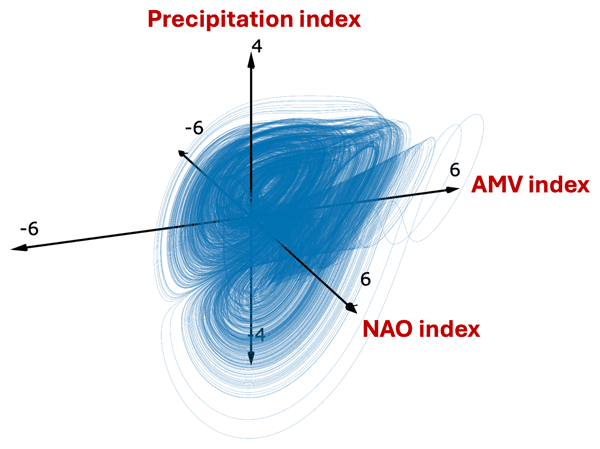
We use artificial intelligence to learn simple equations from historical climate data that describe how North Atlantic ocean temperature, air pressure and rainfall vary and influence each other over decades. Analysing the model's behaviour and equation terms, we find rainfall strongly feeds back on both the ocean and the atmosphere. These interactions are well captured by the models and allow rainfall to be predicted over the ocean, and nearby regions such as Europe over coming decades.
Patric J. L. Boardman, Joseph Clarke, Peter M. Cox, Chris Huntingford, Chris D. Jones, and Mark S. Williamson
Earth Syst. Dynam., 17, 829–841, https://doi.org/10.5194/esd-17-829-2026, https://doi.org/10.5194/esd-17-829-2026, 2026
Short summary
Short summary
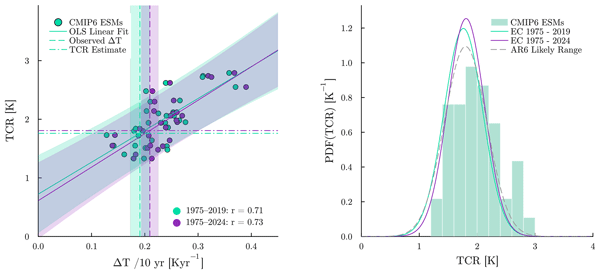
Climate sensitivity quantifies how much Earth warms for a given radiative forcing, and is often described by the Transient Climate Response (TCR) value. Although the Intergovernmental Panel on Climate Change (IPCC) estimates the most likely TCR to be 1.8 K, some models predict values >2.4 K. Record warmth in 2023–2024 raises questions as to whether the TCR may be larger than previously suggested. Using up-to-date data, we estimate the TCR to be ~1.8 K. We also show that future warming falls within the low–mid model range, making the 2°C Paris target still feasible.
Joseph Clarke, Chris Huntingford, Paul D. L. Ritchie, Rebecca Varney, Mark S. Williamson, and Peter Cox
Earth Syst. Dynam., 16, 2087–2100, https://doi.org/10.5194/esd-16-2087-2025, https://doi.org/10.5194/esd-16-2087-2025, 2025
Short summary
Short summary
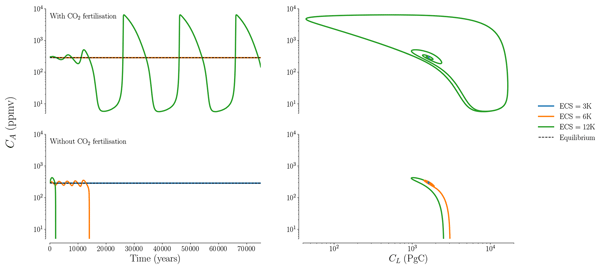
An increase in CO2 in the atmosphere warms the climate through the greenhouse effect, but also leads to uptake of CO2 by the land and ocean. However, the warming is also expected to suppress carbon uptake. If this suppression were strong enough, it could overwhelm the uptake of carbon, leading to a runaway feedback loop causing severe global warming. We find it is possible that this runaway could be relevant in complex climate models and even at the end of the last ice age.
Paul D. L. Ritchie, Chris Huntingford, and Peter M. Cox
Earth Syst. Dynam., 16, 1523–1526, https://doi.org/10.5194/esd-16-1523-2025, https://doi.org/10.5194/esd-16-1523-2025, 2025
Short summary
Short summary
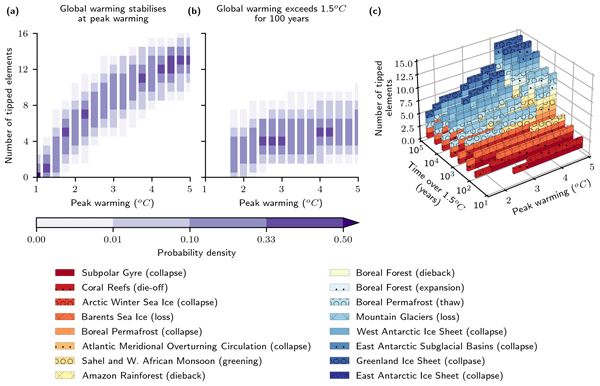
Climate tipping points are not committed upon crossing critical thresholds in global warming, as is often assumed. Instead, it is possible to temporarily overshoot a threshold without causing tipping, provided the duration of the overshoot is short. In this Idea, we demonstrate that restricting the time over 1.5 °C would considerably reduce tipping point risks.
Chris Huntingford, Andrew J. Nicoll, Cornelia Klein, and Jawairia A. Ahmad
Earth Syst. Dynam., 16, 475–495, https://doi.org/10.5194/esd-16-475-2025, https://doi.org/10.5194/esd-16-475-2025, 2025
Short summary
Short summary
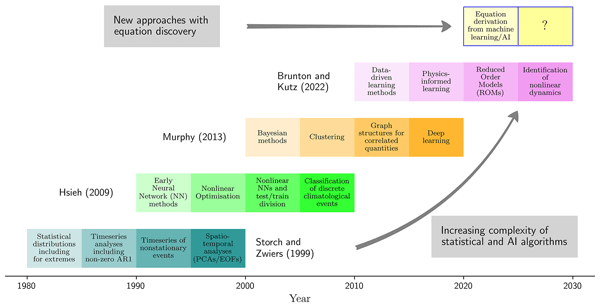
AI is impacting science, providing key data insights, but most algorithms are statistical requiring cautious "out-of-sample" extrapolation. Yet climate research concerns predicting future climatic states. We consider a new method of AI-led equation discovery. Equations offer process interpretation and more robust predictions. We recommend this method for climate analysis, suggesting illustrative application to atmospheric convection, land–atmosphere CO2 flux, and global ocean circulation models.
Camilla Mathison, Eleanor J. Burke, Gregory Munday, Chris D. Jones, Chris J. Smith, Norman J. Steinert, Andy J. Wiltshire, Chris Huntingford, Eszter Kovacs, Laila K. Gohar, Rebecca M. Varney, and Douglas McNeall
Geosci. Model Dev., 18, 1785–1808, https://doi.org/10.5194/gmd-18-1785-2025, https://doi.org/10.5194/gmd-18-1785-2025, 2025
Short summary
Short summary
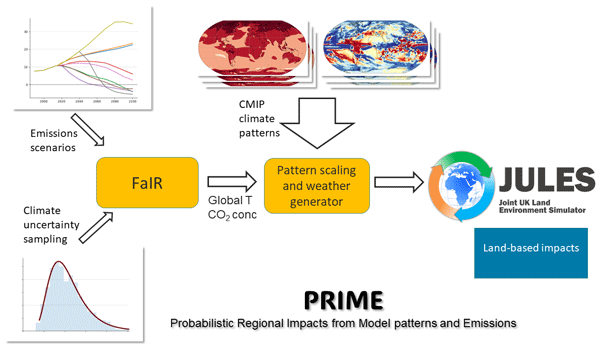
We present PRIME (Probabilistic Regional Impacts from Model patterns and Emissions), which is designed to take new emissions scenarios and rapidly provide regional impact information. PRIME allows large ensembles to be run on multi-centennial timescales, including the analysis of many important variables for impact assessments. Our evaluation shows that PRIME reproduces the climate response for known scenarios, providing confidence in using PRIME for novel scenarios.
Mark S. Williamson, Peter M. Cox, Chris Huntingford, and Femke J. M. M. Nijsse
Earth Syst. Dynam., 15, 829–852, https://doi.org/10.5194/esd-15-829-2024, https://doi.org/10.5194/esd-15-829-2024, 2024
Short summary
Short summary
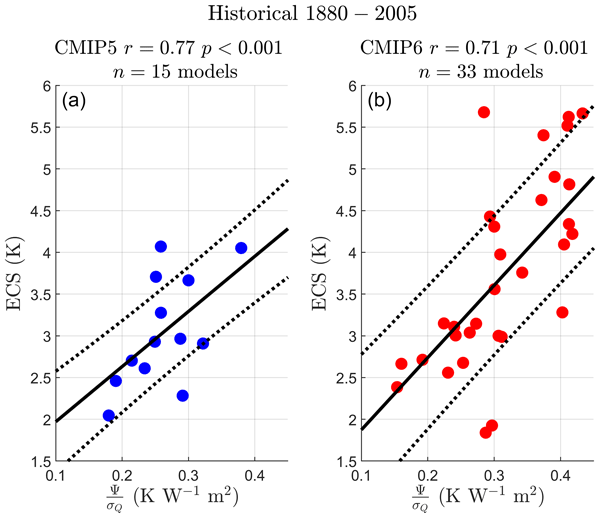
Emergent constraints on equilibrium climate sensitivity (ECS) have generally got statistically weaker in the latest set of state-of-the-art climate models (CMIP6) compared to past sets (CMIP5). We look at why this weakening happened for one particular study (Cox et al, 2018) and attribute it to an assumption made in the theory that when corrected for restores there is a stronger relationship between predictor and ECS.
Emma L. Robinson, Chris Huntingford, Valyaveetil Shamsudheen Semeena, and James M. Bullock
Earth Syst. Sci. Data, 15, 5371–5401, https://doi.org/10.5194/essd-15-5371-2023, https://doi.org/10.5194/essd-15-5371-2023, 2023
Short summary
Short summary
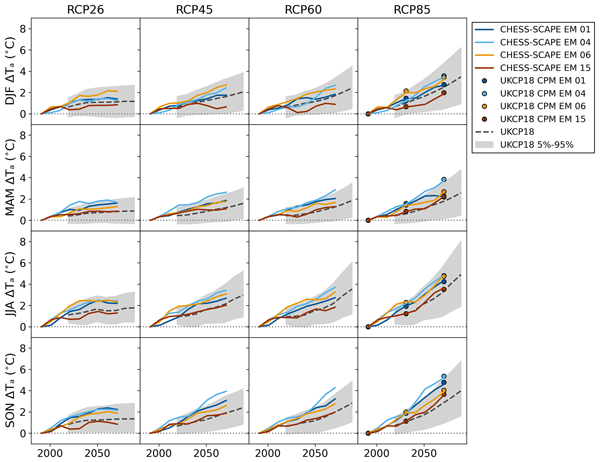
CHESS-SCAPE is a suite of high-resolution climate projections for the UK to 2080, derived from United Kingdom Climate Projections 2018 (UKCP18), designed to support climate impact modelling. It contains four realisations of four scenarios of future greenhouse gas levels (RCP2.6, 4.5, 6.0 and 8.5), with and without bias correction to historical data. The variables are available at 1 km resolution and a daily time step, with monthly, seasonal and annual means and 20-year mean-monthly time slices.

Chris Huntingford, Peter M. Cox, Mark S. Williamson, Joseph J. Clarke, and Paul D. L. Ritchie
Earth Syst. Dynam., 14, 433–442, https://doi.org/10.5194/esd-14-433-2023, https://doi.org/10.5194/esd-14-433-2023, 2023
Short summary
Short summary
Emergent constraints (ECs) reduce the spread of projections between climate models. ECs estimate changes to climate features impacting adaptation policy, and with this high profile, the method is under scrutiny. Asking
What is an EC?, we suggest they are often the discovery of parameters that characterise hidden large-scale equations that climate models solve implicitly. We present this conceptually via two examples. Our analysis implies possible new paths to link ECs and physical processes.
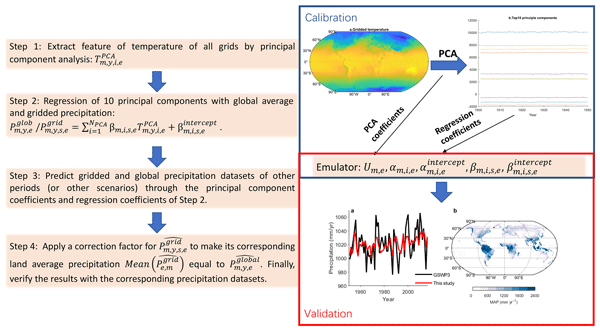
Gang Liu, Shushi Peng, Chris Huntingford, and Yi Xi
Geosci. Model Dev., 16, 1277–1296, https://doi.org/10.5194/gmd-16-1277-2023, https://doi.org/10.5194/gmd-16-1277-2023, 2023
Short summary
Short summary
Due to computational limits, lower-complexity models (LCMs) were developed as a complementary tool for accelerating comprehensive Earth system models (ESMs) but still lack a good precipitation emulator for LCMs. Here, we developed a data-calibrated precipitation emulator (PREMU), a computationally effective way to better estimate historical and simulated precipitation by current ESMs. PREMU has potential applications related to land surface processes and their interactions with climate change.

Louise J. Slater, Chris Huntingford, Richard F. Pywell, John W. Redhead, and Elizabeth J. Kendon
Earth Syst. Dynam., 13, 1377–1396, https://doi.org/10.5194/esd-13-1377-2022, https://doi.org/10.5194/esd-13-1377-2022, 2022
Short summary
Short summary
This work considers how wheat yields are affected by weather conditions during the three main wheat growth stages in the UK. Impacts are strongest in years with compound weather extremes across multiple growth stages. Future climate projections are beneficial for wheat yields, on average, but indicate a high risk of unseen weather conditions which farmers may struggle to adapt to and mitigate against.
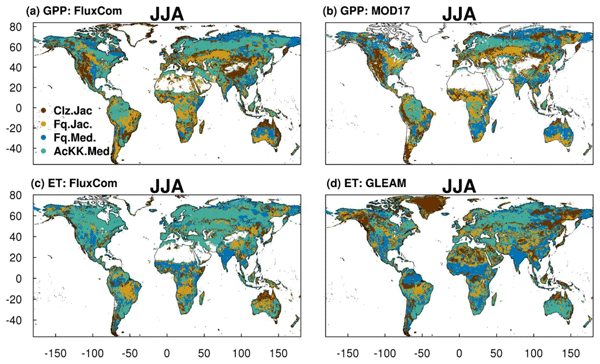
Rebecca J. Oliver, Lina M. Mercado, Doug B. Clark, Chris Huntingford, Christopher M. Taylor, Pier Luigi Vidale, Patrick C. McGuire, Markus Todt, Sonja Folwell, Valiyaveetil Shamsudheen Semeena, and Belinda E. Medlyn
Geosci. Model Dev., 15, 5567–5592, https://doi.org/10.5194/gmd-15-5567-2022, https://doi.org/10.5194/gmd-15-5567-2022, 2022
Short summary
Short summary
We introduce new representations of plant physiological processes into a land surface model. Including new biological understanding improves modelled carbon and water fluxes for the present in tropical and northern-latitude forests. Future climate simulations demonstrate the sensitivity of photosynthesis to temperature is important for modelling carbon cycle dynamics in a warming world. Accurate representation of these processes in models is necessary for robust predictions of climate change.
Chris Huntingford, Rebecca J. Oliver, Lina M. Mercado, Stephen A. Sitch, Douglas B. Clark, Annikki Mäkelä, Carolina Mayoral, and Richard J. Norby
EGUsphere, https://doi.org/10.5194/egusphere-2026-4392, https://doi.org/10.5194/egusphere-2026-4392, 2026
This preprint is open for discussion and under review for Biogeosciences (BG).
Short summary
Short summary
Understanding carbon allocation among land-surface components in a changing climate is important, but it remains poorly understood. As a surrogate for missing knowledge and related equations, optimal allocation hypotheses are proposed. Makela et al. (2008) propose foliage nitrogen adjusted to maximise gross primary productivity. We add to that framework models of photosynthesis and respiration, creating an optimal structure that responds to different near-surface meteorological conditions.
Andrew J. Nicoll, Hannah M. Christensen, Chris Huntingford, and Doug Smith
Earth Syst. Dynam., 17, 1061–1079, https://doi.org/10.5194/esd-17-1061-2026, https://doi.org/10.5194/esd-17-1061-2026, 2026
Short summary
Short summary
We use artificial intelligence to learn simple equations from historical climate data that describe how North Atlantic ocean temperature, air pressure and rainfall vary and influence each other over decades. Analysing the model's behaviour and equation terms, we find rainfall strongly feeds back on both the ocean and the atmosphere. These interactions are well captured by the models and allow rainfall to be predicted over the ocean, and nearby regions such as Europe over coming decades.
Patric J. L. Boardman, Joseph Clarke, Peter M. Cox, Chris Huntingford, Chris D. Jones, and Mark S. Williamson
Earth Syst. Dynam., 17, 829–841, https://doi.org/10.5194/esd-17-829-2026, https://doi.org/10.5194/esd-17-829-2026, 2026
Short summary
Short summary
Climate sensitivity quantifies how much Earth warms for a given radiative forcing, and is often described by the Transient Climate Response (TCR) value. Although the Intergovernmental Panel on Climate Change (IPCC) estimates the most likely TCR to be 1.8 K, some models predict values >2.4 K. Record warmth in 2023–2024 raises questions as to whether the TCR may be larger than previously suggested. Using up-to-date data, we estimate the TCR to be ~1.8 K. We also show that future warming falls within the low–mid model range, making the 2°C Paris target still feasible.
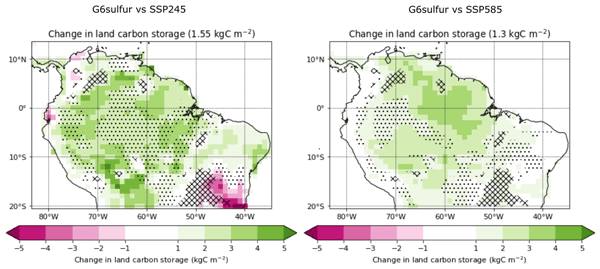
Isobel M. Parry, Paul D. L. Ritchie, Olivier Boucher, Peter M. Cox, James M. Haywood, Ulrike Niemeier, Roland Séférian, Simone Tilmes, and Daniele Visioni
Earth Syst. Dynam., 17, 387–414, https://doi.org/10.5194/esd-17-387-2026, https://doi.org/10.5194/esd-17-387-2026, 2026
Short summary
Short summary
Contrary to some expectations, results from the latest Earth System Models suggest that Solar Radiation Geoengineering could protect the Amazon rainforest from climate-driven dieback. Under Stratospheric Aerosol Injection, carbon storage in Amazonia was projected to increase by a mean of 10.8 % relative to a high CO2 emissions scenario, and even by 8.6% compared to a more conventional medium CO2 emissions scenario.
Joseph Clarke, Chris Huntingford, Paul D. L. Ritchie, Rebecca Varney, Mark S. Williamson, and Peter Cox
Earth Syst. Dynam., 16, 2087–2100, https://doi.org/10.5194/esd-16-2087-2025, https://doi.org/10.5194/esd-16-2087-2025, 2025
Short summary
Short summary
An increase in CO2 in the atmosphere warms the climate through the greenhouse effect, but also leads to uptake of CO2 by the land and ocean. However, the warming is also expected to suppress carbon uptake. If this suppression were strong enough, it could overwhelm the uptake of carbon, leading to a runaway feedback loop causing severe global warming. We find it is possible that this runaway could be relevant in complex climate models and even at the end of the last ice age.
Paul D. L. Ritchie, Chris Huntingford, and Peter M. Cox
Earth Syst. Dynam., 16, 1523–1526, https://doi.org/10.5194/esd-16-1523-2025, https://doi.org/10.5194/esd-16-1523-2025, 2025
Short summary
Short summary
Climate tipping points are not committed upon crossing critical thresholds in global warming, as is often assumed. Instead, it is possible to temporarily overshoot a threshold without causing tipping, provided the duration of the overshoot is short. In this Idea, we demonstrate that restricting the time over 1.5 °C would considerably reduce tipping point risks.
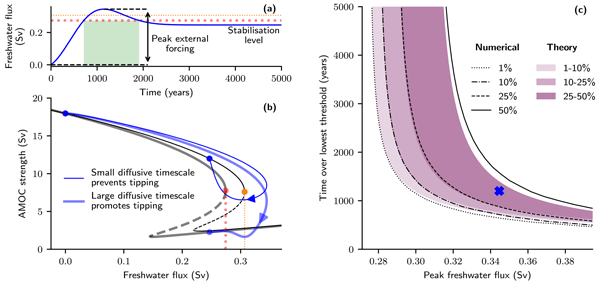
Kerstin Lux-Gottschalk and Paul D. L. Ritchie
Earth Syst. Dynam., 16, 1153–1168, https://doi.org/10.5194/esd-16-1153-2025, https://doi.org/10.5194/esd-16-1153-2025, 2025
Short summary
Short summary
For tipping points at low levels of global warming, overshoots of the threshold are becoming increasingly likely. Importantly, for some systems, tipping can still be avoided provided the forcing is reversed sufficiently quickly. Conditions for a mitigation window, which would avoid tipping, depend on system uncertainties. We highlight the need to account for uncertainty in the threshold location and other system features when designing climate mitigation strategies that avoid tipping.
Chris Huntingford, Andrew J. Nicoll, Cornelia Klein, and Jawairia A. Ahmad
Earth Syst. Dynam., 16, 475–495, https://doi.org/10.5194/esd-16-475-2025, https://doi.org/10.5194/esd-16-475-2025, 2025
Short summary
Short summary
AI is impacting science, providing key data insights, but most algorithms are statistical requiring cautious "out-of-sample" extrapolation. Yet climate research concerns predicting future climatic states. We consider a new method of AI-led equation discovery. Equations offer process interpretation and more robust predictions. We recommend this method for climate analysis, suggesting illustrative application to atmospheric convection, land–atmosphere CO2 flux, and global ocean circulation models.
Camilla Mathison, Eleanor J. Burke, Gregory Munday, Chris D. Jones, Chris J. Smith, Norman J. Steinert, Andy J. Wiltshire, Chris Huntingford, Eszter Kovacs, Laila K. Gohar, Rebecca M. Varney, and Douglas McNeall
Geosci. Model Dev., 18, 1785–1808, https://doi.org/10.5194/gmd-18-1785-2025, https://doi.org/10.5194/gmd-18-1785-2025, 2025
Short summary
Short summary
We present PRIME (Probabilistic Regional Impacts from Model patterns and Emissions), which is designed to take new emissions scenarios and rapidly provide regional impact information. PRIME allows large ensembles to be run on multi-centennial timescales, including the analysis of many important variables for impact assessments. Our evaluation shows that PRIME reproduces the climate response for known scenarios, providing confidence in using PRIME for novel scenarios.
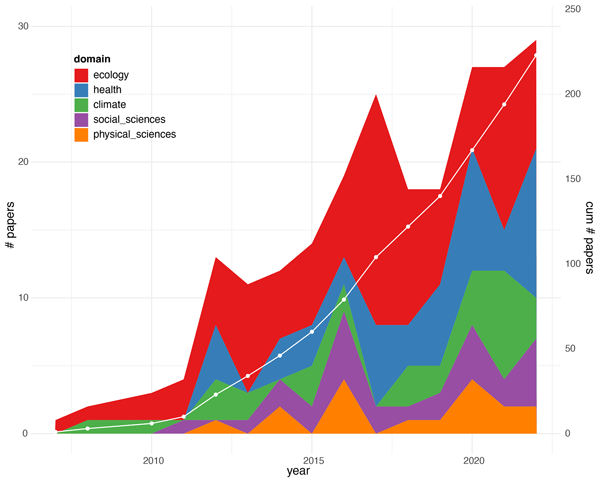
Vasilis Dakos, Chris A. Boulton, Joshua E. Buxton, Jesse F. Abrams, Beatriz Arellano-Nava, David I. Armstrong McKay, Sebastian Bathiany, Lana Blaschke, Niklas Boers, Daniel Dylewsky, Carlos López-Martínez, Isobel Parry, Paul Ritchie, Bregje van der Bolt, Larissa van der Laan, Els Weinans, and Sonia Kéfi
Earth Syst. Dynam., 15, 1117–1135, https://doi.org/10.5194/esd-15-1117-2024, https://doi.org/10.5194/esd-15-1117-2024, 2024
Short summary
Short summary
Tipping points are abrupt, rapid, and sometimes irreversible changes, and numerous approaches have been proposed to detect them in advance. Such approaches have been termed early warning signals and represent a set of methods for identifying changes in the underlying behaviour of a system across time or space that might indicate an approaching tipping point. Here, we review the literature to explore where, how, and which early warnings have been used in real-world case studies so far.
Mark S. Williamson, Peter M. Cox, Chris Huntingford, and Femke J. M. M. Nijsse
Earth Syst. Dynam., 15, 829–852, https://doi.org/10.5194/esd-15-829-2024, https://doi.org/10.5194/esd-15-829-2024, 2024
Short summary
Short summary
Emergent constraints on equilibrium climate sensitivity (ECS) have generally got statistically weaker in the latest set of state-of-the-art climate models (CMIP6) compared to past sets (CMIP5). We look at why this weakening happened for one particular study (Cox et al, 2018) and attribute it to an assumption made in the theory that when corrected for restores there is a stronger relationship between predictor and ECS.
Emma L. Robinson, Chris Huntingford, Valyaveetil Shamsudheen Semeena, and James M. Bullock
Earth Syst. Sci. Data, 15, 5371–5401, https://doi.org/10.5194/essd-15-5371-2023, https://doi.org/10.5194/essd-15-5371-2023, 2023
Short summary
Short summary
CHESS-SCAPE is a suite of high-resolution climate projections for the UK to 2080, derived from United Kingdom Climate Projections 2018 (UKCP18), designed to support climate impact modelling. It contains four realisations of four scenarios of future greenhouse gas levels (RCP2.6, 4.5, 6.0 and 8.5), with and without bias correction to historical data. The variables are available at 1 km resolution and a daily time step, with monthly, seasonal and annual means and 20-year mean-monthly time slices.
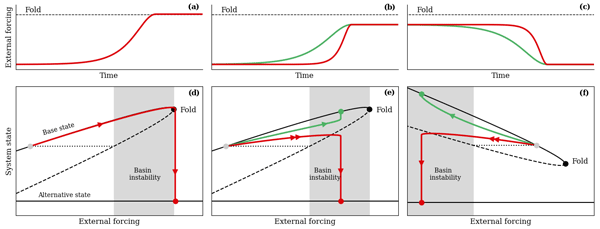
Paul D. L. Ritchie, Hassan Alkhayuon, Peter M. Cox, and Sebastian Wieczorek
Earth Syst. Dynam., 14, 669–683, https://doi.org/10.5194/esd-14-669-2023, https://doi.org/10.5194/esd-14-669-2023, 2023
Short summary
Short summary
Complex systems can undergo abrupt changes or tipping points when external forcing crosses a critical level and are of increasing concern because of their severe impacts. However, tipping points can also occur when the external forcing changes too quickly without crossing any critical levels, which is very relevant for Earth’s systems and contemporary climate. We give an intuitive explanation of such rate-induced tipping and provide illustrative examples from natural and human systems.
Chris Huntingford, Peter M. Cox, Mark S. Williamson, Joseph J. Clarke, and Paul D. L. Ritchie
Earth Syst. Dynam., 14, 433–442, https://doi.org/10.5194/esd-14-433-2023, https://doi.org/10.5194/esd-14-433-2023, 2023
Short summary
Short summary
Emergent constraints (ECs) reduce the spread of projections between climate models. ECs estimate changes to climate features impacting adaptation policy, and with this high profile, the method is under scrutiny. Asking
What is an EC?, we suggest they are often the discovery of parameters that characterise hidden large-scale equations that climate models solve implicitly. We present this conceptually via two examples. Our analysis implies possible new paths to link ECs and physical processes.
Gang Liu, Shushi Peng, Chris Huntingford, and Yi Xi
Geosci. Model Dev., 16, 1277–1296, https://doi.org/10.5194/gmd-16-1277-2023, https://doi.org/10.5194/gmd-16-1277-2023, 2023
Short summary
Short summary
Due to computational limits, lower-complexity models (LCMs) were developed as a complementary tool for accelerating comprehensive Earth system models (ESMs) but still lack a good precipitation emulator for LCMs. Here, we developed a data-calibrated precipitation emulator (PREMU), a computationally effective way to better estimate historical and simulated precipitation by current ESMs. PREMU has potential applications related to land surface processes and their interactions with climate change.
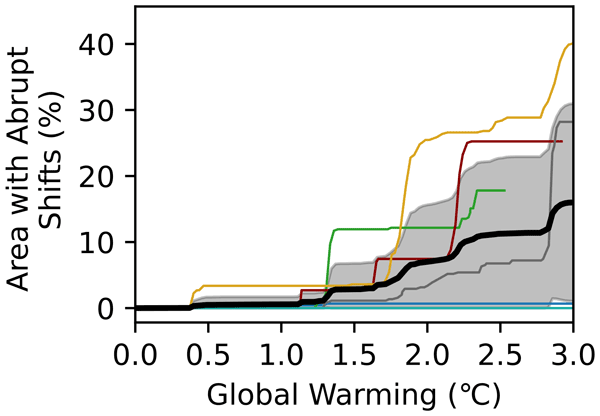
Isobel M. Parry, Paul D. L. Ritchie, and Peter M. Cox
Earth Syst. Dynam., 13, 1667–1675, https://doi.org/10.5194/esd-13-1667-2022, https://doi.org/10.5194/esd-13-1667-2022, 2022
Short summary
Short summary
Despite little evidence of regional Amazon rainforest dieback, many localised abrupt dieback events are observed in the latest state-of-the-art global climate models under anthropogenic climate change. The detected dieback events would still cause severe consequences for local communities and ecosystems. This study suggests that 7 ± 5 % of the northern South America region would experience abrupt downward shifts in vegetation carbon for every degree of global warming past 1.5 °C.
Louise J. Slater, Chris Huntingford, Richard F. Pywell, John W. Redhead, and Elizabeth J. Kendon
Earth Syst. Dynam., 13, 1377–1396, https://doi.org/10.5194/esd-13-1377-2022, https://doi.org/10.5194/esd-13-1377-2022, 2022
Short summary
Short summary
This work considers how wheat yields are affected by weather conditions during the three main wheat growth stages in the UK. Impacts are strongest in years with compound weather extremes across multiple growth stages. Future climate projections are beneficial for wheat yields, on average, but indicate a high risk of unseen weather conditions which farmers may struggle to adapt to and mitigate against.
Rebecca J. Oliver, Lina M. Mercado, Doug B. Clark, Chris Huntingford, Christopher M. Taylor, Pier Luigi Vidale, Patrick C. McGuire, Markus Todt, Sonja Folwell, Valiyaveetil Shamsudheen Semeena, and Belinda E. Medlyn
Geosci. Model Dev., 15, 5567–5592, https://doi.org/10.5194/gmd-15-5567-2022, https://doi.org/10.5194/gmd-15-5567-2022, 2022
Short summary
Short summary
We introduce new representations of plant physiological processes into a land surface model. Including new biological understanding improves modelled carbon and water fluxes for the present in tropical and northern-latitude forests. Future climate simulations demonstrate the sensitivity of photosynthesis to temperature is important for modelling carbon cycle dynamics in a warming world. Accurate representation of these processes in models is necessary for robust predictions of climate change.
Cited articles
Abrams, J. F., Huntingford, C., Williamson, M. S., McKay, D. I. A., Boulton, C. A., Buxton, J. E., Sakschewski, B., Loriani, S., Zimm, C., Winkelmann, R., and Lenton, T. M.: Committed Global Warming Risks Triggering Multiple Climate Tipping Points, Earth's Future, 11, e2022EF003250, https://doi.org/10.1029/2022EF003250, 2023. a
Albrich, K., Rammer, W., and Seidl, R.: Climate change causes critical transitions and irreversible alterations of mountain forests, Glob. Change Biol., 26, 4013–4027, https://doi.org/10.1111/gcb.15118, 2020. a
Angevaare, J. R. and Drijfhout, S. S.: Catalogue of Strong Nonlinear Surprises in ocean, sea-ice, and atmospheric variables in CMIP6, EGUsphere [preprint], https://doi.org/10.5194/egusphere-2025-2039, 2025. a
Armstrong Mckay, D. I., Staal, A., Abrams, J. F., Winkelmann, R., Sakschewski, B., Loriani, S., Fetzer, I., Cornell, S. E., Rockstrom, J., and Lenton, T. M.: Exceeding 1.5 °C global warming could trigger multiple climate tipping points, Science, 377, eabn7950, https://doi.org/10.1126/science.abn7950, 2022. a
Ashwin, P., Wieczorek, S., Vitolo, R., and Cox, P.: Tipping points in open systems: bifurcation, noise-induced and rate-dependent examples in the climate system, Philos. T. R. Soc. A, 370, 1166–1184, https://doi.org/10.1098/rsta.2011.0306, 2012. a
Berglund, N. and Gentz, B.: Metastability in simple climate models: pathwise analysis of slowly driven langevin equations, Stoch. Dynam., 2, 327–356, 2002. a
Bevacqua, E., Schleussner, C.-F., and Zscheischler, J.: A year above 1.5 °C signals that Earth is most probably within the 20-year period that will reach the Paris Agreement limit, Nat. Clim. Change, 15, https://doi.org/10.1038/s41558-025-02246-9, 2025. a
Bochow, N., Poltronieri, A., Robinson, A., Montoya, M., Rypdal, M., and Boers, N.: Overshooting the critical threshold for the Greenland ice sheet, Nature, 622, 528–536, https://doi.org/10.1038/s41586-023-06503-9, 2023. a
Boers, N.: Early-warning signals for Dansgaard–Oeschger events in a high-resolution ice core record, Nat. Commun., 9, 2556, https://doi.org/10.1038/s41467-018-04881-7, 2018. a
Boers, N.: Observation-based early-warning signals for a collapse of the Atlantic Meridional Overturning Circulation, Nat. Clim. Change, 11, 680–688, https://doi.org/10.1038/s41558-021-01097-4, 2021. a
Boers, N., Ghil, M., and Stocker, T. F.: Theoretical and paleoclimatic evidence for abrupt transitions in the Earth system, Environ. Res. Lett., 17, 093006, https://doi.org/10.1088/1748-9326/ac8944, 2022. a
Boucher, O., Halloran, P. R., Burke, E. J., Doutriaux-Boucher, M., Jones, C. D., Lowe, J., Ringer, M. A., Robertson, E., and Wu, P.: Reversibility in an Earth System model in response to CO2 concentration changes, Environ. Res. Lett., 7, 024013, https://doi.org/10.1088/1748-9326/7/2/024013, 2012. a
Buizert, C., Sowers, T. A., Niezgoda, K., Blunier, T., Gkinis, V., Harlan, M., He, C., Jones, T. R., Kjaer, H. A., Liisberg, J. B., Menking, J. A., Morris, V., Noone, D., Rasmussen, S. O., Sime, L. C., Steffensen, J. P., Svensson, A., Vaughng, B. H., Vinther, B. M., and White, J. W. C.: The Greenland spatial fingerprint of Dansgaard–Oeschger events in observations and models, P. Natl. Acad. Sci. USA, 121, e2402637121, https://doi.org/10.1073/pnas.2402637121, 2024. a
Cannon, A. J.: Twelve months at 1.5 °C signals earlier than expected breach of Paris Agreement threshold, Nat. Clim. Change, 15, https://doi.org/10.1038/s41558-025-02247-8, 2025. a
Cessi, P.: A simple box model of stochastically forced thermohaline flow, J. Phys. Oceanogr., 24, 1911–1920, https://doi.org/10.1175/1520-0485(1994)024<1911:ASBMOS>2.0.CO;2, 1994. a
Clarke, J., Huntingford, C., Ritchie, P., and Cox, P.: The compost bomb instability in the continuum limit, Eur. Phys. J.-Spec. Top., 230, 3335–3341, 2021. a
Clarke, J., Huntingford, C., Ritchie, P. D. L., and Cox, P.: Conditions for skilful spatial and temporal tipping point early warning signals, J. Phys.: Complexity, 7, 025007, https://doi.org/10.1088/2632-072X/ae6217, 2026. a
Clarke, J. J., Huntingford, C., Ritchie, P. D. L., and Cox, P. M.: Seeking more robust early warning signals for climate tipping points: the ratio of spectra method (ROSA), Environ. Res. Lett., 18, 035006, https://doi.org/10.1088/1748-9326/acbc8d, 2023. a
Couplet, V. and Crucifix, M.: Tipping interactions and cascades on multimillennial time scales in a model of reduced complexity, EGUsphere [preprint], https://doi.org/10.5194/egusphere-2025-4959, 2025. a, b
Dakos, V. and Kefi, S.: Ecological resilience: what to measure and how, Environ. Res. Lett., 17, 043003, https://doi.org/10.1088/1748-9326/ac5767, 2022. a
Dakos, V., Boulton, C. A., Buxton, J. E., Abrams, J. F., Arellano-Nava, B., Armstrong McKay, D. I., Bathiany, S., Blaschke, L., Boers, N., Dylewsky, D., López-Martínez, C., Parry, I., Ritchie, P., van der Bolt, B., van der Laan, L., Weinans, E., and Kéfi, S.: Tipping point detection and early warnings in climate, ecological, and human systems, Earth Syst. Dynam., 15, 1117–1135, https://doi.org/10.5194/esd-15-1117-2024, 2024. a, b
Dijkstra, H. A.: Nonlinear Climate Dynamics, Cambridge University Press, https://doi.org/10.1017/CBO9781139034135, 2013. a
Ditlevsen, P. D. and Johnsen, S. J.: Tipping points: Early warning and wishful thinking, Geophys. Res. Lett., 37, https://doi.org/10.1029/2010GL044486, 2010. a
Drijfhout, S., Bathiany, S., Beaulieu, C., Brovkin, V., Claussen, M., Huntingford, C., Scheffer, M., Sgubin, G., and Swingedouw, D.: Catalogue of abrupt shifts in Intergovernmental Panel on Climate Change climate models, P. Natl. Acad. Sci. USA, 112, E5777–E5786, https://doi.org/10.1073/pnas.1511451112, 2015. a
Drijfhout, S., Angevaare, J. R., Mecking, J., van Westen, R. M., and Rahmstorf, S.: Shutdown of northern Atlantic overturning after 2100 following deep mixing collapse in CMIP6 projections, Environ. Res. Lett., 20, 094062, https://doi.org/10.1088/1748-9326/adfa3b, 2025. a
Enns, R. H.: It's a Nonlinear World, 1st edn., Springer, New York, https://doi.org/10.1007/978-0-387-75340-9, 2010. a
Eyring, V., Bony, S., Meehl, G. A., Senior, C. A., Stevens, B., Stouffer, R. J., and Taylor, K. E.: Overview of the Coupled Model Intercomparison Project Phase 6 (CMIP6) experimental design and organization, Geosci. Model Dev., 9, 1937–1958, https://doi.org/10.5194/gmd-9-1937-2016, 2016. a
Garbe, J., Albrecht, T., Levermann, A., Donges, J. F., and Winkelmann, R.: The hysteresis of the Antarctic Ice Sheet, Nature, 585, 538–544, https://doi.org/10.1038/s41586-020-2727-5, 2020. a
Hawkins, E., Smith, R. S., Allison, L. C., Gregory, J. M., Woollings, T. J., Pohlmann, H., and de Cuevas, B.: Bistability of the Atlantic overturning circulation in a global climate model and links to ocean freshwater transport, Geophys. Res. Lett., 38, L10605, https://doi.org/10.1029/2011GL047208, 2011. a
Huntingford, C.: Robust projections of risks to the Amazon rainforest, Nature, 654, 37–38, https://doi.org/10.1038/d41586-026-01158-8, 2026. a
Huntingford, C. and Lowe, J.: “Overshoot” scenarios and climate change, Science, 316, 829, https://doi.org/10.1126/science.316.5826.829b, 2007. a
Huntingford, C., Yang, H., Harper, A., Cox, P. M., Gedney, N., Burke, E. J., Lowe, J. A., Hayman, G., Collins, W. J., Smith, S. M., and Comyn-Platt, E.: Flexible parameter-sparse global temperature time profiles that stabilise at 1.5 and 2.0 °C, Earth Syst. Dynam., 8, 617–626, https://doi.org/10.5194/esd-8-617-2017, 2017. a
IPCC: Climate Change 2021: The Physical Science Basis. Contribution of Working Group I to the Sixth Assessment Report of the Intergovernmental Panel on Climate Change, Cambridge University Press, Cambridge, United Kingdom and New York, NY, USA, https://doi.org/10.1017/9781009157896, 2021. a
Kug, J.-S., Oh, J.-H., An, S.-I., Yeh, S.-W., Min, S.-K., Son, S.-W., Kam, J., Ham, Y.-G., and Shin, J.: Hysteresis of the intertropical convergence zone to CO2 forcing, Nat. Clim. Change, 12, 47–53, https://doi.org/10.1038/s41558-021-01211-6, 2022. a
Kuznetsov, Y.: Elements of Applied Bifurcation Theory, Applied Mathematical Sciences, 4th edn., Springer, New York, https://doi.org/10.1007/978-3-031-22007-4, 2023. a
Lenton, T. M., Held, H., Kriegler, E., Hall, J. W., Lucht, W., Rahmstorf, S., and Schellnhuber, H. J.: Tipping elements in the Earth's climate system, P. Natl. Acad. Sci. USA, 105, 1786–1793, https://doi.org/10.1073/pnas.0705414105, 2008. a
Lenton, T. M., I., A. M. D., Loriani, S., Abrams, J. F., Lade, S. J., Donges, J. F., Milkoreit, M., Powell, T., Smith, S. R., Zimm, C., Buxton, J. E., Bailey, E., Laybourn, L., Ghadiali, A., and Dyke, J. G.: The Global Tipping Points Report 2023, Tech. rep., University of Exeter, https://report-2023.global-tipping-points.org/ (last access: June 2026), 2023. a
Lohmann, J., Dijkstra, H. A., Jochum, M., Lucarini, V., and Ditlevsen, P. D.: Multistability and intermediate tipping of the Atlantic Ocean circulation, Sci. Adv., 10, eadi4253, https://doi.org/10.1126/sciadv.adi4253, 2024. a
Loriani, S., Aksenov, Y., Armstrong McKay, D. I., Bala, G., Born, A., Chiessi, C. M., Dijkstra, H. A., Donges, J. F., Drijfhout, S., England, M. H., Fedorov, A. V., Jackson, L. C., Kornhuber, K., Messori, G., Pausata, F. S. R., Rynders, S., Sallée, J.-B., Sinha, B., Sherwood, S. C., Swingedouw, D., and Tharammal, T.: Tipping points in ocean and atmosphere circulations, Earth Syst. Dynam., 16, 1611–1653, https://doi.org/10.5194/esd-16-1611-2025, 2025. a, b
Melnikova, I., Hajima, T., Shiogama, H., Hayashi, M., Ito, A., Nishina, K., Tachiiri, K., and Yokohata, T.: Amazon dieback beyond the 21st century under high-emission scenarios by Earth System models, Commun. Earth Environ., 6, 670, https://doi.org/10.1038/s43247-025-02606-5, 2025. a
Parry, I. M., Ritchie, P. D. L., and Cox, P. M.: Evidence of localised Amazon rainforest dieback in CMIP6 models, Earth Syst. Dynam., 13, 1667–1675, https://doi.org/10.5194/esd-13-1667-2022, 2022. a
Petrini, M., Scherrenberg, M. D. W., Muntjewerf, L., Vizcaino, M., Sellevold, R., Leguy, G. R., Lipscomb, W. H., and Goelzer, H.: A topographically controlled tipping point for complete Greenland ice sheet melt, The Cryosphere, 19, 63–81, https://doi.org/10.5194/tc-19-63-2025, 2025. a
Rahmstorf, S.: On the freshwater forcing and transport of the Atlantic thermohaline circulation, Clim. Dynam., 12, 799–811, https://doi.org/10.1007/s003820050144, 1996. a
Rahmstorf, S., Crucifix, M., Ganopolski, A., Goosse, H., Kamenkovich, I., Knutti, R., Lohmann, G., Marsh, R., Mysak, L., Wang, Z., and Weaver, A.: Thermohaline circulation hysteresis: A model intercomparison, Geophys. Res. Lett., 32, L23605, https://doi.org/10.1029/2005GL023655, 2005. a
Reisinger, A., Fuglestvedt, J. S., Pirani, A., Geden, O., Jones, C. D., Maharaj, S., Poloczanska, E. S., Morelli, A., Johansen, T. G., Adler, C., Betts, R. A., and Seneviratne, S. I.: Overshoot: A Conceptual Review of Exceeding and Returning to Global Warming of 1.5 °C, Annu. Rev. Environ. Resour., https://doi.org/10.1146/annurev-environ-111523-102029, 2025. a
Riahi, K., van Vuuren, D. P., Kriegler, E., Edmonds, J., O'Neill, B. C., Fujimori, S., Bauer, N., Calvin, K., Dellink, R., Fricko, O., Lutz, W., Popp, A., Cuaresma, J. C., Samir, K. C., Leimbach, M., Jiang, L., Kram, T., Rao, S., Emmerling, J., Ebi, K., Hasegawa, T., Havlik, P., Humpenoeder, F., da Silva, L. A., Smith, S., Stehfest, E., Bosetti, V., Eom, J., Gernaat, D., Masui, T., Rogelj, J., Strefler, J., Drouet, L., Krey, V., Luderer, G., Harmsen, M., Takahashi, K., Baumstark, L., Doelman, J. C., Kainuma, M., Klimont, Z., Marangoni, G., Lotze-Campen, H., Obersteiner, M., Tabeau, A., and Tavoni, M.: The Shared Socioeconomic Pathways and their energy, land use, and greenhouse gas emissions implications: An overview, Global Environ. Chang., 42, 153–168, https://doi.org/10.1016/j.gloenvcha.2016.05.009, 2017. a
Rietkerk, M., Skiba, V., Weinans, E., Hebert, R., and Laepple, T.: Ambiguity of early warning signals for climate tipping points, Nat. Clim. Change, 15, 479–488, https://doi.org/10.1038/s41558-025-02328-8, 2025. a
Ritchie, P. D. L., Huntingford, C., and Cox, P. M.: ESD Ideas: Climate tipping is not instantaneous – the duration of an overshoot matters, Earth Syst. Dynam., 16, 1523–1526, https://doi.org/10.5194/esd-16-1523-2025, 2025. a, b, c
Staal, A., Fetzer, I., Wang-Erlandsson, L., Bosmans, J. H. C., Dekker, S. C., van Nes, E. H., Rockstroem, J., and Tuinenburg, O. A.: Hysteresis of tropical forests in the 21st century, Nat. Commun., 11, 4978, https://doi.org/10.1038/s41467-020-18728-7, 2020. a
Stommel, H.: Thermohaline convection with two stable regimes of flow, Tellus, 13, 224–230, https://doi.org/10.3402/tellusa.v13i2.9491, 1961. a
Tebaldi, C., Debeire, K., Eyring, V., Fischer, E., Fyfe, J., Friedlingstein, P., Knutti, R., Lowe, J., O'Neill, B., Sanderson, B., van Vuuren, D., Riahi, K., Meinshausen, M., Nicholls, Z., Tokarska, K. B., Hurtt, G., Kriegler, E., Lamarque, J.-F., Meehl, G., Moss, R., Bauer, S. E., Boucher, O., Brovkin, V., Byun, Y.-H., Dix, M., Gualdi, S., Guo, H., John, J. G., Kharin, S., Kim, Y., Koshiro, T., Ma, L., Olivié, D., Panickal, S., Qiao, F., Rong, X., Rosenbloom, N., Schupfner, M., Séférian, R., Sellar, A., Semmler, T., Shi, X., Song, Z., Steger, C., Stouffer, R., Swart, N., Tachiiri, K., Tang, Q., Tatebe, H., Voldoire, A., Volodin, E., Wyser, K., Xin, X., Yang, S., Yu, Y., and Ziehn, T.: Climate model projections from the Scenario Model Intercomparison Project (ScenarioMIP) of CMIP6, Earth Syst. Dynam., 12, 253–293, https://doi.org/10.5194/esd-12-253-2021, 2021. a
UNFCCC: Adoption of the Paris Agreement, Report No. FCCC/CP/2015/L.9/Rev.1, https://unfccc.int/resource/docs/2015/cop21/eng/l09r01.pdf, (last access: June 2026), 2015. a
van den Akker, T., Lipscomb, W. H., Leguy, G. R., Bernales, J., Berends, C. J., van de Berg, W. J., and van de Wal, R. S. W.: Present-day mass loss rates are a precursor for West Antarctic Ice Sheet collapse, The Cryosphere, 19, 283–301, https://doi.org/10.5194/tc-19-283-2025, 2025. a
van den Berk, J., Drijfhout, S., and Hazeleger, W.: Characterisation of Atlantic meridional overturning hysteresis using Langevin dynamics, Earth Syst. Dynam., 12, 69–81, https://doi.org/10.5194/esd-12-69-2021, 2021. a
van Westen, R. M., Kliphuis, M., and Dijkstra, H. A.: Physics-based early warning signal shows that AMOC is on tipping course, Sci. Adv., 10, eadk1189, https://doi.org/10.1126/sciadv.adk1189, 2024. a
Walton, J. and Huntingford, C.: Little evidence of hysteresis in regional precipitation, when indexed by global temperature rise and fall in an overshoot climate simulation, Environ. Res. Lett., 19, 084028, https://doi.org/10.1088/1748-9326/ad60de, 2024. a
Wunderling, N., Donges, J. F., Kurths, J., and Winkelmann, R.: Interacting tipping elements increase risk of climate domino effects under global warming, Earth Syst. Dynam., 12, 601–619, https://doi.org/10.5194/esd-12-601-2021, 2021. a, b
Wunderling, N., Winkelmann, R., Rockstroem, J., Loriani, S., McKay, D. I. A., Ritchie, P. D. L., Sakschewski, B., and Donges, J. F.: Global warming overshoots increase risks of climate tipping cascades in a network model, Nat. Clim. Change, 13, 75–82, https://doi.org/10.1038/s41558-022-01545-9, 2023. a
Wunderling, N., Sakschewski, B., Rockstrom, J., Flores, B. M., Hirota, M., and Staal, A.: Deforestation-induced drying lowers Amazon climate threshold, Nature, 654, https://doi.org/10.1038/s41586-026-10456-0, 2026. a
Short summary
The risk of climate change triggering tipping points is a concern. While Earth System Models (ESMs) predict these points, their timing often varies. Equations of nonlinear dynamical systems can model tipping, hysteresis, and inertia, enabling comparison with ESMs. We propose a method to map tipping timing estimates onto a dynamical system that simulates a full hysteresis loop. We focus on solutions to the equation under overshoot forcing in global temperature and different inertia levels.
The risk of climate change triggering tipping points is a concern. While Earth System Models...


