Articles | Volume 33, issue 3
https://doi.org/10.5194/npg-33-335-2026
© Author(s) 2026. This work is distributed under
the Creative Commons Attribution 4.0 License.
https://doi.org/10.5194/npg-33-335-2026
© Author(s) 2026. This work is distributed under
the Creative Commons Attribution 4.0 License.
Noise-scaled accuracy of the ensemble Kalman filter with an instability-based minimum ensemble size

Kota Takeda
CORRESPONDING AUTHOR
Department of Applied Physics, Graduate School of Engineering, Nagoya University, Nagoya, Japan
RIKEN Center for Computational Science, Kobe, Japan
Takemasa Miyoshi
RIKEN Center for Computational Science, Kobe, Japan
RIKEN Center for Interdisciplinary Theoretical and Mathematical Sciences, Wako, Japan
Related authors
No articles found.
Yuki Kobayashi, Shun Ohishi, and Takemasa Miyoshi
EGUsphere, https://doi.org/10.5194/egusphere-2026-2653, https://doi.org/10.5194/egusphere-2026-2653, 2026
This preprint is open for discussion and under review for Nonlinear Processes in Geophysics (NPG).
Short summary
Short summary
Modern environmental forecasting combines computer simulations with real-world observations. Most systems assume errors in these sources are independent, but in reality, they are occasionally linked. We developed a new method to estimate the hidden correlations. Using a simplified atmospheric model, we showed our method successfully identifies the correlations and significantly improves prediction accuracy. This work provides a practical path toward more reliable weather and ocean forecasts.
Shun Ohishi, Takemasa Miyoshi, and Misako Kachi
EGUsphere, https://doi.org/10.5194/egusphere-2026-2277, https://doi.org/10.5194/egusphere-2026-2277, 2026
This preprint is open for discussion and under review for Ocean Science (OS).
Short summary
Short summary
We developed a new eddy-permitting local ensemble Kalman filter (LETKF)-based Ocean Research Analysis (LORA) version 2.0 for a quasi-global domain (LORA-QG) from June 2002. Validation results show that LORA-QG is the second-most accurate among the four quasi-global and global ocean analysis datasets and has sufficient accuracy for scientific and practical applications.
Juan M. Guerrieri, Manuel Pulido, Takemasa Miyoshi, Arata Amemiya, and Juan J. Ruiz
Nonlin. Processes Geophys., 33, 33–49, https://doi.org/10.5194/npg-33-33-2026, https://doi.org/10.5194/npg-33-33-2026, 2026
Short summary
Short summary
This work extends the Mapping Particle Filter to account for local dependencies. Two localization methods are tested: a global particle flow with local kernels, and iterative local mappings based on correlation radius. Using a two-scale Lorenz-96 truth and a one-scale forecast model, experiments with full/partial and linear/nonlinear observations show Root Mean Square Error reductions using localized Gaussian mixture priors, achieving competitive performance against Gaussian filters.
Arata Amemiya and Takemasa Miyoshi
Nonlin. Processes Geophys., 33, 1–16, https://doi.org/10.5194/npg-33-1-2026, https://doi.org/10.5194/npg-33-1-2026, 2026
Short summary
Short summary
The accurate estimation of atmospheric state variables from radar observation in rapidly growing deep convection, which causes heavy thunderstorms, is a major challenge. This study examines the advantage of incorporating radar observation data with very high frequency such as 30 s compared with the conventional case of 5 min, from a theoretical perspective.
Michael Goodliff and Takemasa Miyoshi
EGUsphere, https://doi.org/10.5194/egusphere-2025-933, https://doi.org/10.5194/egusphere-2025-933, 2025
Preprint archived
Short summary
Short summary
Data-driven models (DDMs) learn from large datasets to make predictions, but data limitations affect reliability. Data assimilation (DA) improves accuracy by combining real-world observations with computational models. This research explores how DA enhances DDMs despite limited data. We propose an algorithm using DA to refine DDM training iteratively. This work has broad implications for fields like meteorology, engineering, and environmental science, where accurate prediction is critical.
Kenta Kurosawa, Shunji Kotsuki, and Takemasa Miyoshi
Nonlin. Processes Geophys., 30, 457–479, https://doi.org/10.5194/npg-30-457-2023, https://doi.org/10.5194/npg-30-457-2023, 2023
Short summary
Short summary
This study aimed to enhance weather and hydrological forecasts by integrating soil moisture data into a global weather model. By assimilating atmospheric observations and soil moisture data, the accuracy of forecasts was improved, and certain biases were reduced. The method was found to be particularly beneficial in areas like the Sahel and equatorial Africa, where precipitation patterns vary seasonally. This new approach has the potential to improve the precision of weather predictions.
Qiwen Sun, Takemasa Miyoshi, and Serge Richard
Nonlin. Processes Geophys., 30, 117–128, https://doi.org/10.5194/npg-30-117-2023, https://doi.org/10.5194/npg-30-117-2023, 2023
Short summary
Short summary
This paper is a follow-up of a work by Miyoshi and Sun which was published in NPG Letters in 2022. The control simulation experiment is applied to the Lorenz-96 model for avoiding extreme events. The results show that extreme events of this partially and imperfectly observed chaotic system can be avoided by applying pre-designed small perturbations. These investigations may be extended to more realistic numerical weather prediction models.
Tobias Necker, David Hinger, Philipp Johannes Griewank, Takemasa Miyoshi, and Martin Weissmann
Nonlin. Processes Geophys., 30, 13–29, https://doi.org/10.5194/npg-30-13-2023, https://doi.org/10.5194/npg-30-13-2023, 2023
Short summary
Short summary
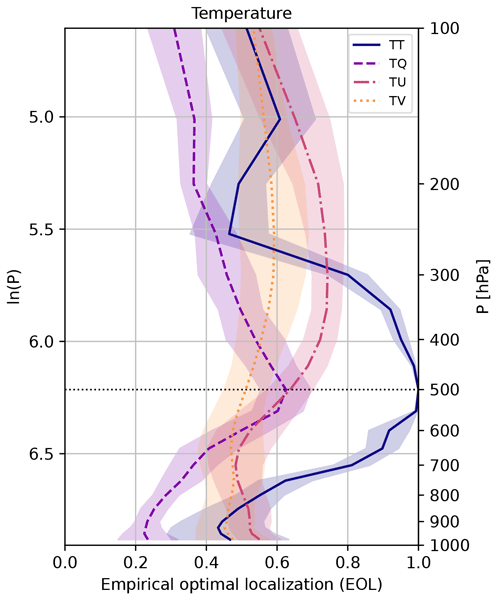
This study investigates vertical localization based on a convection-permitting 1000-member ensemble simulation. We derive an empirical optimal localization (EOL) that minimizes sampling error in 40-member sub-sample correlations assuming 1000-member correlations as truth. The results will provide guidance for localization in convective-scale ensemble data assimilation systems.
Shun Ohishi, Takemasa Miyoshi, and Misako Kachi
Geosci. Model Dev., 15, 9057–9073, https://doi.org/10.5194/gmd-15-9057-2022, https://doi.org/10.5194/gmd-15-9057-2022, 2022
Short summary
Short summary
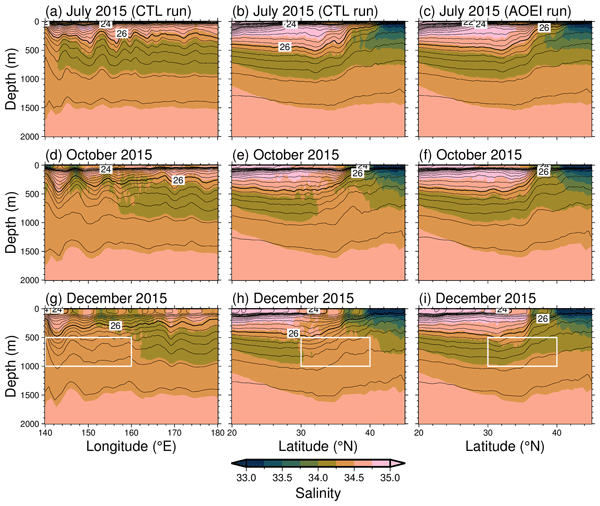
An adaptive observation error inflation (AOEI) method was proposed for atmospheric data assimilation to mitigate erroneous analysis updates caused by large observation-minus-forecast differences for satellite brightness temperature around clear- and cloudy-sky boundaries. This study implemented the AOEI with an ocean data assimilation system, leading to an improvement of analysis accuracy and dynamical balance around the frontal regions with large meridional temperature differences.
Shun Ohishi, Tsutomu Hihara, Hidenori Aiki, Joji Ishizaka, Yasumasa Miyazawa, Misako Kachi, and Takemasa Miyoshi
Geosci. Model Dev., 15, 8395–8410, https://doi.org/10.5194/gmd-15-8395-2022, https://doi.org/10.5194/gmd-15-8395-2022, 2022
Short summary
Short summary
We develop an ensemble-Kalman-filter-based regional ocean data assimilation system in which satellite and in situ observations are assimilated at a daily frequency. We find the best setting for dynamical balance and accuracy based on sensitivity experiments focused on how to inflate the ensemble spread and how to apply the analysis update to the model evolution. This study has a broader impact on more general data assimilation systems in which the initial shocks are a significant issue.
Shunji Kotsuki, Takemasa Miyoshi, Keiichi Kondo, and Roland Potthast
Geosci. Model Dev., 15, 8325–8348, https://doi.org/10.5194/gmd-15-8325-2022, https://doi.org/10.5194/gmd-15-8325-2022, 2022
Short summary
Short summary
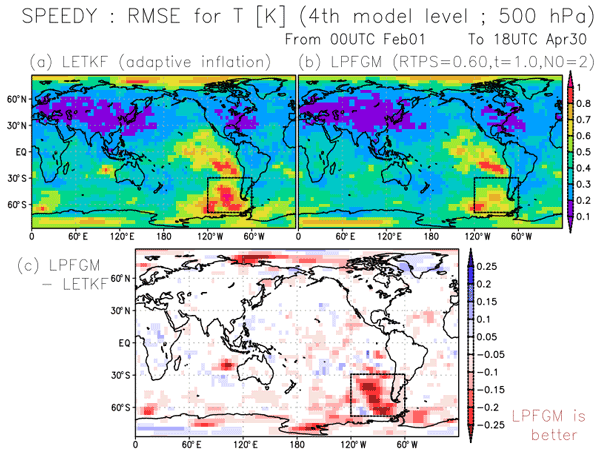
Data assimilation plays an important part in numerical weather prediction (NWP) in terms of combining forecasted states and observations. While data assimilation methods in NWP usually assume the Gaussian error distribution, some variables in the atmosphere, such as precipitation, are known to have non-Gaussian error statistics. This study extended a widely used ensemble data assimilation algorithm to enable the assimilation of more non-Gaussian observations.
Takemasa Miyoshi and Qiwen Sun
Nonlin. Processes Geophys., 29, 133–139, https://doi.org/10.5194/npg-29-133-2022, https://doi.org/10.5194/npg-29-133-2022, 2022
Short summary
Short summary
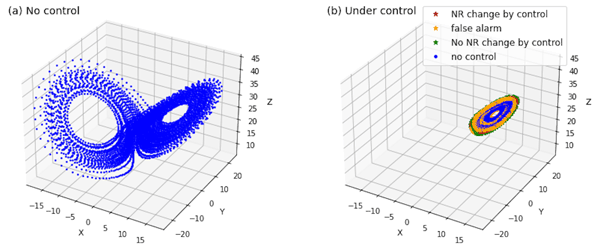
The weather is chaotic and hard to predict, but the chaos implies an effective control where a small control signal grows rapidly to make a big difference. This study proposes a control simulation experiment where we apply a small signal to control
naturein a computational simulation. Idealized experiments with a low-order chaotic system show successful results by small control signals of only 3 % of the observation error. This is the first step toward realistic weather simulations.
Juan Ruiz, Guo-Yuan Lien, Keiichi Kondo, Shigenori Otsuka, and Takemasa Miyoshi
Nonlin. Processes Geophys., 28, 615–626, https://doi.org/10.5194/npg-28-615-2021, https://doi.org/10.5194/npg-28-615-2021, 2021
Short summary
Short summary
Effective use of observations with numerical weather prediction models, also known as data assimilation, is a key part of weather forecasting systems. For precise prediction at the scales of thunderstorms, fast nonlinear processes pose a grand challenge because most data assimilation systems are based on linear processes and normal distribution errors. We investigate how, every 30 s, weather radar observations can help reduce the effect of nonlinear processes and nonnormal distributions.
Cited articles
Barreira, L. and Pesin, Y.: Lyapunov Exponents and Smooth Ergodic Theory, vol. 23, University Lecture Series, American Mathematical Society, Providence, Rhode Island, ISBN 978-0-8218-2921-9, https://doi.org/10.1090/ulect/023, 2002. a
Bishop, C. H., Etherton, B. J., and Majumdar, S. J.: Adaptive Sampling with the Ensemble Transform Kalman Filter. Part I: Theoretical Aspects, Mon. Weather Rev., 129, 420–436, https://doi.org/10.1175/1520-0493(2001)129<0420:ASWTET>2.0.CO;2, 2001. a, b
Biswas, A. and Branicki, M.: A Unified Framework for the Analysis of Accuracy and Stability of a Class of Approximate Gaussian Filters for the Navier–Stokes Equations, Nonlinearity, 37, 125013, https://doi.org/10.1088/1361-6544/ad805b, 2024. a, b, c
Bocquet, M.: Ensemble Kalman filtering without the intrinsic need for inflation, Nonlin. Processes Geophys., 18, 735–750, https://doi.org/10.5194/npg-18-735-2011, 2011. a, b
Bocquet, M. and Carrassi, A.: Four-Dimensional Ensemble Variational Data Assimilation and the Unstable Subspace, Tellus A, 69, 1304504, https://doi.org/10.1080/16000870.2017.1304504, 2017. a, b, c, d
Bocquet, M., Gurumoorthy, K. S., Apte, A., Carrassi, A., Grudzien, C., and Jones, C. K. R. T.: Degenerate Kalman Filter Error Covariances and Their Convergence onto the Unstable Subspace, SIAM/ASA J. Uncertain. Quantif., 5, 304–333, https://doi.org/10.1137/16M1068712, 2017. a, b, c
Carrassi, A., Bocquet, M., Demaeyer, J., Grudzien, C., Raanes, P., and Vannitsem, S.: Data Assimilation for Chaotic Dynamics, in: Data Assimilation for Atmospheric, Oceanic and Hydrologic Applications (Vol. IV), edited by: Park, S. K. and Xu, L., Springer International Publishing, Cham, 42 pp., ISBN 978-3-030-77722-7, https://doi.org/10.1007/978-3-030-77722-7_1, 2022. a, b
De Cruz, L., Demaeyer, J., and Vannitsem, S.: The Modular Arbitrary-Order Ocean-Atmosphere Model: MAOOAM v1.0, Geosci. Model Dev., 9, 2793–2808, https://doi.org/10.5194/gmd-9-2793-2016, 2016. a, b
Eckmann, J. P. and Ruelle, D.: Ergodic Theory of Chaos and Strange Attractors, Rev. Mod. Phys., 57, 617–656, https://doi.org/10.1103/RevModPhys.57.617, 1985. a
Evensen, G.: Data Assimilation: The Ensemble Kalman Filter, Springer, Berlin, Heidelberg, ISBN 978-3-642-03710-8, https://doi.org/10.1007/978-3-642-03711-5, 2009. a, b
González-Tokman, C. and Hunt, B. R.: Ensemble Data Assimilation for Hyperbolic Systems, Physica D, 243, 128–142, https://doi.org/10.1016/j.physd.2012.10.005, 2013. a, b
Grudzien, C., Carrassi, A., and Bocquet, M.: Asymptotic Forecast Uncertainty and the Unstable Subspace in the Presence of Additive Model Error, SIAM/ASA J. Uncertain. Quantif., https://doi.org/10.1137/17M114073X, 2018a. a
Grudzien, C., Carrassi, A., and Bocquet, M.: Chaotic dynamics and the role of covariance inflation for reduced rank Kalman filters with model error, Nonlin. Processes Geophys., 25, 633–648, https://doi.org/10.5194/npg-25-633-2018, 2018b. a
Gurumoorthy, K. S., Grudzien, C., Apte, A., Carrassi, A., and Jones, C. K. R. T.: Rank Deficiency of Kalman Error Covariance Matrices in Linear Time-Varying System With Deterministic Evolution, SIAM J. Control Optim., 55, 741–759, https://doi.org/10.1137/15M1025839, 2017. a
Haken, H.: At Least One Lyapunov Exponent Vanishes If the Trajectory of an Attractor Does Not Contain a Fixed Point, Phys. Lett. A, 94, 71–72, https://doi.org/10.1016/0375-9601(83)90209-8, 1983. a, b
Hamill, T. M., Whitaker, J. S., and Snyder, C.: Distance-Dependent Filtering of Background Error Covariance Estimates in an Ensemble Kalman Filter, Mon. Weather Rev., 129, 2776–2790, https://doi.org/10.1175/1520-0493(2001)129<2776:DDFOBE>2.0.CO;2, 2001. a
Hunt, B. R., Kostelich, E. J., and Szunyogh, I.: Efficient Data Assimilation for Spatiotemporal Chaos: A Local Ensemble Transform Kalman Filter, Physica D, 230, 112–126, https://doi.org/10.1016/j.physd.2006.11.008, 2007. a
Kalnay, E.: Atmospheric Modeling, Data Assimilation and Predictability, Cambridge University Press, New York, https://doi.org/10.1017/CBO9780511802270, 2002. a
Kelly, D. and Stuart, A. M.: Ergodicity and Accuracy of Optimal Particle Filters for Bayesian Data Assimilation, Chinese Ann. Math. B, 40, 811–842, https://doi.org/10.1007/s11401-019-0161-5, 2019. a, b, c
Kelly, D. T. B., Law, K. J. H., and Stuart, A. M.: Well-Posedness and Accuracy of the Ensemble Kalman Filter in Discrete and Continuous Time, Nonlinearity, 27, 2579–2603, https://doi.org/10.1088/0951-7715/27/10/2579, 2014. a, b, c
Oseledets, V. I.: A Multiplicative Ergodic Theorem. Lyapunov Characteristic Numbers for Dynamical Systems, Trans. Mosc. Math. Soc., 19, 197–231, 1968. a
Reinhold, B. B. and Pierrehumbert, R. T.: Dynamics of Weather Regimes: Quasi-Stationary Waves and Blocking, Mon. Weather Rev., 110, 1105–1145, https://doi.org/10.1175/1520-0493(1982)110<1105:DOWRQS>2.0.CO;2, 1982. a
Sanz-Alonso, D. and Waniorek, N.: Long-Time Accuracy of Ensemble Kalman Filters for Chaotic Dynamical Systems and Machine-Learned Dynamical Systems, SIAM J. Appl. Dyn. Syst., 2246–2286, https://doi.org/10.1137/24M1719232, 2025. a, b, c
Takeda, K.: KotaTakeda/enkf_ensemble_downsizing: Reproducibility code for the revised manuscript, Zenodo [code, data set], https://doi.org/10.5281/zenodo.17319854, 2026a. a
Takeda, K.: Jupyter Notebook in Binder, binder [ICE] https://mybinder.org/v2/gh/KotaTakeda/enkf_ensemble_downsizing/v1.1.1?urlpath=%2Fdoc%2Ftree%2Ftest.ipynb, last access: 16 April 2026b. a
Takeda, K. and Sakajo, T.: Uniform Error Bounds of the Ensemble Transform Kalman Filter for Chaotic Dynamics with Multiplicative Covariance Inflation, SIAM/ASA J. Uncertain. Quantif., 12, 1315–1335, https://doi.org/10.1137/24M1637192, 2024. a, b, c, d
Tippett, M. K., Anderson, J. L., Bishop, C. H., Hamill, T. M., and Whitaker, J. S.: Ensemble Square Root Filters, Mon. Weather Rev., 131, 1485–1490, 2003. a
Trevisan, A. and Palatella, L.: On the Kalman Filter error covariance collapse into the unstable subspace, Nonlin. Processes Geophys., 18, 243–250, https://doi.org/10.5194/npg-18-243-2011, 2011. a
Trevisan, A. and Uboldi, F.: Assimilation of Standard and Targeted Observations within the Unstable Subspace of the Observation–Analysis–Forecast Cycle System, J. Atmos. Sci., 61, 103–113, https://doi.org/10.1175/1520-0469(2004)061<0103:AOSATO>2.0.CO;2, 2004. a
Trevisan, A., D'Isidoro, M., and Talagrand, O.: Four-dimensional variational assimilation in the unstable subspace and the optimal subspace dimension, Q. J. Roy. Meteor. Soc., 136, 487–496, https://doi.org/10.1002/qj.571, 2010. a
von Bremen, H. F., Udwadia, F. E., and Proskurowski, W.: An Efficient QR Based Method for the Computation of Lyapunov Exponents, Physica D, 101, 1–16, https://doi.org/10.1016/S0167-2789(96)00216-3, 1997. a, b
Short summary
This study examines the minimum ensemble size for accurate geophysical forecasting using a method called the ensemble Kalman filter. We reformulate accuracy via observation noise-dependency to classify filter performance qualitatively. Through numerical experiments with a chaotic model, we link the minimum ensemble size for the accuracy to system's instability and propose an effective ensemble downsizing method that ensures both stability and accuracy.
This study examines the minimum ensemble size for accurate geophysical forecasting using a...