Articles | Volume 33, issue 3
https://doi.org/10.5194/npg-33-401-2026
© Author(s) 2026. This work is distributed under
the Creative Commons Attribution 4.0 License.
https://doi.org/10.5194/npg-33-401-2026
© Author(s) 2026. This work is distributed under
the Creative Commons Attribution 4.0 License.
Elucidating the performance of data assimilation neural networks for chaotic dynamics
CEREA, ENPC, EDF R&D, Institut Polytechnique de Paris, Île-de-France, France
Tobias Sebastian Finn
CEREA, ENPC, EDF R&D, Institut Polytechnique de Paris, Île-de-France, France
Sibo Cheng
CEREA, ENPC, EDF R&D, Institut Polytechnique de Paris, Île-de-France, France
Alban Farchi
ECMWF, Shinfield Park, Reading, UK
Related authors
Wenbo Yu, Anirbit Ghosh, Tobias Sebastian Finn, Rossella Arcucci, Marc Bocquet, and Sibo Cheng
Geosci. Model Dev., 19, 1027–1054, https://doi.org/10.5194/gmd-19-1027-2026, https://doi.org/10.5194/gmd-19-1027-2026, 2026
Short summary
Short summary
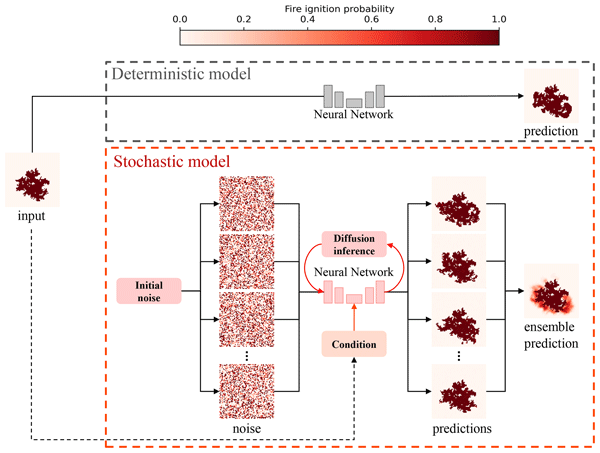
We introduce the first denoising diffusion model for wildfire spread prediction, a new kind of generative AI model that learns to simulate fires not just as one fixed outcome, but as a range of possible scenarios. This allows us to capture the inherent uncertainty of wildfire dynamics. Our model produces ensembles of forecasts that reflect physically meaningful distributions of where fire might go next.
Charlotte Durand, Tobias Sebastian Finn, Alban Farchi, Marc Bocquet, Julien Brajard, and Laurent Bertino
The Cryosphere, 19, 5613–5637, https://doi.org/10.5194/tc-19-5613-2025, https://doi.org/10.5194/tc-19-5613-2025, 2025
Short summary
Short summary
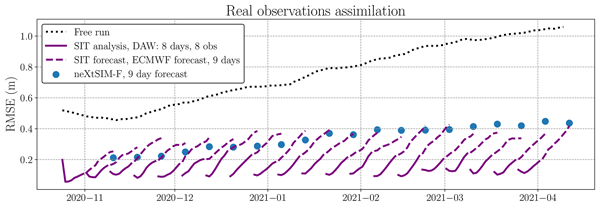
This paper presents a four-dimensional variational data assimilation system based on a neural network emulator for sea-ice thickness, learned from neXtSIM (neXt generation Sea Ice Model) simulation outputs. Testing with simulated and real observation retrievals, the system improves forecasts and bias error, performing comparably to operational methods, demonstrating the promise of sea-ice data-driven data assimilation systems.
Joffrey Dumont Le Brazidec, Pierre Vanderbecken, Alban Farchi, Grégoire Broquet, Gerrit Kuhlmann, and Marc Bocquet
Geosci. Model Dev., 18, 3607–3622, https://doi.org/10.5194/gmd-18-3607-2025, https://doi.org/10.5194/gmd-18-3607-2025, 2025
Short summary
Short summary
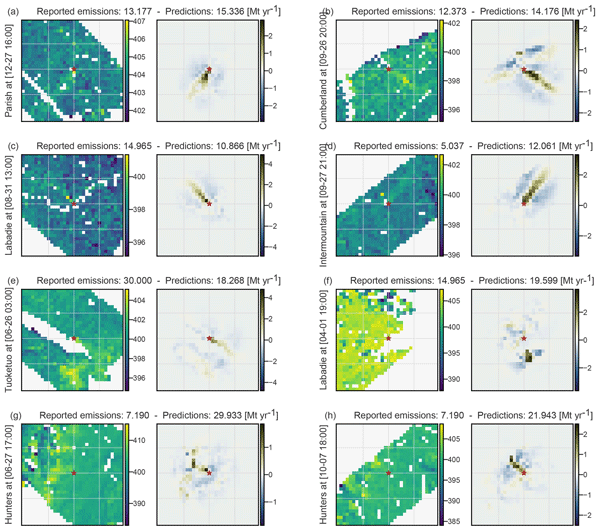
We developed a deep learning method to estimate CO2 emissions from power plants using satellite images. Trained and validated on simulated data, our model accurately predicts emissions despite challenges like cloud cover. When applied to real OCO3 satellite images, the results closely match reported emissions. This study shows that neural networks trained on simulations can effectively analyse real satellite data, offering a new way to monitor CO2 emissions from space.
Simon Driscoll, Alberto Carrassi, Julien Brajard, Laurent Bertino, Einar Ólason, Marc Bocquet, and Amos Lawless
EGUsphere, https://doi.org/10.5194/egusphere-2024-2476, https://doi.org/10.5194/egusphere-2024-2476, 2024
Preprint archived
Short summary
Short summary
The formation and evolution of sea ice melt ponds (ponds of melted water) are complex, insufficiently understood and represented in models with considerable uncertainty. These uncertain representations are not traditionally included in climate models potentially causing the known underestimation of sea ice loss in climate models. Our work creates the first observationally based machine learning model of melt ponds that is also a ready and viable candidate to be included in climate models.
Tobias Sebastian Finn, Lucas Disson, Alban Farchi, Marc Bocquet, and Charlotte Durand
Nonlin. Processes Geophys., 31, 409–431, https://doi.org/10.5194/npg-31-409-2024, https://doi.org/10.5194/npg-31-409-2024, 2024
Short summary
Short summary
We train neural networks as denoising diffusion models for state generation in the Lorenz 1963 system and demonstrate that they learn an internal representation of the system. We make use of this learned representation and the pre-trained model in two downstream tasks: surrogate modelling and ensemble generation. For both tasks, the diffusion model can outperform other more common approaches. Thus, we see a potential of representation learning with diffusion models for dynamical systems.
Marc Bocquet, Pierre J. Vanderbecken, Alban Farchi, Joffrey Dumont Le Brazidec, and Yelva Roustan
Nonlin. Processes Geophys., 31, 335–357, https://doi.org/10.5194/npg-31-335-2024, https://doi.org/10.5194/npg-31-335-2024, 2024
Short summary
Short summary
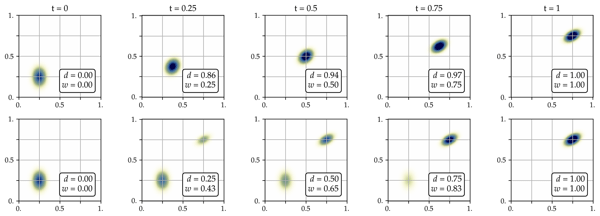
A novel approach, optimal transport data assimilation (OTDA), is introduced to merge DA and OT concepts. By leveraging OT's displacement interpolation in space, it minimises mislocation errors within DA applied to physical fields, such as water vapour, hydrometeors, and chemical species. Its richness and flexibility are showcased through one- and two-dimensional illustrations.
Yumeng Chen, Polly Smith, Alberto Carrassi, Ivo Pasmans, Laurent Bertino, Marc Bocquet, Tobias Sebastian Finn, Pierre Rampal, and Véronique Dansereau
The Cryosphere, 18, 2381–2406, https://doi.org/10.5194/tc-18-2381-2024, https://doi.org/10.5194/tc-18-2381-2024, 2024
Short summary
Short summary
We explore multivariate state and parameter estimation using a data assimilation approach through idealised simulations in a dynamics-only sea-ice model based on novel rheology. We identify various potential issues that can arise in complex operational sea-ice models when model parameters are estimated. Even though further investigation will be needed for such complex sea-ice models, we show possibilities of improving the observed and the unobserved model state forecast and parameter accuracy.
Charlotte Durand, Tobias Sebastian Finn, Alban Farchi, Marc Bocquet, Guillaume Boutin, and Einar Ólason
The Cryosphere, 18, 1791–1815, https://doi.org/10.5194/tc-18-1791-2024, https://doi.org/10.5194/tc-18-1791-2024, 2024
Short summary
Short summary
This paper focuses on predicting Arctic-wide sea-ice thickness using surrogate modeling with deep learning. The model has a predictive power of 12 h up to 6 months. For this forecast horizon, persistence and daily climatology are systematically outperformed, a result of learned thermodynamics and advection. Consequently, surrogate modeling with deep learning proves to be effective at capturing the complex behavior of sea ice.
Joffrey Dumont Le Brazidec, Pierre Vanderbecken, Alban Farchi, Grégoire Broquet, Gerrit Kuhlmann, and Marc Bocquet
Geosci. Model Dev., 17, 1995–2014, https://doi.org/10.5194/gmd-17-1995-2024, https://doi.org/10.5194/gmd-17-1995-2024, 2024
Short summary
Short summary
Our research presents an innovative approach to estimating power plant CO2 emissions from satellite images of the corresponding plumes such as those from the forthcoming CO2M satellite constellation. The exploitation of these images is challenging due to noise and meteorological uncertainties. To overcome these obstacles, we use a deep learning neural network trained on simulated CO2 images. Our method outperforms alternatives, providing a positive perspective for the analysis of CO2M images.
Tobias Sebastian Finn, Charlotte Durand, Alban Farchi, Marc Bocquet, Yumeng Chen, Alberto Carrassi, and Véronique Dansereau
The Cryosphere, 17, 2965–2991, https://doi.org/10.5194/tc-17-2965-2023, https://doi.org/10.5194/tc-17-2965-2023, 2023
Short summary
Short summary
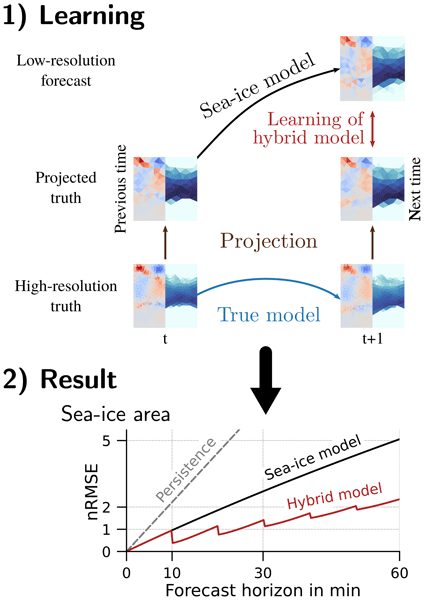
We combine deep learning with a regional sea-ice model to correct model errors in the sea-ice dynamics of low-resolution forecasts towards high-resolution simulations. The combined model improves the forecast by up to 75 % and thereby surpasses the performance of persistence. As the error connection can additionally be used to analyse the shortcomings of the forecasts, this study highlights the potential of combined modelling for short-term sea-ice forecasting.
Joffrey Dumont Le Brazidec, Pierre Vanderbecken, Alban Farchi, Marc Bocquet, Jinghui Lian, Grégoire Broquet, Gerrit Kuhlmann, Alexandre Danjou, and Thomas Lauvaux
Geosci. Model Dev., 16, 3997–4016, https://doi.org/10.5194/gmd-16-3997-2023, https://doi.org/10.5194/gmd-16-3997-2023, 2023
Short summary
Short summary
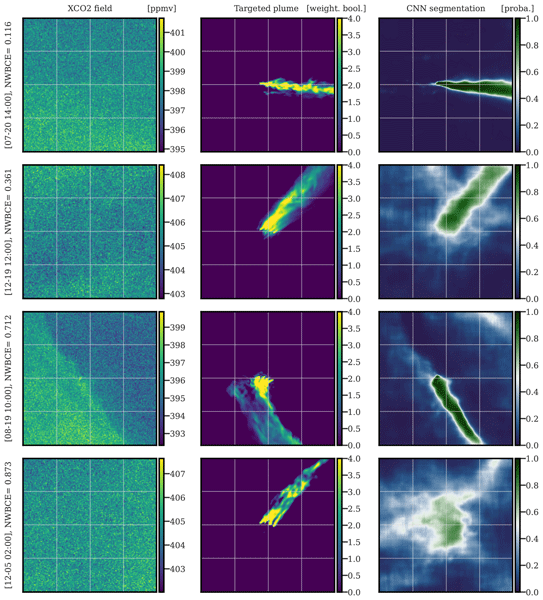
Monitoring of CO2 emissions is key to the development of reduction policies. Local emissions, from cities or power plants, may be estimated from CO2 plumes detected in satellite images. CO2 plumes generally have a weak signal and are partially concealed by highly variable background concentrations and instrument errors, which hampers their detection. To address this problem, we propose and apply deep learning methods to detect the contour of a plume in simulated CO2 satellite images.
Pierre J. Vanderbecken, Joffrey Dumont Le Brazidec, Alban Farchi, Marc Bocquet, Yelva Roustan, Élise Potier, and Grégoire Broquet
Atmos. Meas. Tech., 16, 1745–1766, https://doi.org/10.5194/amt-16-1745-2023, https://doi.org/10.5194/amt-16-1745-2023, 2023
Short summary
Short summary
Instruments dedicated to monitoring atmospheric gaseous compounds from space will provide images of urban-scale plumes. We discuss here the use of new metrics to compare observed plumes with model predictions that will be less sensitive to meteorology uncertainties. We have evaluated our metrics on diverse plumes and shown that by eliminating some aspects of the discrepancies, they are indeed less sensitive to meteorological variations.
Joffrey Dumont Le Brazidec, Marc Bocquet, Olivier Saunier, and Yelva Roustan
Geosci. Model Dev., 16, 1039–1052, https://doi.org/10.5194/gmd-16-1039-2023, https://doi.org/10.5194/gmd-16-1039-2023, 2023
Short summary
Short summary
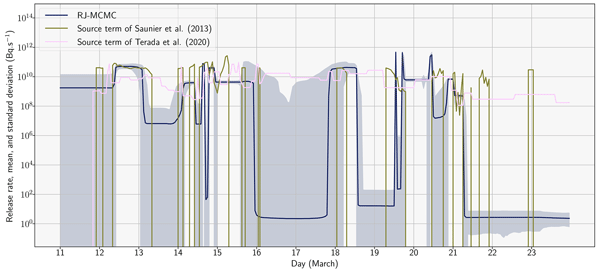
When radionuclides are released into the atmosphere, the assessment of the consequences depends on the evaluation of the magnitude and temporal evolution of the release, which can be highly variable as in the case of Fukushima Daiichi.
Here, we propose Bayesian inverse modelling methods and the reversible-jump Markov chain Monte Carlo technique, which allows one to evaluate the temporal variability of the release and to integrate different types of information in the source reconstruction.
Colin Grudzien and Marc Bocquet
Geosci. Model Dev., 15, 7641–7681, https://doi.org/10.5194/gmd-15-7641-2022, https://doi.org/10.5194/gmd-15-7641-2022, 2022
Short summary
Short summary
Iterative optimization techniques, the state of the art in data assimilation, have largely focused on extending forecast accuracy to moderate- to long-range forecast systems. However, current methodology may not be cost-effective in reducing forecast errors in online, short-range forecast systems. We propose a novel optimization of these techniques for online, short-range forecast cycles, simultaneously providing an improvement in forecast accuracy and a reduction in the computational cost.
Joffrey Dumont Le Brazidec, Marc Bocquet, Olivier Saunier, and Yelva Roustan
Atmos. Chem. Phys., 21, 13247–13267, https://doi.org/10.5194/acp-21-13247-2021, https://doi.org/10.5194/acp-21-13247-2021, 2021
Short summary
Short summary
The assessment of the environmental consequences of a radionuclide release depends on the estimation of its source. This paper aims to develop inverse Bayesian methods which combine transport models with measurements, in order to reconstruct the ensemble of possible sources.
Three methods to quantify uncertainties based on the definition of probability distributions and the physical models are proposed and evaluated for the case of 106Ru releases over Europe in 2017.
Jiahe Zheng, Zhengsen Xu, Rossella Arcucci, Sandy P. Harrison, Lincoln Linlin Xu, and Sibo Cheng
Nat. Hazards Earth Syst. Sci., 26, 2871–2895, https://doi.org/10.5194/nhess-26-2871-2026, https://doi.org/10.5194/nhess-26-2871-2026, 2026
Short summary
Short summary
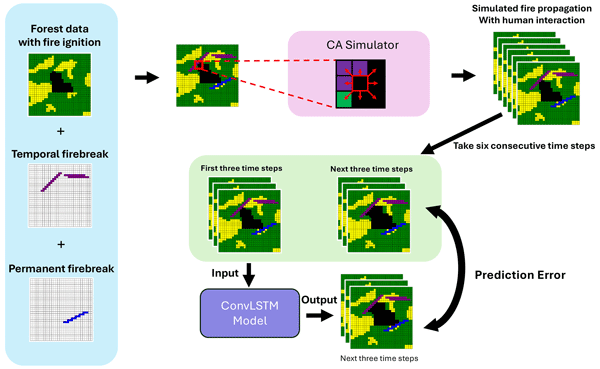
We introduce the first AI model that predicts wildfire spread with the placement of both permanent and temporary firebreaks. Our spatiotemporal model learns from simulation data to capture how fire interacts with changing suppression efforts over time. Our model runs fast enough for near real-time use and performs well across different wildfire events. This approach could lead to better tools for helping decision-makers understand where and when firebreaks are most effective.
Wenbo Yu, Anirbit Ghosh, Tobias Sebastian Finn, Rossella Arcucci, Marc Bocquet, and Sibo Cheng
Geosci. Model Dev., 19, 1027–1054, https://doi.org/10.5194/gmd-19-1027-2026, https://doi.org/10.5194/gmd-19-1027-2026, 2026
Short summary
Short summary
We introduce the first denoising diffusion model for wildfire spread prediction, a new kind of generative AI model that learns to simulate fires not just as one fixed outcome, but as a range of possible scenarios. This allows us to capture the inherent uncertainty of wildfire dynamics. Our model produces ensembles of forecasts that reflect physically meaningful distributions of where fire might go next.
Charlotte Durand, Tobias Sebastian Finn, Alban Farchi, Marc Bocquet, Julien Brajard, and Laurent Bertino
The Cryosphere, 19, 5613–5637, https://doi.org/10.5194/tc-19-5613-2025, https://doi.org/10.5194/tc-19-5613-2025, 2025
Short summary
Short summary
This paper presents a four-dimensional variational data assimilation system based on a neural network emulator for sea-ice thickness, learned from neXtSIM (neXt generation Sea Ice Model) simulation outputs. Testing with simulated and real observation retrievals, the system improves forecasts and bias error, performing comparably to operational methods, demonstrating the promise of sea-ice data-driven data assimilation systems.
Joffrey Dumont Le Brazidec, Pierre Vanderbecken, Alban Farchi, Grégoire Broquet, Gerrit Kuhlmann, and Marc Bocquet
Geosci. Model Dev., 18, 3607–3622, https://doi.org/10.5194/gmd-18-3607-2025, https://doi.org/10.5194/gmd-18-3607-2025, 2025
Short summary
Short summary
We developed a deep learning method to estimate CO2 emissions from power plants using satellite images. Trained and validated on simulated data, our model accurately predicts emissions despite challenges like cloud cover. When applied to real OCO3 satellite images, the results closely match reported emissions. This study shows that neural networks trained on simulations can effectively analyse real satellite data, offering a new way to monitor CO2 emissions from space.
Simon Driscoll, Alberto Carrassi, Julien Brajard, Laurent Bertino, Einar Ólason, Marc Bocquet, and Amos Lawless
EGUsphere, https://doi.org/10.5194/egusphere-2024-2476, https://doi.org/10.5194/egusphere-2024-2476, 2024
Preprint archived
Short summary
Short summary
The formation and evolution of sea ice melt ponds (ponds of melted water) are complex, insufficiently understood and represented in models with considerable uncertainty. These uncertain representations are not traditionally included in climate models potentially causing the known underestimation of sea ice loss in climate models. Our work creates the first observationally based machine learning model of melt ponds that is also a ready and viable candidate to be included in climate models.
Tobias Sebastian Finn, Lucas Disson, Alban Farchi, Marc Bocquet, and Charlotte Durand
Nonlin. Processes Geophys., 31, 409–431, https://doi.org/10.5194/npg-31-409-2024, https://doi.org/10.5194/npg-31-409-2024, 2024
Short summary
Short summary
We train neural networks as denoising diffusion models for state generation in the Lorenz 1963 system and demonstrate that they learn an internal representation of the system. We make use of this learned representation and the pre-trained model in two downstream tasks: surrogate modelling and ensemble generation. For both tasks, the diffusion model can outperform other more common approaches. Thus, we see a potential of representation learning with diffusion models for dynamical systems.
Marc Bocquet, Pierre J. Vanderbecken, Alban Farchi, Joffrey Dumont Le Brazidec, and Yelva Roustan
Nonlin. Processes Geophys., 31, 335–357, https://doi.org/10.5194/npg-31-335-2024, https://doi.org/10.5194/npg-31-335-2024, 2024
Short summary
Short summary
A novel approach, optimal transport data assimilation (OTDA), is introduced to merge DA and OT concepts. By leveraging OT's displacement interpolation in space, it minimises mislocation errors within DA applied to physical fields, such as water vapour, hydrometeors, and chemical species. Its richness and flexibility are showcased through one- and two-dimensional illustrations.
Yumeng Chen, Polly Smith, Alberto Carrassi, Ivo Pasmans, Laurent Bertino, Marc Bocquet, Tobias Sebastian Finn, Pierre Rampal, and Véronique Dansereau
The Cryosphere, 18, 2381–2406, https://doi.org/10.5194/tc-18-2381-2024, https://doi.org/10.5194/tc-18-2381-2024, 2024
Short summary
Short summary
We explore multivariate state and parameter estimation using a data assimilation approach through idealised simulations in a dynamics-only sea-ice model based on novel rheology. We identify various potential issues that can arise in complex operational sea-ice models when model parameters are estimated. Even though further investigation will be needed for such complex sea-ice models, we show possibilities of improving the observed and the unobserved model state forecast and parameter accuracy.
Charlotte Durand, Tobias Sebastian Finn, Alban Farchi, Marc Bocquet, Guillaume Boutin, and Einar Ólason
The Cryosphere, 18, 1791–1815, https://doi.org/10.5194/tc-18-1791-2024, https://doi.org/10.5194/tc-18-1791-2024, 2024
Short summary
Short summary
This paper focuses on predicting Arctic-wide sea-ice thickness using surrogate modeling with deep learning. The model has a predictive power of 12 h up to 6 months. For this forecast horizon, persistence and daily climatology are systematically outperformed, a result of learned thermodynamics and advection. Consequently, surrogate modeling with deep learning proves to be effective at capturing the complex behavior of sea ice.
Joffrey Dumont Le Brazidec, Pierre Vanderbecken, Alban Farchi, Grégoire Broquet, Gerrit Kuhlmann, and Marc Bocquet
Geosci. Model Dev., 17, 1995–2014, https://doi.org/10.5194/gmd-17-1995-2024, https://doi.org/10.5194/gmd-17-1995-2024, 2024
Short summary
Short summary
Our research presents an innovative approach to estimating power plant CO2 emissions from satellite images of the corresponding plumes such as those from the forthcoming CO2M satellite constellation. The exploitation of these images is challenging due to noise and meteorological uncertainties. To overcome these obstacles, we use a deep learning neural network trained on simulated CO2 images. Our method outperforms alternatives, providing a positive perspective for the analysis of CO2M images.
Tobias Sebastian Finn, Charlotte Durand, Alban Farchi, Marc Bocquet, Yumeng Chen, Alberto Carrassi, and Véronique Dansereau
The Cryosphere, 17, 2965–2991, https://doi.org/10.5194/tc-17-2965-2023, https://doi.org/10.5194/tc-17-2965-2023, 2023
Short summary
Short summary
We combine deep learning with a regional sea-ice model to correct model errors in the sea-ice dynamics of low-resolution forecasts towards high-resolution simulations. The combined model improves the forecast by up to 75 % and thereby surpasses the performance of persistence. As the error connection can additionally be used to analyse the shortcomings of the forecasts, this study highlights the potential of combined modelling for short-term sea-ice forecasting.
Joffrey Dumont Le Brazidec, Pierre Vanderbecken, Alban Farchi, Marc Bocquet, Jinghui Lian, Grégoire Broquet, Gerrit Kuhlmann, Alexandre Danjou, and Thomas Lauvaux
Geosci. Model Dev., 16, 3997–4016, https://doi.org/10.5194/gmd-16-3997-2023, https://doi.org/10.5194/gmd-16-3997-2023, 2023
Short summary
Short summary
Monitoring of CO2 emissions is key to the development of reduction policies. Local emissions, from cities or power plants, may be estimated from CO2 plumes detected in satellite images. CO2 plumes generally have a weak signal and are partially concealed by highly variable background concentrations and instrument errors, which hampers their detection. To address this problem, we propose and apply deep learning methods to detect the contour of a plume in simulated CO2 satellite images.
Pierre J. Vanderbecken, Joffrey Dumont Le Brazidec, Alban Farchi, Marc Bocquet, Yelva Roustan, Élise Potier, and Grégoire Broquet
Atmos. Meas. Tech., 16, 1745–1766, https://doi.org/10.5194/amt-16-1745-2023, https://doi.org/10.5194/amt-16-1745-2023, 2023
Short summary
Short summary
Instruments dedicated to monitoring atmospheric gaseous compounds from space will provide images of urban-scale plumes. We discuss here the use of new metrics to compare observed plumes with model predictions that will be less sensitive to meteorology uncertainties. We have evaluated our metrics on diverse plumes and shown that by eliminating some aspects of the discrepancies, they are indeed less sensitive to meteorological variations.
Joffrey Dumont Le Brazidec, Marc Bocquet, Olivier Saunier, and Yelva Roustan
Geosci. Model Dev., 16, 1039–1052, https://doi.org/10.5194/gmd-16-1039-2023, https://doi.org/10.5194/gmd-16-1039-2023, 2023
Short summary
Short summary
When radionuclides are released into the atmosphere, the assessment of the consequences depends on the evaluation of the magnitude and temporal evolution of the release, which can be highly variable as in the case of Fukushima Daiichi.
Here, we propose Bayesian inverse modelling methods and the reversible-jump Markov chain Monte Carlo technique, which allows one to evaluate the temporal variability of the release and to integrate different types of information in the source reconstruction.
Colin Grudzien and Marc Bocquet
Geosci. Model Dev., 15, 7641–7681, https://doi.org/10.5194/gmd-15-7641-2022, https://doi.org/10.5194/gmd-15-7641-2022, 2022
Short summary
Short summary
Iterative optimization techniques, the state of the art in data assimilation, have largely focused on extending forecast accuracy to moderate- to long-range forecast systems. However, current methodology may not be cost-effective in reducing forecast errors in online, short-range forecast systems. We propose a novel optimization of these techniques for online, short-range forecast cycles, simultaneously providing an improvement in forecast accuracy and a reduction in the computational cost.
Joffrey Dumont Le Brazidec, Marc Bocquet, Olivier Saunier, and Yelva Roustan
Atmos. Chem. Phys., 21, 13247–13267, https://doi.org/10.5194/acp-21-13247-2021, https://doi.org/10.5194/acp-21-13247-2021, 2021
Short summary
Short summary
The assessment of the environmental consequences of a radionuclide release depends on the estimation of its source. This paper aims to develop inverse Bayesian methods which combine transport models with measurements, in order to reconstruct the ensemble of possible sources.
Three methods to quantify uncertainties based on the definition of probability distributions and the physical models are proposed and evaluated for the case of 106Ru releases over Europe in 2017.
Cited articles
Agarwal, S., Jabbari, S., Agarwal, C., Upadhyay, S., Wu, S., and Lakkaraju, H.: Towards the Unification and Robustness of Perturbation and Gradient Based Explanations, in: Proceedings of the 38th International Conference on Machine Learning, vol. 139, edited by Meila, M. and Zhang, T., Proceedings of Machine Learning Research, PMLR, 110–119, https://proceedings.mlr.press/v139/agarwal21c.html (last access: 7 August 2026), 2021. a
Allen, A., Markou, S., Tebbutt, W., Requeima, J., Bruinsma, W. P., Andersson, T. R., Herzog, M., Lane, N. D., Chantry, M., Hosking, J. S., and Turner, R. E.: End-to-end data-driven weather prediction, Nature, https://doi.org/10.1038/s41586-025-08897-0, 2025. a
Arnold, L.: Random Dynamical Systems, Springer Berlin, Heidelberg, https://doi.org/10.1007/978-3-662-12878-7, 1998. a
Asch, M., Bocquet, M., and Nodet, M.: Data Assimilation: Methods, Algorithms, and Applications, Fundamentals of Algorithms, SIAM, Philadelphia, https://doi.org/10.1137/1.9781611974546, 2016. a, b
Bannister, R. N.: A review of operational methods of variational and ensemble-variational data assimilation, Q. J. Roy. Meteor. Soc., 143, 607–633, https://doi.org/10.1002/qj.2982, 2017. a
Barone, A., Carrassi, A., Savary, T., Demaeyer, J., and Vannitsem, S.: Structural origins and real-time predictors of intermittency, Chaos, 35, 103119, https://doi.org/10.1063/5.0287572, 2025. a
Bocquet, M.: Ensemble Kalman filtering without the intrinsic need for inflation, Nonlin. Processes Geophys., 18, 735–750, https://doi.org/10.5194/npg-18-735-2011, 2011. a, b
Bocquet, M.: Dan1D: One-Dimensional Data Assimilation Network [Computer software], Zenodo [code], https://doi.org/10.5281/zenodo.21427793, 2026 (code also available at: https://github.com/cerea-daml/Dan1D, last access: 7 August 2026). a
Bocquet, M. and Carrassi, A.: Four-dimensional ensemble variational data assimilation and the unstable subspace, Tellus A, 69, 1304504, https://doi.org/10.1080/16000870.2017.1304504, 2017. a, b
Bocquet, M. and Farchi, A.: On the consistency of the perturbation update of local ensemble square root Kalman filters, Tellus A, 71, 1–21, https://doi.org/10.1080/16000870.2019.1613142, 2019. a
Bocquet, M. and Sakov, P.: Combining inflation-free and iterative ensemble Kalman filters for strongly nonlinear systems, Nonlin. Processes Geophys., 19, 383–399, https://doi.org/10.5194/npg-19-383-2012, 2012. a, b, c
Bocquet, M. and Sakov, P.: Joint state and parameter estimation with an iterative ensemble Kalman smoother, Nonlin. Processes Geophys., 20, 803–818, https://doi.org/10.5194/npg-20-803-2013, 2013. a, b, c
Bocquet, M. and Sakov, P.: An iterative ensemble Kalman smoother, Q. J. Roy. Meteor. Soc., 140, 1521–1535, https://doi.org/10.1002/qj.2236, 2014. a, b
Bocquet, M., Raanes, P. N., and Hannart, A.: Expanding the validity of the ensemble Kalman filter without the intrinsic need for inflation, Nonlin. Processes Geophys., 22, 645–662, https://doi.org/10.5194/npg-22-645-2015, 2015. a, b, c
Bocquet, M., Gurumoorthy, K. S., Apte, A., Carrassi, A., Grudzien, C., and Jones, C. K. R. T.: Degenerate Kalman filter error covariances and their convergence onto the unstable subspace, SIAM/ASA J. Uncertain. Quantif., 5, 304–333, https://doi.org/10.1137/16M1068712, 2017. a, b, c, d
Bocquet, M., Farchi, A., Finn, T. S., Durand, C., Cheng, S., Chen, Y., Pasmans, I., and Carrassi, A.: Accurate deep learning-based filtering for chaotic dynamics by identifying instabilities without an ensemble, Chaos, 34, 091104, https://doi.org/10.1063/5.0230837, 2024. a, b, c, d
Boucher, E., Alexe, M., Lean, P., Pinnington, E., Lang, S., Laloyaux, P., Zampieri, L., de Rosnay, P., Bormann, N., and McNally, A.: Learning Coupled Earth System Dynamics with GraphDOP, arXiv [preprint], https://doi.org/10.48550/arXiv.2510.20416, 2025. a
Buehner, M., McTaggart-Cowan, R., Beaulne, A., Charette, C., Garand, L., Heilliette, S., Lapalme, E., Laroche, S., Macpherson, S. R., Morneau, J., and Zadra, A.: Implementation of Deterministic Weather Forecasting Systems based on Ensemble-Variational Data Assimilation at Environment Canada. Part I: The Global System, Mon. Weather Rev., 143, 2532–2559, https://doi.org/10.1175/MWR-D-14-00354.1, 2015. a
Carrassi, A., Ghil, M., Trevisan, A., and Uboldi, F.: Data assimilation as a nonlinear dynamical systems problem: Stability and convergence of the prediction-assimilation system, Chaos, 18, 023112, https://doi.org/10.1063/1.2909862, 2008. a
Carrassi, A., Bocquet, M., Bertino, L., and Evensen, G.: Data Assimilation in the Geosciences: An overview on methods, issues, and perspectives, WIREs Clim. Change, 9, e535, https://doi.org/10.1002/wcc.535, 2018. a
Carrassi, A., Bocquet, M., Demaeyer, J., Gruzien, C., Raanes, P. N., and Vannitsem, S.: Data assimilation for chaotic dynamics, in: Data Assimilation for Atmospheric, Oceanic and Hydrologic Applications, vol. IV, edited by: Seon, K. P. and Liang, X., Springer International Publishing, Cham, 1–42, https://doi.org/10.1007/978-3-030-77722-7_1, 2022. a
Chekroun, M. D., Simonnet, E., and Ghil, M.: Stochastic climate dynamics: Random attractors and time-dependent invariant measures, Physica D, 240, 1685–1700, https://doi.org/10.1016/j.physd.2011.06.005, 2011. a
Cheng, S., Quilodran-Casas, C., Ouala, S., Farchi, A., Liu, C., Tandeo, P., Fablet, R., Lucor, D., Iooss, B., Brajard, J., Xiao, D., Janjic, T., Ding, W., Guo, Y., Carrassi, A., Bocquet, M., and Arcucci, R.: Machine learning with data assimilation and uncertainty quantification for dynamical systems: a review, IEEE/CAA J. Autom. Sin., 10, 1361–1387, https://doi.org/10.1109/JAS.2023.123537, 2023. a
Cintra, R. S. and de Campos Velho, H. F.: Data assimilation by artificial neural networks for an atmospheric general circulation model, Chap. 17, IntechOpen, 265–286, https://doi.org/10.5772/intechopen.70791, 2018. a
Daley, R.: Atmospheric Data Analysis, Cambridge University Press, New York, ISBN 978-0-521-38215-1, 1991. a
Desroziers, G., Camino, J.-T., and Berre, L.: 4DEnVar: link with 4D state formulation of variational assimilation and different possible implementations, Q. J. Roy. Meteor. Soc., 140, 2097–2110, https://doi.org/10.1002/qj.2325, 2014. a
Fablet, R., Chapron, B., Drumetz, L., Mémin, E., Pannekoucke, O., and Rousseau, F.: Learning Variational Data Assimilation Models and Solvers, J. Adv. Model. Earth Sy., 13, e2021MS002572, https://doi.org/10.1029/2021MS002572, 2021. a
Fillion, A., Bocquet, M., and Gratton, S.: Quasi-static ensemble variational data assimilation: a theoretical and numerical study with the iterative ensemble Kalman smoother, Nonlin. Processes Geophys., 25, 315–334, https://doi.org/10.5194/npg-25-315-2018, 2018. a
Fillion, A., Bocquet, M., Gratton, S., Gürol, S., and Sakov, P.: An iterative ensemble Kalman smoother in presence of additive model error, SIAM/ASA J. Uncertain. Quantif., 8, 198–228, https://doi.org/10.1137/19M1244147, 2020. a
Filoche, A., Brajard, J., Charantonis, A., and Béréziat, D.: Learning 4DVAR Inversion Directly from Observations, in: Computational Science – ICCS 2023, edited by: Mikyška, J., de Mulatier, C., Paszynski, M., Krzhizhanovskaya, V. V., Dongarra, J. J., and Sloot, P. M., Springer Nature Switzerland, Cham, 414–421, https://doi.org/10.1007/978-3-031-36027-5_32, 2023. a
Flandoli, F. and Tonello, E.: An introduction to random dynamical systems for climate, https://pagine.dm.unipi.it/flandoli/Part1bis.pdf (last access: 7 August 2026), 2021. a
Frerix, T., Kochkov, D., Smith, J., Cremers, D., Brenner, M., and Hoyer, S.: Variational Data Assimilation with a Learned Inverse Observation Operator, in: Proceedings of the 38th International Conference on Machine Learning, edited by Meila, M. and Zhang, T., vol. 139 of Proceedings of Machine Learning Research, PMLR, 3449–3458, https://proceedings.mlr.press/v139/frerix21a.html (last access: 7 August 2026), 2021. a
Ghil, M. and Sciamarella, D.: Review article: Dynamical systems, algebraic topology and the climate sciences, Nonlin. Processes Geophys., 30, 399–434, https://doi.org/10.5194/npg-30-399-2023, 2023. a
Härter, T. P. and de Campos Velho, H. F.: Data Assimilation Procedure by Recurrent Neural Network, Eng. Appl. Comp. Fluid, 6, 224–233, https://doi.org/10.1080/19942060.2012.11015417, 2012. a
Jazwinski, A. H.: Stochastic Processes and Filtering Theory, Academic Press, New York, ISBN 978-0-12-381550-7, https://doi.org/10.1016/S0076-5392(09)60368-4, 1970. a
Kalnay, E.: Atmospheric Modeling, Data Assimilation and Predictability, Cambridge University Press, Cambridge, ISBN 978-0-521-79629-3, https://doi.org/10.1017/CBO9780511802270, 2003. a
Karimi, A. and Paul, M. R.: Extensive chaos in the Lorenz-96 model, Chaos, 20, 043105, https://doi.org/10.1063/1.3496397, 2010. a
Keller, J. D. and Potthast, R.: AI-based data assimilation: Learning the functional of analysis estimation, arXiv [preprint], https://doi.org/10.48550/arXiv.2406.00390, 2024. a
Kuramoto, Y. and Tsuzuki, T.: Persistent propagation of concentration waves in dissipative media far from thermal equilibrium, Prog. Theor. Phys., 55, 356–369, https://doi.org/10.1143/PTP.55.356, 1976. a
Lafon, N., Fablet, R., and Naveau, P.: Uncertainty Quantification When Learning Dynamical Models and Solvers With Variational Methods, J. Adv. Model. Earth Sy., 15, e2022MS003446, https://doi.org/10.1029/2022MS003446, 2023. a
Laloyaux, P., Alexe, M., Boucher, E., Lean, P., Pinnington, E., Lang, S., Necker, T., and McNally, A.: Using data assimilation tools to dissect GraphDOP, arXiv [preprint], https://doi.org/10.48550/arXiv.2510.27388, 2025. a
Lean, P., Alexe, M., Boucher, E., Pinnington, E., Lang, S., Laloyaux, P., Bormann, N., and McNally, A.: Learning from nature: insights into GraphDOP's representations of the Earth System, arXiv [preprint], https://doi.org/10.48550/arXiv.2508.18018, 2025. a
Liu, J. S.: Siegel's formula via Stein's identities, Stat. Probabil. Lett., 21, 247–251, https://doi.org/10.1016/0167-7152(94)90121-X, 1994. a
Lorenz, E. N. and Emanuel, K. A.: Optimal sites for supplementary weather observations: simulation with a small model, J. Atmos. Sci., 55, 399–414, https://doi.org/10.1175/1520-0469(1998)055<0399:OSFSWO>2.0.CO;2, 1998. a, b, c
Lu, F.: U-Net Kalman Filter (UNetKF): An Example of Machine Learning-Assisted Data Assimilation, J. Adv. Model. Earth Sy., 17, e2023MS003979, https://doi.org/10.1029/2023MS003979, 2025. a
Maddy, E. S., Boukabara, S. A., and Iturbide-Sanchez, F.: Assessing the Feasibility of an NWP Satellite Data Assimilation System Entirely Based on AI Techniques, IEEE J. Sel. Top. Appl., 17, 9828–9845, https://doi.org/10.1109/JSTARS.2024.3397078, 2024. a
McCabe, M. and Brown, J.: Learning to Assimilate in Chaotic Dynamical Systems, in: Advances in Neural Information Processing Systems, vol. 34, edited by: Ranzato, M., Beygelzimer, A., Dauphin, Y., Liang, P., and Vaughan, J. W., Curran Associates, Inc., 12237–12250, https://proceedings.neurips.cc/paper_files/paper/2021/file/65cc2c8205a05d7379fa3a6386f710e1-Paper.pdf (last access: 7 August 2026), 2021. a, b, c, d, e, f
Misra, D.: Mish: A Self Regularized Non-Monotonic Neural Activation Function, arXiv [preprint], https://doi.org/10.48550/arXiv.1908.08681, 2019. a
Palatella, L., Carrassi, A., and Trevisan, A.: Lyapunov vectors and assimilation in the unstable subspace: theory and applications, J. Phys. A-Math. Theor., 46, 254020, https://doi.org/10.1088/1751-8113/46/25/254020, 2013. a
Pannekoucke, O. and Fablet, R.: PDE-NetGen 1.0: from symbolic partial differential equation (PDE) representations of physical processes to trainable neural network representations, Geosci. Model Dev., 13, 3373–3382, https://doi.org/10.5194/gmd-13-3373-2020, 2020. a
Pannekoucke, O., Ricci, S., Barthelemy, S., Ménard, R., and Thual, O.: Parametric Kalman filter for chemical transport model, Tellus A, 68, 31457, https://doi.org/10.3402/tellusa.v68.31547, 2016. a
Pannekoucke, O., Bocquet, M., and Ménard, R.: Parametric covariance dynamics for the nonlinear diffusive Burgers equation, Nonlin. Processes Geophys., 25, 481–495, https://doi.org/10.5194/npg-25-481-2018, 2018. a
Raanes, P. N., Stordal, A. S., and Evensen, G.: Revising the stochastic iterative ensemble smoother, Nonlin. Processes Geophys., 26, 325–338, https://doi.org/10.5194/npg-26-325-2019, 2019. a, b
Ribeiro, M. T., Singh, S., and Guestrin, C.: Why Should I Trust You?: Explaining the Predictions of Any Classifier, in: Proceedings of the 22nd ACM SIGKDD International Conference on Knowledge Discovery and Data Mining, KDD '16, Association for Computing Machinery, New York, NY, USA, 1135–1144, https://doi.org/10.1145/2939672.2939778, 2016. a
Sacco, M. A., Pulido, M., Ruiz, J. J., and Tandeo, P.: On-line machine-learning forecast uncertainty estimation for sequential data assimilation, Q. J. Roy. Meteor. Soc., 150, 2937–2954, https://doi.org/10.1002/qj.4743, 2024. a, b, c, d
Sakov, P., Oliver, D. S., and Bertino, L.: An iterative EnKF for strongly nonlinear systems, Mon. Weather Rev., 140, 1988–2004, https://doi.org/10.1175/MWR-D-11-00176.1, 2012. a, b, c
Sivashinsky, G. I.: Nonlinear analysis of hydrodynamic instability in laminar flames-I. Derivation of basic equations, Acta Astronaut., 4, 1177–1206, https://doi.org/10.1016/0094-5765(77)90096-0, 1977. a
Smilkov, D., Thorat, N., Kim, B., Viégas, F. B., and Wattenberg, M.: SmoothGrad: removing noise by adding noise, CoRR, arXiv [preprint], https://doi.org/10.48550/arXiv.1706.03825, 2017. a
Stordal, A. S., Szklarz, S. P., and Leeuwenburgh, O.: A Theoretical look at Ensemble-Based Optimization in Reservoir Management, Math. Geosci., 48, 399–417, https://doi.org/10.1007/s11004-015-9598-6, 2016. a
Tang, H. and Glass, J.: On Training Recurrent Networks with Truncated Backpropagation Through time in Speech Recognition, in: 2018 IEEE Spoken Language Technology Workshop (SLT), 48–55, https://doi.org/10.1109/SLT.2018.8639517, 2018. a
van Kekem, D. L. and Sterk, A. E.: Travelling waves and their bifurcations in the Lorenz-96 model, Physica D, 367, 38–60, https://doi.org/10.1016/j.physd.2017.11.008, 2018. a
Wishner, R. P., Tabaczynski, J. A., and Athans, M.: A Comparison of Three Non-Linear Filters, Automatica, 5, 487–496, https://doi.org/10.1016/0005-1098(69)90110-1, 1969. a

Short summary
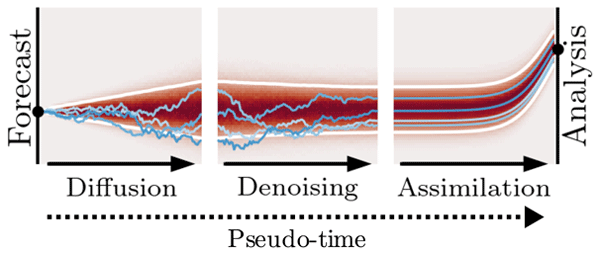
Deep learning has been used to discover new data assimilation methods to track chaotic dynamical systems. Strikingly, these data assimilation networks can match the accuracy of ensemble-based methods using only a single state forecast. This paper first investigates the reasons for this efficacy, and then shows that their performance in more nonlinear regimes matches that of the most accurate scalable data assimilation methods, with greater efficiency and robustness.
Deep learning has been used to discover new data assimilation methods to track chaotic dynamical...