Articles | Volume 33, issue 3
https://doi.org/10.5194/npg-33-373-2026
© Author(s) 2026. This work is distributed under
the Creative Commons Attribution 4.0 License.
https://doi.org/10.5194/npg-33-373-2026
© Author(s) 2026. This work is distributed under
the Creative Commons Attribution 4.0 License.
An improved noise model for representing westerly wind bursts in the recharge oscillator model of ENSO

Georg A. Gottwald
CORRESPONDING AUTHOR
School of Mathematics and Statistics, University of Sydney, Sydney, Australia
Eli Tziperman
Department of Earth and Planetary Sciences and School of Engineering and Applied Sciences, Harvard University, Cambridge, MA, USA
Alexey Fedorov
Department of Earth and Planetary Sciences, Yale University, New Haven, USA
Related authors
No articles found.
Elizabeth K. Brabson, Loren F. Doyle, R. Paul Acosta, Alexey V. Fedorov, Pincelli M. Hull, and Natalie J. Burls
Geosci. Model Dev., 19, 1143–1156, https://doi.org/10.5194/gmd-19-1143-2026, https://doi.org/10.5194/gmd-19-1143-2026, 2026
Short summary
Short summary
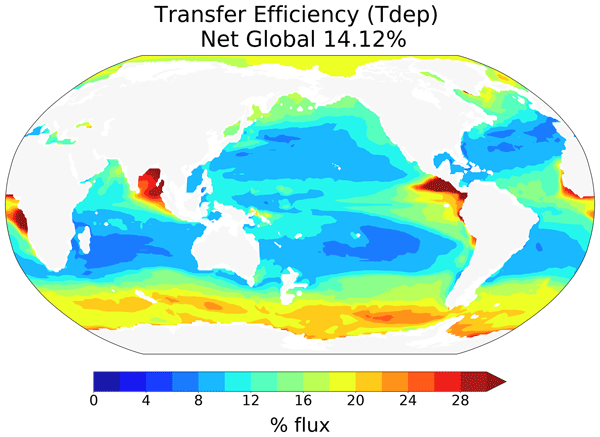
Earth System Models are an essential tool for climate studies, yet temperature-sensitive parameters are often absent, resulting in a gap in model predictive capabilities. Organic carbon breakdown, also known as remineralization, is one such process. Here, we add this parameter to the Community Earth System Model and find improved regional patterns of carbon export. The new code will serve as a useful tool to improve the examination of marine carbon cycle feedbacks to changing climate conditions.
Sina Loriani, Yevgeny Aksenov, David I. Armstrong McKay, Govindasamy Bala, Andreas Born, Cristiano Mazur Chiessi, Henk A. Dijkstra, Jonathan F. Donges, Sybren Drijfhout, Matthew H. England, Alexey V. Fedorov, Laura C. Jackson, Kai Kornhuber, Gabriele Messori, Francesco S. R. Pausata, Stefanie Rynders, Jean-Baptiste Sallée, Bablu Sinha, Steven C. Sherwood, Didier Swingedouw, and Thejna Tharammal
Earth Syst. Dynam., 16, 1611–1653, https://doi.org/10.5194/esd-16-1611-2025, https://doi.org/10.5194/esd-16-1611-2025, 2025
Short summary
Short summary
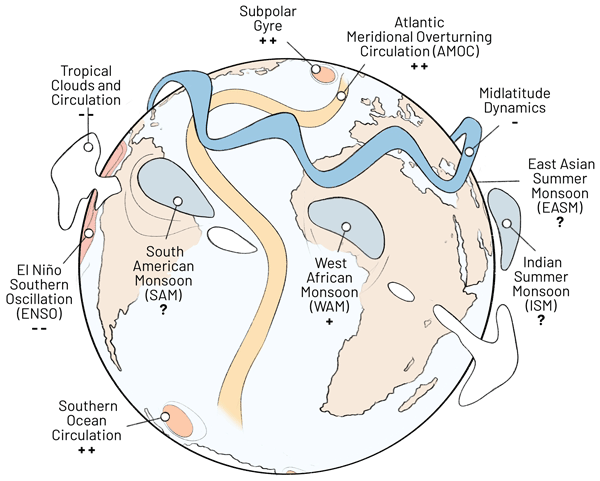
In this work, we draw on palaeo-records, observations, and modelling studies to review tipping points in the ocean overturning circulations, monsoon systems, and global atmospheric circulations. We find indications for tipping in the ocean overturning circulations and the West African monsoon, with potentially severe impacts on the Earth system and humans. Tipping in the other considered systems is regarded as conceivable but is currently not sufficiently supported by evidence.
Kirstin Koepnick, Minmin Fu, and Eli Tziperman
EGUsphere, https://doi.org/10.5194/egusphere-2024-1998, https://doi.org/10.5194/egusphere-2024-1998, 2024
Preprint archived
Short summary
Short summary
The exact impact of climate feedbacks on glacial cycles still remains unclear. In this study, we calculate the surface mass balance (SMB) of the Laurentide Ice Sheet from 21,000 to about 12,000 years ago using a climate model experiment. We found that the model overestimates ice loss compared to existing data. The melt rate is influenced by small changes in albedo and radiation, suggesting that climate models struggle to accurately calculate SMB, hindering our understanding of ice ages.
Camille Hankel and Eli Tziperman
Nonlin. Processes Geophys., 30, 299–309, https://doi.org/10.5194/npg-30-299-2023, https://doi.org/10.5194/npg-30-299-2023, 2023
Short summary
Short summary
We present a novel, efficient method for identifying climate
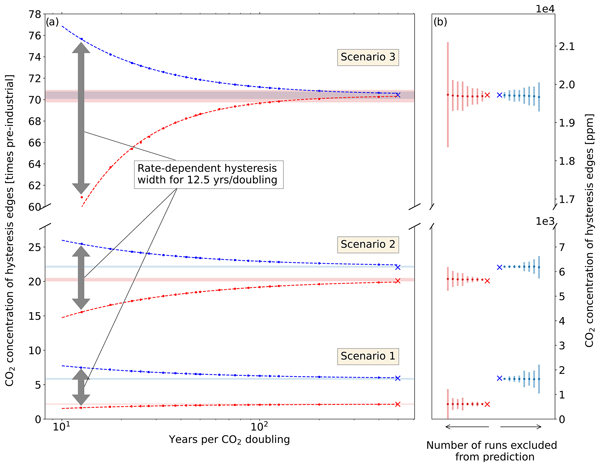
tipping pointthreshold values of CO2 beyond which rapid and irreversible changes occur. We use a simple model of Arctic sea ice to demonstrate the method’s efficacy and its potential for use in state-of-the-art global climate models that are too expensive to run for this purpose using current methods. The ability to detect tipping points will improve our preparedness for rapid changes that may occur under future climate change.
Cited articles
Applebaum, D.: Lévy Processes and Stochastic Calculus, in: vol. 116 of Cambridge Studies in Advanced Mathematics, 2nd Edn., Cambridge University Press, Cambridge, ISBN 978-0-521-73865-1, 2009. a
Bianucci, M.: Analytical probability density function for the statistics of the ENSO phenomenon: Asymmetry and power law tail, Geophys. Res. Lett., 43, 386–394, https://doi.org/10.1002/2015GL066772, 2016. a
Bianucci, M., Capotondi, A., Merlino, S., and Mannella, R.: Estimate of the average timing for strong El Niño events using the recharge oscillator model with a multiplicative perturbation, Chaos, 28, 103118, https://doi.org/10.1063/1.5030413, 2018. a
Burgers, G., Jin, F., and van Oldenborgh, G.: The simplest ENSO recharge oscillator, Geophys. Res. Lett., 32, https://doi.org/10.1029/2005GL022951, 2005. a, b
Chechkin, A. V., Metzler, R., Klafter, J., and Gonchar, V. Y.: Introduction to the theory of Lévy flights, in: Anomalous Transport, edited by: Klages, R., Radons, G., and Sokolov, I. M., Wiley-VCH Verlag GmbH & Co. KGaA, 29–162, https://doi.org/10.1002/9783527622979.ch5, 2008. a
Conley, A. J., Garcia, R., Kinnison, D., Lamarque, J.-F., Marsh, D., Mills, M., Smith, A. K., Tilmes, S., Vitt, F., Morrison, H., Cameron-Smith, P., Collins, W. D., Iacono, M. J., Easter, R. C., Ghan, S. J., Liu, X., Rasch, P. J., and Taylor, M. A.: Description of the NCAR Community Atmosphere Model (CAM 5.0), Technical Note NCAR/TN-486+STR, National Center for Atmospheric Research, Boulder, Colorado, USA, https://n2t.org/ark:/85065/d7s46whd (last access: 17 July 2026), 2012. a
Danabasoglu, G., Lamarque, J.-F., Bacmeister, J., Bailey, D. A., DuVivier, A. K., Edwards, J., Emmons, L. K., Fasullo, J., Garcia, R., Gettelman, A., Hannay, C., Holland, M. M., Large, W. G., Lauritzen, P. H., Lawrence, D. M., Lenaerts, J. T. M., Lindsay, K., Lipscomb, W. H., Mills, M. J., Neale, R., Oleson, K. W., Otto-Bliesner, B., Phillips, A. S., Sacks, W., Tilmes, S., van Kampenhout, L., Vertenstein, M., Bertini, A., Dennis, J., Deser, C., Fischer, C., Fox-Kemper, B., Kay, J. E., Kinnison, D., Kushner, P. J., Larson, V. E., Long, M. C., Mickelson, S., Moore, J. K., Nienhouse, E., Polvani, L., Rasch, P. J., and Strand, W. G.: The Community Earth System Model version 2 (CESM2), J. Adv. Model. Earth Syst., 12, e2019MS001916, https://doi.org/10.1029/2019MS001916, 2020. a
Eisenman, I., Yu, L. S., and Tziperman, E.: Westerly wind bursts: ENSO's tail rather than the dog?, J. Climate, 18, 5224–5238, https://doi.org/10.1175/JCLI3588.1, 2005. a, b
Gebbie, G., Eisenman, I., Wittenberg, A. T., and Tziperman, E.: Modulation of westerly wind bursts by sea surface temperature: A semi-stochastic feedback for ENSO, J. Atmos. Sci., 64, 3281–3295, https://doi.org/10.1175/JAS4029.1, 2007. a, b
Gottwald, G., Crommelin, D., and Franzke, C.: Stochastic climate theory, in: Nonlinear and Stochastic Climate Dynamics, edited by: Franzke, C. L. E. and O'Kane, T. J., Cambridge University Press, Cambridge, 209–240, https://doi.org/10.1017/9781316339251, 2017. a
Gottwald, G. A.: A model for Dansgaard-Oeschger events and millennial-scale abrupt climate change without external forcing, Clim. Dynam., 56, 227–243, https://doi.org/10.1007/s00382-020-05476-z, 2021. a
Han, S., Fedorov, A. V., and Vialard, J.: Realistic ENSO dynamics requires a damped nonlinear recharge oscillator, J. Climate, 39, 77–101, https://doi.org/10.1175/JCLI-D-25-0250.1, 2026. a, b
Harrison, D. E. and Vecchi, G. A.: Westerly wind events in the tropical Pacific, 1986–95, J. Climate, 10, 3131–3156, 1997. a
Jin, F.-F., Lin, L., Timmermann, A., and Zhao, J.: Ensemble-mean dynamics of the ENSO recharge oscillator under state-dependent stochastic forcing, Geophys. Res. Lett., 34, https://doi.org/10.1029/2006GL027372, 2007. a, b, c, d
Kessler, W. S., Mcphaden, M. J., and Weickmann, K. M.: Forcing of intraseasonal Kelvin waves in the equatorial Pacific, J. Geophys. Res., 100, 10613–10631, 1995. a
Lengaigne, M., Boulanger, J.-P., Delecluse, P., Menkes, C., Guilyardi, E., and Slingo, J.: Westerly wind events in the tropical Pacific and their influence on the coupled ocean–atmosphere system: A review, in: Earth Climate: The Ocean–Atmosphere Interaction, vol. 147 of AGU Geophysical Monograph Series, edited by: Wang, C., Xie, S.-P., and Carton, J. A., American Geophysical Union, Washington, D.C., 49–69, https://doi.org/10.1029/147GM03, 2004. a
Levine, A., Jin, F. F., and McPhaden, M. J.: Extreme noise–extreme El Niño: How state-dependent noise forcing creates El Niño–La Niña asymmetry, J. Climate, 29, 5483–5499, https://doi.org/10.1175/JCLI-D-16-0091.1, 2016. a, b, c
Levine, A. F. Z. and Jin, F. F.: A simple approach to quantifying the noise–ENSO interaction. Part I: Deducing the state-dependency of the windstress forcing using monthly mean data, Clim. Dynam., 48, 1–18, https://doi.org/10.1007/s00382-015-2748-1, 2017. a
Lian, T., Tang, Y., Zhou, L., Islam, S. U., Zhang, C., Li, X., and Ling, Z.: Westerly wind bursts simulated in CAM4 and CCSM4, Clim. Dynam., 50, 1353–1371, 2018. a
Liang, Y. and Fedorov, A. V.: Linking the Madden–Julian Oscillation, tropical cyclones and westerly wind bursts as part of El Niño development, Clim. Dynam., 57, 1039–1060, https://doi.org/10.1007/s00382-021-05757-1, 2021a. a, b, c
Liang, Y. and Fedorov, A. V.: Linking the Madden–Julian Oscillation, Tropical Cyclones and Westerly Wind Bursts as Part of El Niño Development, Clim. Dynam., 57, 1039–1060, https://doi.org/10.1007/s00382-021-05757-1, 2021b. a
Liu, F., Vialard, J., Fedorov, A. V., Éthé, C., Person, R., Zhang, W., and Lengaigne, M.: Why do oceanic nonlinearities contribute only weakly to extreme El Niño events?, Geophys. Res. Lett., 51, e2024GL108813, https://doi.org/10.1029/2024GL108813, 2024. a
Majda, A. J., Franzke, C., and Crommelin, D.: Normal forms for reduced stochastic climate models, P. Natl. Acad. Sci. USA, 106, 3649–3653, 2009. a
Martinez-Villalobos, C., Newman, M., Vimont, D. J., Penland, C., and David Neelin, J.: Observed El Niño-La Niña asymmetry in a linear model, Geophys. Res. Lett., 46, 9909–9919, https://doi.org/10.1029/2019GL082922, 2019. a, b
Pavliotis, G. A. and Stuart, A. M.: Multiscale Methods: Averaging and Homogenization, Springer, New York, https://doi.org/10.1007/978-0-387-73829-1, 2008. a
Penland, C. and Sardeshmukh, P. D.: Alternative interpretations of power-law distributions found in nature, Chaos, 22, 023119, https://doi.org/10.1063/1.4706504, 2012. a, b, c
Puy, M., Vialard, J., Lengaigne, M., Guilyardi, E., DiNezio, P. N., Voldoire, A., Balmaseda, M., Madec, G., Menkes, C., and Mcphaden, M. J.: Influence of westerly wind events stochasticity on El Niño amplitude: The case of 2014 vs. 2015, Clim. Dynam., 52, 7435–7454, 2019. a
Rayner, N., Parker, D. E., Horton, E., Folland, C., Alexander, L., Rowell, D., Kent, E., and Kaplan, A.: Global analyses of sea surface temperature, sea ice, and night marine air temperature since the late nineteenth century, J. Geophys. Res.-Atmos., 108, https://doi.org/10.1029/2002JD002670, 2003. a, b
Sardeshmukh, P. D. and Penland, C.: Understanding the distinctively skewed and heavy tailed character of atmospheric and oceanic probability distributions, Chaos, 25, 036410, https://doi.org/10.1063/1.4914169, 2015. a, b, c
Thompson, W. F., Kuske, R. A., and Monahan, A. H.: Reduced α-stable dynamics for multiple time scale systems forced with correlated additive and multiplicative Gaussian white noise, Chaos, 27, 113105, https://doi.org/10.1063/1.4985675, 2017. a, b
Vialard, J., Jin, F.-F., Mcphaden, M. J., Fedorov, A., Cai, W., An, S.-I., Dommenget, D., Fang, X., Stuecker, M., Wang, C., Wittenberg, A., Zhao, S., Liu, F., Kim, S.-K., Planton, Y., Geng, T., Lengaigne, M., Capotondi, A., Chen, N., Geng, L., Hu, S., Izumo, T., Kug, J.-S., Luo, J.-J., McGregor, S., Pagli, B., Priya, P., Stevenson, S., and Thual, S.: The El Niño Southern Oscillation (ENSO) recharge oscillator conceptual model: Achievements and future prospects, Rev. Geophys., 63, e2024RG000843, https://doi.org/10.1029/2024RG000843, 2025. a, b, c, d, e, f, g, h, i, j, k, l, m
Weeks, E. and Tziperman, E.: Challenges in determining whether ENSO is a damped or a self‐sustained oscillation, Geophys. Res. Lett., 52, e2025GL116328, https://doi.org/10.1029/2025GL116328, 2025. a
Yu, L., Weller, R. A., and Liu, T. W.: Case analysis of a role of ENSO in regulating the generation of westerly wind bursts in the Western Equatorial Pacific, J. Geophys. Res., 108, https://doi.org/10.1029/2002JC001498, 2003. a, b
Yu, S. and Fedorov, A. V.: The role of westerly wind bursts during different seasons versus ocean heat recharge in the development of extreme El Niño in climate models, Geophys. Res. Lett., 47, e2020GL088381, https://doi.org/10.1029/2020GL088381, 2020. a
Yu, S. and Fedorov, A. V.: The essential role of westerly wind bursts in ENSO dynamics and extreme events quantified in model “wind stress shaving” experiments, J. Climate, 35, 7519–7538, https://doi.org/10.1175/JCLI-D-21-0401.1, 2022. a
Zebiak, S. E. and Cane, M. A.: A model El Niño-Southern Oscillation, Mon. Weather Rev., 115, 2262–2278, 1987. a
Short summary
The recharge oscillator model has served as a simple yet powerful toy model for modelling the El Niño–Southern Oscillation. Whereas the addition of Gaussian noise is sufficient to capture the observed overall statistical features, it fails to resolve dynamical signatures associated with major El Niño events. Here we propose to employ a conditional non-Gaussian noise model that better captures the effect of large westerly wind bursts and their effect on major warming events.
The recharge oscillator model has served as a simple yet powerful toy model for modelling the El...