Articles | Volume 33, issue 1
https://doi.org/10.5194/npg-33-85-2026
© Author(s) 2026. This work is distributed under
the Creative Commons Attribution 4.0 License.
https://doi.org/10.5194/npg-33-85-2026
© Author(s) 2026. This work is distributed under
the Creative Commons Attribution 4.0 License.
Dynamic mode decomposition of extreme events
Maša Ann
CORRESPONDING AUTHOR
University of Hamburg, 20146 Hamburg, Germany
Jörn Behrens
University of Hamburg, 20146 Hamburg, Germany
Jana Sillmann
University of Hamburg, 20146 Hamburg, Germany
Related authors
No articles found.
Philip J. Ward, Sophie L. Buijs, Roxana Ciurean, Judith N. Claassen, James Daniell, Kelley De Polt, Melanie Duncan, Stefania Gottardo, Stefan Hochrainer-Stigler, Robert Šakić Trogrlić, Julius Schlumberger, Timothy Tiggeloven, Silvia Torresan, Nicole van Maanen, Andrew Warren, Carmen D. Álvarez-Albelo, Vanessa Banks, Benjamin Blanz, Veronica Casartelli, Jordan Correa, Julia Crummy, Anne Sophie Daloz, Marleen C. de Ruiter, Juan José Díaz-Hernández, Jaime Díaz-Pacheco, Pedro Dorta Antequera, Davide Ferrario, David Geurts, Sara García-González, Joel C. Gill, Raúl Hernández-Martín, Wiebke S. Jäger, Abel López-Díez, Lin Ma, Jaroslav Mysiak, Diep Ngoc Nguyen, Noemi Padrón Fumero, Eva-Cristina Petrescu, Karina Reiter, Jana Sillmann, Lara Smale, and Tristian Stolte
Nat. Hazards Earth Syst. Sci., 26, 1325–1345, https://doi.org/10.5194/nhess-26-1325-2026, https://doi.org/10.5194/nhess-26-1325-2026, 2026
Short summary
Short summary
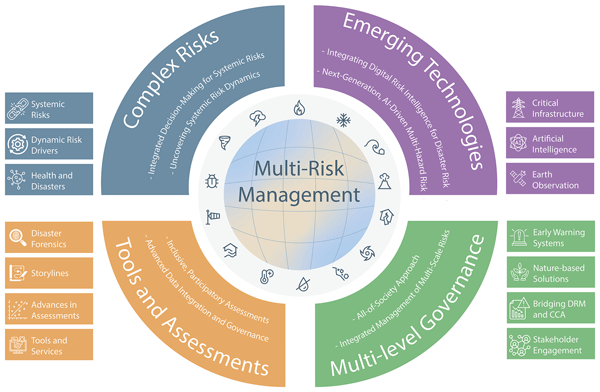
Disasters often result from interactions between different hazards, like floods triggering landslides, or earthquakes followed by tropical cyclones, so-called multi-hazards. People and societies are increasingly exposed and vulnerable to these multi-hazards. Assessing these aspects is referred to as multi-risk assessment and management. In this paper we synthesise key learnings from the MYRIAD-EU (Multi-hazard and sYstemic framework for enhancing Risk-Informed mAnagement and Decision-making in the E.U.) project, reflecting on progress and challenges faced in addressing multi-hazards and multi-risk.
Nina Schuhen, Carley E. Iles, Marit Sandstad, Viktor Ananiev, and Jana Sillmann
Nat. Hazards Earth Syst. Sci., 26, 753–773, https://doi.org/10.5194/nhess-26-753-2026, https://doi.org/10.5194/nhess-26-753-2026, 2026
Short summary
Short summary
As climate changes, extremes are becoming increasingly frequent. We investigate the time of emergence for a large range of different extremes, meaning the earliest time when a significant change in these extremes can be detected beyond natural variability, whether in the past or in the future. The results are based on 21 global climate models and show considerable differences between regions, types of indices and emissions scenarios, as well as between temperature and precipitation extremes.
Anastasia Vogelbacher, Malte von Szombathely, Marc Lennartz, Benjamin Poschlod, and Jana Sillmann
EGUsphere, https://doi.org/10.5194/egusphere-2025-6362, https://doi.org/10.5194/egusphere-2025-6362, 2026
Short summary
Short summary
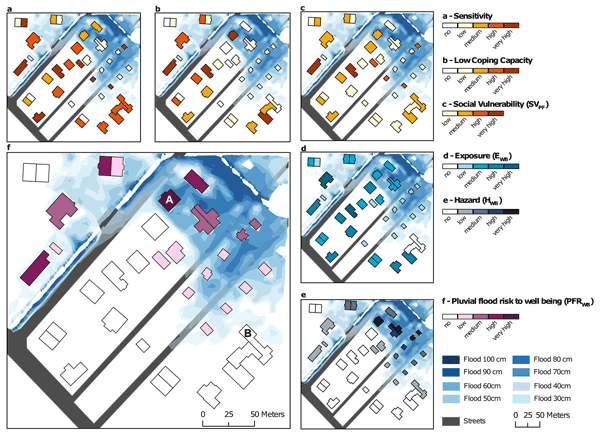
In this study we address risk to pluvial floods by following the risk definition of the Intergovernmental Panel on Climate Change (IPCC), developed in co-operation with stakeholders. We identify buildings in urban areas where residents face higher flood risk due to greater social vulnerability, increased exposure, or elevated flood hazard. We present the development and application of a Python-based ArcGIS toolbox for estimating pluvial flood risk at building scale.
Alexander Lee Rischmuller, Benjamin Poschlod, and Jana Sillmann
Adv. Stat. Clim. Meteorol. Oceanogr., 12, 1–19, https://doi.org/10.5194/ascmo-12-1-2026, https://doi.org/10.5194/ascmo-12-1-2026, 2026
Short summary
Short summary
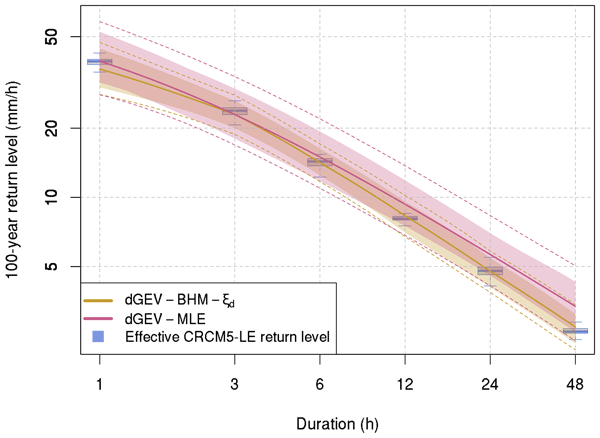
Extreme precipitation probability estimation is vital for hazard protection design but has high uncertainty. We tested six statistical models using 2000 years of climate data. Our Bayesian hierarchical duration-dependent Generalized Extreme Value model shows the highest accuracy and robustness for sample sizes between 30 and 100 years, making it highly promising for use with limited observational records.
Iris Mužić, Øivind Hodnebrog, Yeliz A. Yilmaz, Terje K. Berntsen, Jana Sillmann, David M. Lawrence, and Paul A. Dirmeyer
Adv. Stat. Clim. Meteorol. Oceanogr., 11, 273–292, https://doi.org/10.5194/ascmo-11-273-2025, https://doi.org/10.5194/ascmo-11-273-2025, 2025
Short summary
Short summary
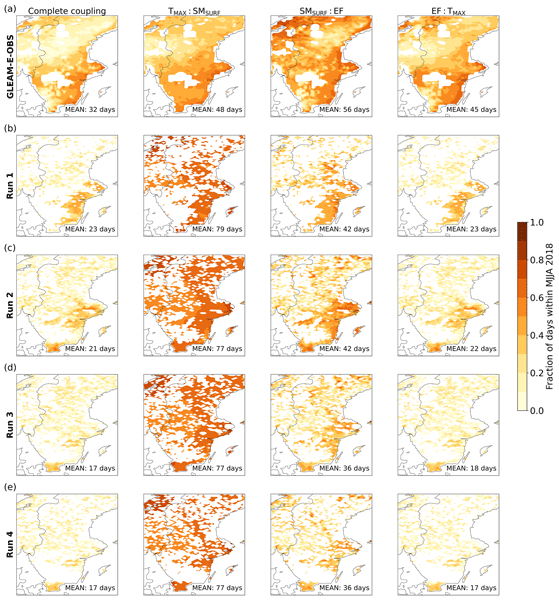
This study investigates soil moisture–temperature coupling during the extreme warm conditions in May–August 2018 in southern and central Sweden using the merged GLEAM-E-OBS dataset and four simulations from the Weather Research and Forecasting model coupled with the Community Terrestrial Systems Model (WRF-CTSM). Based on changes in surface soil moisture, evaporative fraction, and daily maximum 2 m temperature, on average across the region and five datasets, the coupling lasted for 22 d.
Natalia Castillo Bautista, Marco Gaetani, Leonard F. Borchert, Benjamin Poschlod, Lukas Brunner, Jana Sillmann, and Mario L. V. Martina
EGUsphere, https://doi.org/10.5194/egusphere-2025-5073, https://doi.org/10.5194/egusphere-2025-5073, 2025
Short summary
Short summary
When hot temperatures and drought occur together (compound events), they can cause harmful impacts on crops and society. Using six decades of climate data, we show that such compound events repeatedly occurred in three breadbaskets of the Northern Hemisphere. These events are linked to atmospheric circulation patterns that favor heat and dryness, which in turn interact to amplify the impact. Our study contributes to understand the drivers of these events to support climate impact assessment.
Anna Pagnone, Jörn Behrens, David Marcolino Nielsen, Linda Jetter, Lluc Vayreda Calbó, Sam Burton-Weiss, Dit Coesebrink, Daniele Alef Grillo, Carl Maria Kemper, Nana Petzet, and Jenni Schurr
EGUsphere, https://doi.org/10.5194/egusphere-2025-5213, https://doi.org/10.5194/egusphere-2025-5213, 2025
This preprint is open for discussion and under review for Geoscience Communication (GC).
Short summary
Short summary
In "Portraits of Climate", we examine dynamics and roles in art–science collaborations and find that success depends less on one- or two-way exchange, or fixed or blended artist/scientist roles, than on openness, trust, and mutual understanding. Participants' subjective views often differ from external assessments and from each other. The project showed how such collaborations foster growth, role expansion, and new ways to address environmental challenges.
Timothy Tiggeloven, Colin Raymond, Marleen C. de Ruiter, Jana Sillmann, Annegret H. Thieken, Sophie L. Buijs, Roxana Ciurean, Emma Cordier, Julia M. Crummy, Lydia Cumiskey, Kelley De Polt, Melanie Duncan, Davide M. Ferrario, Wiebke S. Jäger, Elco E. Koks, Nicole van Maanen, Heather J. Murdock, Jaroslav Mysiak, Sadhana Nirandjan, Benjamin Poschlod, Peter Priesmeier, Nivedita Sairam, Pia-Johanna Schweizer, Tristian R. Stolte, Marie-Luise Zenker, James E. Daniell, Alexander Fekete, Christian M. Geiß, Marc J. C. van den Homberg, Sirkku K. Juhola, Christian Kuhlicke, Karen Lebek, Robert Šakić Trogrlić, Stefan Schneiderbauer, Silvia Torresan, Cees J. van Westen, Judith N. Claassen, Bijan Khazai, Virginia Murray, Julius Schlumberger, and Philip J. Ward
EGUsphere, https://doi.org/10.5194/egusphere-2025-2771, https://doi.org/10.5194/egusphere-2025-2771, 2025
Short summary
Short summary
Natural hazards like floods, earthquakes, and landslides are often interconnected which may create bigger problems than when they occur alone. We studied expert discussions from an international conference to understand how scientists and policymakers can better prepare for these multi-hazards and use new technologies to protect its communities while contributing to dialogues about future international agreements beyond the Sendai Framework and supporting global sustainability goals.
Detlef van Vuuren, Brian O'Neill, Claudia Tebaldi, Louise Chini, Pierre Friedlingstein, Tomoko Hasegawa, Keywan Riahi, Benjamin Sanderson, Bala Govindasamy, Nico Bauer, Veronika Eyring, Cheikh Fall, Katja Frieler, Matthew Gidden, Laila Gohar, Andrew Jones, Andrew King, Reto Knutti, Elmar Kriegler, Peter Lawrence, Chris Lennard, Jason Lowe, Camila Mathison, Shahbaz Mehmood, Luciana Prado, Qiang Zhang, Steven Rose, Alexander Ruane, Carl-Friederich Schleussner, Roland Seferian, Jana Sillmann, Chris Smith, Anna Sörensson, Swapna Panickal, Kaoru Tachiiri, Naomi Vaughan, Saritha Vishwanathan, Tokuta Yokohata, and Tilo Ziehn
EGUsphere, https://doi.org/10.5194/egusphere-2024-3765, https://doi.org/10.5194/egusphere-2024-3765, 2025
Short summary
Short summary
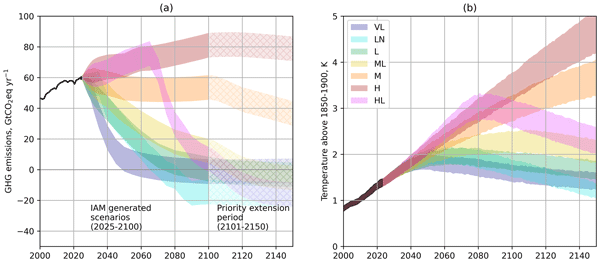
We propose a set of six plausible 21st century emission scenarios, and their multi-century extensions, that will be used by the international community of climate modeling centers to produce the next generation of climate projections. These projections will support climate, impact and mitigation researchers, provide information to practitioners to address future risks from climate change, and contribute to policymakers’ considerations of the trade-offs among various levels of mitigation.
Viktoria Spaiser, Sirkku Juhola, Sara M. Constantino, Weisi Guo, Tabitha Watson, Jana Sillmann, Alessandro Craparo, Ashleigh Basel, John T. Bruun, Krishna Krishnamurthy, Jürgen Scheffran, Patricia Pinho, Uche T. Okpara, Jonathan F. Donges, Avit Bhowmik, Taha Yasseri, Ricardo Safra de Campos, Graeme S. Cumming, Hugues Chenet, Florian Krampe, Jesse F. Abrams, James G. Dyke, Stefanie Rynders, Yevgeny Aksenov, and Bryan M. Spears
Earth Syst. Dynam., 15, 1179–1206, https://doi.org/10.5194/esd-15-1179-2024, https://doi.org/10.5194/esd-15-1179-2024, 2024
Short summary
Short summary
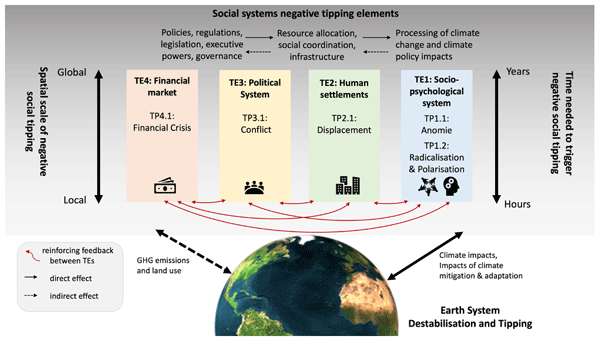
In this paper, we identify potential negative social tipping points linked to Earth system destabilization and draw on related research to understand the drivers and likelihood of these negative social tipping dynamics, their potential effects on human societies and the Earth system, and the potential for cascading interactions and contribution to systemic risks.
Clemens Schwingshackl, Anne Sophie Daloz, Carley Iles, Kristin Aunan, and Jana Sillmann
Nat. Hazards Earth Syst. Sci., 24, 331–354, https://doi.org/10.5194/nhess-24-331-2024, https://doi.org/10.5194/nhess-24-331-2024, 2024
Short summary
Short summary
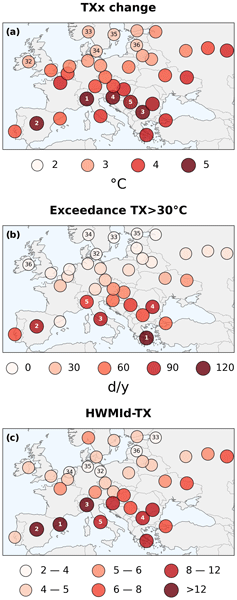
Ambient heat in European cities will substantially increase under global warming, as projected by three heat metrics calculated from high-resolution climate model simulations. While the heat metrics consistently project high levels of ambient heat for several cities, in other cities the projected heat levels vary considerably across the three heat metrics. Using complementary heat metrics for projections of ambient heat is thus important for assessments of future risks from heat stress.
Philip J. Ward, James Daniell, Melanie Duncan, Anna Dunne, Cédric Hananel, Stefan Hochrainer-Stigler, Annegien Tijssen, Silvia Torresan, Roxana Ciurean, Joel C. Gill, Jana Sillmann, Anaïs Couasnon, Elco Koks, Noemi Padrón-Fumero, Sharon Tatman, Marianne Tronstad Lund, Adewole Adesiyun, Jeroen C. J. H. Aerts, Alexander Alabaster, Bernard Bulder, Carlos Campillo Torres, Andrea Critto, Raúl Hernández-Martín, Marta Machado, Jaroslav Mysiak, Rene Orth, Irene Palomino Antolín, Eva-Cristina Petrescu, Markus Reichstein, Timothy Tiggeloven, Anne F. Van Loon, Hung Vuong Pham, and Marleen C. de Ruiter
Nat. Hazards Earth Syst. Sci., 22, 1487–1497, https://doi.org/10.5194/nhess-22-1487-2022, https://doi.org/10.5194/nhess-22-1487-2022, 2022
Short summary
Short summary
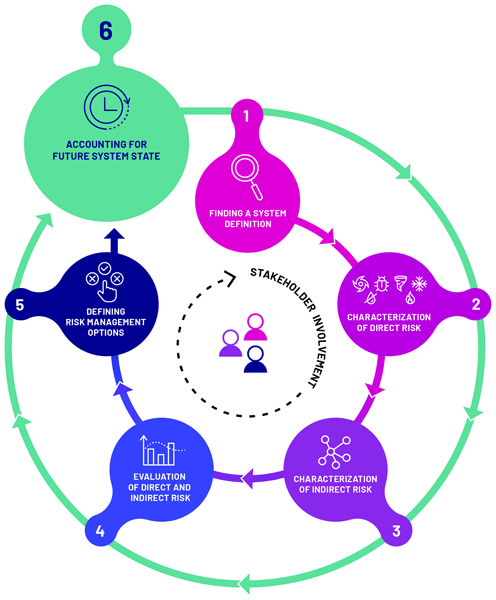
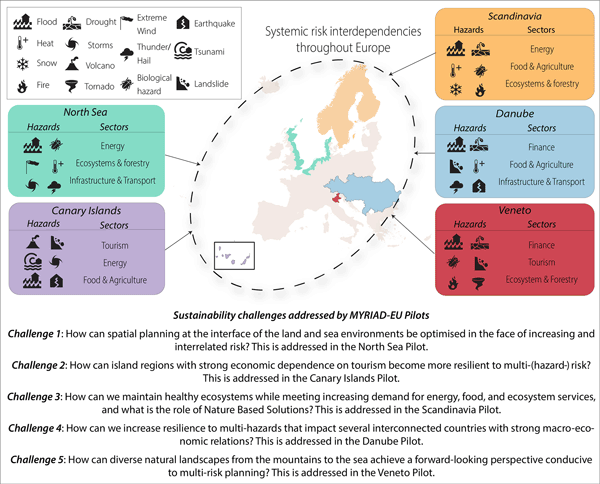
The majority of natural-hazard risk research focuses on single hazards (a flood, a drought, a volcanic eruption, an earthquake, etc.). In the international research and policy community it is recognised that risk management could benefit from a more systemic approach. In this perspective paper, we argue for an approach that addresses multi-hazard, multi-risk management through the lens of sustainability challenges that cut across sectors, regions, and hazards.
Katja Weigel, Lisa Bock, Bettina K. Gier, Axel Lauer, Mattia Righi, Manuel Schlund, Kemisola Adeniyi, Bouwe Andela, Enrico Arnone, Peter Berg, Louis-Philippe Caron, Irene Cionni, Susanna Corti, Niels Drost, Alasdair Hunter, Llorenç Lledó, Christian Wilhelm Mohr, Aytaç Paçal, Núria Pérez-Zanón, Valeriu Predoi, Marit Sandstad, Jana Sillmann, Andreas Sterl, Javier Vegas-Regidor, Jost von Hardenberg, and Veronika Eyring
Geosci. Model Dev., 14, 3159–3184, https://doi.org/10.5194/gmd-14-3159-2021, https://doi.org/10.5194/gmd-14-3159-2021, 2021
Short summary
Short summary
This work presents new diagnostics for the Earth System Model Evaluation Tool (ESMValTool) v2.0 on the hydrological cycle, extreme events, impact assessment, regional evaluations, and ensemble member selection. The ESMValTool v2.0 diagnostics are developed by a large community of scientists aiming to facilitate the evaluation and comparison of Earth system models (ESMs) with a focus on the ESMs participating in the Coupled Model Intercomparison Project (CMIP).
Yumeng Chen, Konrad Simon, and Jörn Behrens
Geosci. Model Dev., 14, 2289–2316, https://doi.org/10.5194/gmd-14-2289-2021, https://doi.org/10.5194/gmd-14-2289-2021, 2021
Short summary
Short summary
Mesh adaptivity can reduce overall model error by only refining meshes in specific areas where it us necessary in the runtime. Here we suggest a way to integrate mesh adaptivity into an existing Earth system model, ECHAM6, without having to redesign the implementation from scratch. We show that while the additional computational effort is manageable, the error can be reduced compared to a low-resolution standard model using an idealized test and relatively realistic dust transport tests.
Cited articles
Alcayaga, L., Larsen, G. C., Kelly, M., and Mann, J.: Identification of large-scale atmospheric structures under different stability conditions using Dynamic Mode Decomposition, J. Phys. Conf. Ser., 2265, 022006, https://doi.org/10.1088/1742-6596/2265/2/022006, 2022. a
Barriopedro, D., Fischer, E. M., Luterbacher, J., Trigo, R. M., and García-Herrera, R.: The hot summer of 2010: redrawing the temperature record map of Europe, Science, 332, 220–224, https://doi.org/10.1126/science.1201224, 2011. a
Berkooz, G., Holmes, P., and Lumley, J. L.: The proper orthogonal decomposition in the analysis of turbulent flows, Annu. Rev. Fluid Mech., 25, 539–575, https://doi.org/10.1146/annurev.fl.25.010193.002543, 1993. a
Brunton, S. L., Proctor, J. L., and Kutz, J. N.: Discovering governing equations from data by sparse identification of nonlinear dynamical systems, P. Natl. Acad. Sci. USA, 113, 3932–3937, https://doi.org/10.1073/pnas.1517384113, 2016. a
Brunton, S. L., Budišić, M., Kaiser, E., and Kutz, J. N.: Modern Koopman Theory for Dynamical Systems, arXiv [preprint], https://doi.org/10.48550/arXiv.2102.12086, 2021. a
Casati, B., Yagouti, A., and Chaumont, D.: Regional climate projections of extreme heat events in nine pilot Canadian communities for public health planning, J. Appl. Meteorol., 52, 2669–2698, https://doi.org/10.1175/JAMC-D-12-0341.1, 2013. a
Chowdary, P. N., Pingali, S., Unnikrishnan, P., Sanjeev, R., Sowmya, V., Gopalakrishnan, E. A., and Dhanya, M.: Unleashing the Power of Dynamic Mode Decomposition and Deep Learning for Rainfall Prediction in North-East India, arXiv [preprint] arXiv:2309.09336 [cs.LG], 2023.470, https://doi.org/10.48550/arXiv.2309.09336, 2023. a, b
Duke, D., Soria, J., and Honnery, D.: An error analysis of the dynamic mode decomposition, Exp. Fluids, 52, 529–542, 2012. a
Erichson, N. B., Brunton, S. L., and Kutz, J. N.: Compressed dynamic mode decomposition for background modeling, J. Real-Time Image Pr., 16, 1479–1492, https://doi.org/10.1007/s11554-016-0655-2, 2016. a, b
Froyland, G., Giannakis, D., Lintner, B. R., Pike, M., and Slawinska, J.: Spectral analysis of climate dynamics with operator-theoretic approaches, Nat. Commun., 12, https://doi.org/10.1038/s41467-021-26357-x, 2021. a, b
García-Herrera, R., Díaz, J., Trigo, R. M., Luterbacher, J., and and, E. M. F.: A review of the European summer heat wave of 2003, Crit. Rev. Env. Sci. Tec., 40, 267–306, https://doi.org/10.1080/10643380802238137, 2010. a
Gaspard, P.: Chaos, Scattering and Statistical Mechanics, Cambridge University Press, https://doi.org/10.1017/CBO9780511628856, 1998. a
Hersbach, H. and Dee, D.: ERA5 reanalysis is in production, ECMWF Newsletter, https://www.ecmwf.int/sites/default/files/elibrary/2016/16299-newsletter-no147-spring-2016.pdf (last access: 31 January 2026), 2016. a
Holmes, P., Lumley, J. L., and Berkooz, G.: Turbulence, Coherent Structures, Dynamical Systems and Symmetry, Cambridge University Press, https://doi.org/10.1017/CBO9780511919701, 2012. a
Hotelling, H.: Analysis of a complex of statistical variables into principal components, J. Educ. Psychol., 24, 417–441, https://doi.org/10.1037/h0071325, 1933. a
Jovanović, M. R., Schmid, P. J., and Nichols, J. W.: Sparsity-promoting dynamic mode decomposition, Phys. Fluids, 26, https://doi.org/10.1063/1.4863670, 2014. a, b
Koopman, B. O.: Hamiltonian systems and transformation in Hilbert space, P. Natl. Acad. Sci. USA, 17, 315–318, https://doi.org/10.1073/pnas.17.5.315, 1931. a
Lorenz, E. N.: Empirical Orthogonal Functions and Statistical Weather Prediction, Tech. Rep., Statistical Forecasting Project Report No. 1, Department of Meteorology, Massachusetts Institute of Technology, Cambridge, MA, https://wind.mit.edu/~emanuel/Lorenz/EdLorenz/Empirical_Orthogonal_Functions_1956.pdf (last access: 31 January 2026), 1956. a
Lucarini, V., Faranda, D., Freitas, A. C. M., Freitas, J. M., Kuna, T., Holland, M., Nicol, M., Todd, M., and Vaienti, S.: Extremes and Recurrence in Dynamical Systems, Pure and Applied Mathematics: A Wiley Series of Texts, Monographs and Tracts, Wiley, ISBN 9781118632192, https://books.google.hr/books?id=ebTOoQEACAAJ (last access: 31 January 2026), 2016. a
Mankovich, N., Bouabid, S., Nowack, P., Bassotto, D., and Camps-Valls, G.: Analyzing climate scenarios using dynamic mode decomposition with control, Environmental Data Science, 4, e16, https://doi.org/10.1017/eds.2025.8, 2025. a
Mezić, I.: Spectral properties of dynamical systems, model reduction and decompositions, Nonlinear Dynam., 41, 309–325, https://doi.org/10.1007/s11071-005-2824-x, 2005. a
Mezić, I.: Analysis of fluid flows via spectral properties of the Koopman operator, Annu. Rev. Fluid Mech., 45, 357–378, 2013. a
Mezić, I.: Operator is the Model, arXiv [preprint], https://doi.org/10.48550/arXiv.2310.18516, 2023. a
Navarra, A., Tribbia, J., Klus, S., and Lorenzo-Sánchez, P.: Variability of SST through Koopman Modes, J. Climate, 37, 4095–4114, https://doi.org/10.1175/JCLI-D-23-0335.1, 2024. a
Perkins-Kirkpatrick, S. E. and Gibson, P. B.: Changes in regional heatwave characteristics as a function of increasing global temperature, Sci. Rep.-UK, 7, 12256, https://doi.org/10.1038/s41598-017-12520-2, 2017. a
Proctor, J. L. and Eckhoff, P. A.: Discovering dynamic patterns from infectious disease data using dynamic mode decomposition, Int. Health, 7, 139–145, https://doi.org/10.1093/inthealth/ihv009, 2015. a
Rowley, C. W., Mezić, I., Bagheri, S., Schlatter, P., and Henningson, D. S.: Spectral analysis of nonlinear flows, J. Fluid Mech., 641, 85–113, 2009a. a
Rowley, C. W., Mezić, I., Bagheri, S., Schlatter, P., and Henningson, D. S.: Spectral analysis of nonlinear flows, J. Fluid Mech., 641, 115–127, https://doi.org/10.1017/S0022112009992059, 2009b. a, b, c, d
Rudy, S. H., Brunton, S. L., Proctor, J. L., and Kutz, J. N.: Data-driven discovery of partial differential equations, arXiv [preprint], https://doi.org/10.48550/arXiv.1609.06401, 2016. a
Schaller, N., Sillmann, J., Anstey, J., Fischer, E. M., Grams, C. M., and Russo, S.: Influence of blocking on Northern European and Western Russian heatwaves in large climate model ensembles, Environ. Res. Lett., 13, 054015, https://doi.org/10.1088/1748-9326/aaba55, 2018. a
Schmid, P. J. and Sesterhenn, J.: On dynamic mode decomposition: Theory and applications, in: 61st Annual Meeting of the APS Division of Fluid Dynamics, American Institute of Mathematical Sciences, 391–421, https://doi.org/10.3934/jcd.2014.1.391, 2008. a, b
Schmid, P. J., Violato, D., and Scarano, F.: Decomposition of time-resolved tomographic PIV, Exp. Fluids, 52, 1567–1579, 2012. a
Shi, L., Haseli, M., Mamakoukas, G., Bruder, D., Abraham, I., Murphey, T., Cortes, J., and Karydis, K.: Koopman Operators in Robot Learning, arXiv [preprint], https://doi.org/10.48550/arXiv.2408.04200, 2024. a
Smith, T. R., Moehlis, J., and Holmes, P.: Low-dimensional modelling of turbulence using the proper orthogonal decomposition: a tutorial, Nonlinear Dynam., 41, 275–307, https://doi.org/10.1007/s11071-005-2823-y, 2005. a, b
Uchida, T., Yadidya, B., Lapo, K. E., Xu, X., Early, J. J., Arbic, B. K., Menemenlis, D., Hiron, L., Chassignet, E. P., Shriver, J. F., and Buijsman, M. C.: Dynamic mode decomposition of geostrophically balanced motions from SWOT Cal/Val in the separated Gulf Stream, Earth and Space Science, 12, e2024EA004079, https://doi.org/10.1029/2024EA004079, 2025. a
Vogel, M. M., Zscheischler, J., Fischer, E. M., and Seneviratne, S. I.: Development of future heatwaves for different hazard thresholds, J. Geophys. Res.-Atmos., 125, e2019JD032070, https://doi.org/10.1029/2019JD032070, 2020. a, b
Wang, H., Liang, W., Liang, B., Ren, H., Du, Z., and Wu, Y.: Robust Position Control of a Continuum Manipulator Based on Selective Approach and Koopman Operator, IEEE T. Ind. Electron., https://doi.org/10.1109/TIE.2023.3236082, 2023. a
Xu, Z., FitzGerald, G., Guo, Y., Jalaludin, B., and Tong, S.: Impact of heatwave on mortality under different heatwave definitions: a systematic review and meta-analysis, Environ. Int., 89–90, 193–203, https://doi.org/10.1016/j.envint.2016.02.007, 2016. a, b
Yin, C., Yang, Y., Chen, X., Yue, X., Liu, Y., and Xin, Y.: Changes in global heat waves and its socioeconomic exposure in a warmer future, Climate Risk Management, 38, 100459, https://doi.org/10.1016/j.crm.2022.100459, 2022. a
Zhang, Q., Liu, Y., and Wang, S.: The identification of coherent structures using proper orthogonal decomposition and dynamic mode decomposition, J. Fluid Struct., 49, 53–72, https://doi.org/10.1016/j.jfluidstructs.2014.04.002, 2014. a, b
Zhang, Z., Susuki, Y., and Okazaki, A.: Extracting transient Koopman modes from short-term weather simulations with sparsity-promoting dynamic mode decomposition, arXiv [preprint], https://doi.org/10.48550/arXiv.2506.14083, 2025. a, b
Short summary
We present a new framework based on Dynamic Mode Decomposition (DMD) to better detect outliers and model extremes. Unlike standard DMD, which focuses on average system behaviour, our approach targets rare, exceptional dynamics. Applied to climate data, it improves extreme event approximation and reveals meaningful spatiotemporal patterns. The method may generalise to other types of extremes.
We present a new framework based on Dynamic Mode Decomposition (DMD) to better detect outliers...