Articles | Volume 33, issue 4
https://doi.org/10.5194/npg-33-579-2026
© Author(s) 2026. This work is distributed under
the Creative Commons Attribution 4.0 License.
https://doi.org/10.5194/npg-33-579-2026
© Author(s) 2026. This work is distributed under
the Creative Commons Attribution 4.0 License.
Stochastic collection equation: invariant evolution of the cloud droplet–size distribution

Jun-Ichi Yano
CORRESPONDING AUTHOR
CNRM, UMR 3589 (CNRS), Météo-France, 31057, Toulouse CEDEX, France
Marta Wacławczyk
Institute of Geophysics, Faculty of Physics, University of Warsaw, Warsaw, Poland
Maarten H. P. Ambaum
Department of Meteorology, University of Reading, Reading, UK
Related authors
Vaughan T. J. Phillips, Sanne M. H. de Jong, Robert Garvey, Martin K. Skoglund, Torbjörn Ahlström, Fredrik Charpentier Ljungqvist, Mikael Pontarp, Joacim Rocklöv, Matthew Toohey, Jun-Ichi Yano, Helene Castenbrandt, Carl-Johan Fraenkel, Adam Linder, Henrik Sjödin, and Jesper Sjolte
EGUsphere, https://doi.org/10.5194/egusphere-2026-5195, https://doi.org/10.5194/egusphere-2026-5195, 2026
Short summary
Short summary
We investigate how volcanic eruptions may have amplified plague pandemics through climate-driven harvest failure and malnutrition. Using a model linking climate, food production, nutrition and disease, we find that the eruptions of 536 and 540 CE could have greatly increased mortality during the Justinianic Plague. The results suggest that food shortages and human movement were important in shaping the pandemic's severity and spread.
Jun-Ichi Yano, Vincent E. Larson, and Vaughan T. J. Phillips
Atmos. Chem. Phys., 25, 9357–9386, https://doi.org/10.5194/acp-25-9357-2025, https://doi.org/10.5194/acp-25-9357-2025, 2025
Short summary
Short summary
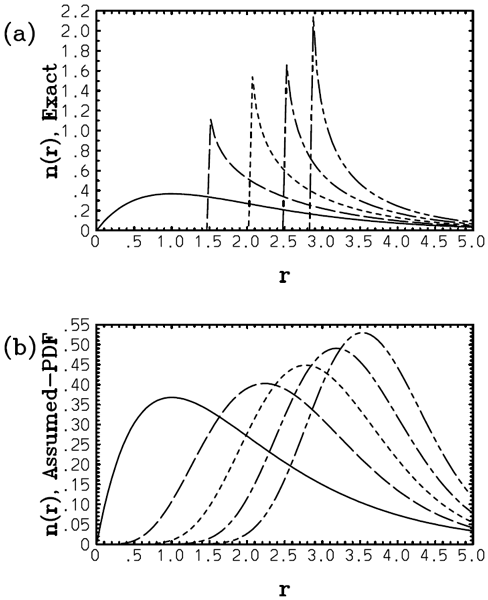
The distribution problems appear in atmospheric sciences at almost every corner when describing diverse processes. This paper presents a general formulation for addressing all these problems.
Jun-Ichi Yano
Nonlin. Processes Geophys., 31, 359–380, https://doi.org/10.5194/npg-31-359-2024, https://doi.org/10.5194/npg-31-359-2024, 2024
Short summary
Short summary
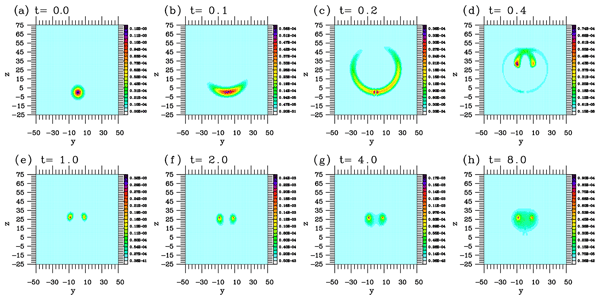
A methodology for directly predicting the time evolution of the assumed parameters for the distribution densities based on the Liouville equation, as proposed earlier, is extended to multidimensional cases and to cases in which the systems are constrained by integrals over a part of the variable range. The extended methodology is tested against a convective energy-cycle system as well as the Lorenz strange attractor.
Rhiannon Biddiscombe, Maarten Ambaum, and Ben Harvey
Weather Clim. Dynam., 7, 2267–2276, https://doi.org/10.5194/wcd-7-2267-2026, https://doi.org/10.5194/wcd-7-2267-2026, 2026
Short summary
Short summary
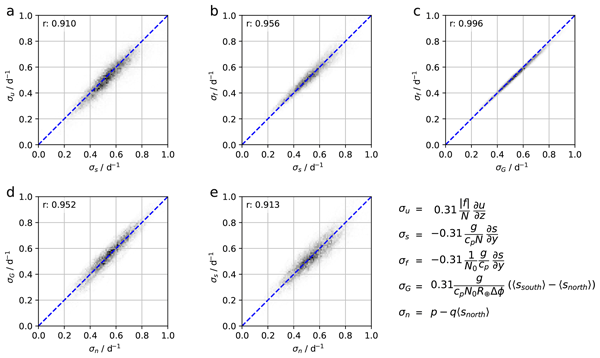
The strength of the North Atlantic storm track, a region where cyclones develop and propagate, is determined by the north to south temperature gradient across the storm track. The usual measure of this strength is the Eady growth rate, which encodes relevant information about the structure of wind and temperature. In this manuscript we show that this rather complex measure can be reduced to a much simplified expression while maintaining its accuracy.
Vaughan T. J. Phillips, Sanne M. H. de Jong, Robert Garvey, Martin K. Skoglund, Torbjörn Ahlström, Fredrik Charpentier Ljungqvist, Mikael Pontarp, Joacim Rocklöv, Matthew Toohey, Jun-Ichi Yano, Helene Castenbrandt, Carl-Johan Fraenkel, Adam Linder, Henrik Sjödin, and Jesper Sjolte
EGUsphere, https://doi.org/10.5194/egusphere-2026-5195, https://doi.org/10.5194/egusphere-2026-5195, 2026
Short summary
Short summary
We investigate how volcanic eruptions may have amplified plague pandemics through climate-driven harvest failure and malnutrition. Using a model linking climate, food production, nutrition and disease, we find that the eruptions of 536 and 540 CE could have greatly increased mortality during the Justinianic Plague. The results suggest that food shortages and human movement were important in shaping the pandemic's severity and spread.
Hans Segura, Xabier Pedruzo-Bagazgoitia, Philipp Weiss, Sebastian K. Müller, Thomas Rackow, Junhong Lee, Edgar Dolores-Tesillos, Imme Benedict, Matthias Aengenheyster, Razvan Aguridan, Gabriele Arduini, Alexander J. Baker, Jiawei Bao, Swantje Bastin, Eulàlia Baulenas, Tobias Becker, Sebastian Beyer, Hendryk Bockelmann, Nils Brüggemann, Lukas Brunner, Suvarchal K. Cheedela, Sushant Das, Jasper Denissen, Ian Dragaud, Piotr Dziekan, Madeleine Ekblom, Jan Frederik Engels, Monika Esch, Richard Forbes, Claudia Frauen, Lilli Freischem, Diego García-Maroto, Philipp Geier, Paul Gierz, Álvaro González-Cervera, Katherine Grayson, Matthew Griffith, Oliver Gutjahr, Helmuth Haak, Ioan Hadade, Kerstin Haslehner, Shabeh ul Hasson, Jan Hegewald, Lukas Kluft, Aleksei Koldunov, Nikolay Koldunov, Tobias Kölling, Shunya Koseki, Sergey Kosukhin, Josh Kousal, Peter Kuma, Arjun U. Kumar, Rumeng Li, Nicolas Maury, Maximilian Meindl, Sebastian Milinski, Kristian Mogensen, Bimochan Niraula, Jakub Nowak, Divya Sri Praturi, Ulrike Proske, Dian Putrasahan, René Redler, David Santuy, Domokos Sármány, Reiner Schnur, Patrick Scholz, Dmitry Sidorenko, Dorian Spät, Birgit Sützl, Daisuke Takasuka, Adrian Tompkins, Alejandro Uribe, Mirco Valentini, Menno Veerman, Aiko Voigt, Sarah Warnau, Fabian Wachsmann, Marta Wacławczyk, Nils Wedi, Karl-Hermann Wieners, Jonathan Wille, Marius Winkler, Yuting Wu, Florian Ziemen, Janos Zimmermann, Frida A.-M. Bender, Dragana Bojovic, Sandrine Bony, Simona Bordoni, Patrice Brehmer, Marcus Dengler, Emanuel Dutra, Saliou Faye, Erich Fischer, Chiel van Heerwaarden, Cathy Hohenegger, Heikki Järvinen, Markus Jochum, Thomas Jung, Johann H. Jungclaus, Noel S. Keenlyside, Daniel Klocke, Heike Konow, Martina Klose, Szymon Malinowski, Olivia Martius, Thorsten Mauritsen, Juan Pedro Mellado, Theresa Mieslinger, Elsa Mohino, Hanna Pawłowska, Karsten Peters-von Gehlen, Abdoulaye Sarré, Pajam Sobhani, Philip Stier, Lauri Tuppi, Pier Luigi Vidale, Irina Sandu, and Bjorn Stevens
Geosci. Model Dev., 18, 7735–7761, https://doi.org/10.5194/gmd-18-7735-2025, https://doi.org/10.5194/gmd-18-7735-2025, 2025
Short summary
Short summary
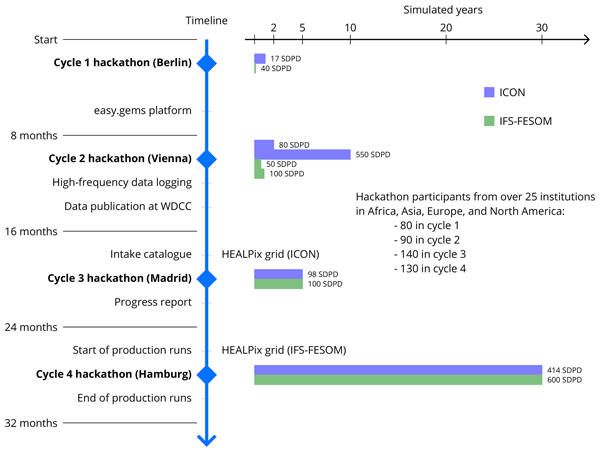
The Next Generation of Earth Modeling Systems project (nextGEMS) developed two Earth system models that use horizontal grid spacing of 10 km and finer, giving more fidelity to the representation of local phenomena, globally. In its fourth cycle, nextGEMS simulated the Earth System climate over the 2020–2049 period under the SSP3-7.0 scenario. Here, we provide an overview of nextGEMS, insights into the model development, and the realism of multi-decadal, kilometer-scale simulations.
Jun-Ichi Yano, Vincent E. Larson, and Vaughan T. J. Phillips
Atmos. Chem. Phys., 25, 9357–9386, https://doi.org/10.5194/acp-25-9357-2025, https://doi.org/10.5194/acp-25-9357-2025, 2025
Short summary
Short summary
The distribution problems appear in atmospheric sciences at almost every corner when describing diverse processes. This paper presents a general formulation for addressing all these problems.
Maciej Karasewicz, Marta Wacławczyk, Pablo Ortiz-Amezcua, Łucja Janicka, Patryk Poczta, Camilla Kassar Borges, and Iwona S. Stachlewska
Atmos. Chem. Phys., 24, 13231–13251, https://doi.org/10.5194/acp-24-13231-2024, https://doi.org/10.5194/acp-24-13231-2024, 2024
Short summary
Short summary
This work concerns analysis of turbulence in the atmospheric boundary layer shortly before sunset. Based on a large set of measurements at a rural and an urban site, we analyze how turbulence properties change in time during rapid decay of convection. We explain the observations using recent theories of non-equilibrium turbulence. The presence of non-equilibrium suggests that classical parametrization schemes fail to predict turbulence statistics shortly before sunset.
Jun-Ichi Yano
Nonlin. Processes Geophys., 31, 359–380, https://doi.org/10.5194/npg-31-359-2024, https://doi.org/10.5194/npg-31-359-2024, 2024
Short summary
Short summary
A methodology for directly predicting the time evolution of the assumed parameters for the distribution densities based on the Liouville equation, as proposed earlier, is extended to multidimensional cases and to cases in which the systems are constrained by integrals over a part of the variable range. The extended methodology is tested against a convective energy-cycle system as well as the Lorenz strange attractor.
Cited articles
Bender, C. M., and Orszag, S. A.: Advanced Mathematical Methods for Scientists and Engineers, McGraw-Hill, New York, 593 pp., ISBN-10 007004452X, 1978. a
Berry, E. X.: Cloud droplet growth by collection, J. Atmos. Sci., 24, 688–701, https://doi.org/10.1175/1520-0469(1967)024<0688:CDGBC>2.0.CO;2, 1967. a, b, c
Berry, E. X. and Reinhardt, R. L.: An analysis of cloud drop growth by collection: Part I. Double distribution, J. Atmos. Sci., 31, 1814–1824, https://doi.org/10.1175/1520-0469(1974)031<1814:AAOCDG>2.0.CO;2, 1974a. a, b
Berry, E. X. and Reinhardt, R. L.: An analysis of cloud drop growth by collection: Part II. Single initial distribution, J. Atmos. Sci., 31, 1825–1831, https://doi.org/10.1175/1520-0469(1974)031<1825:AAOCDG>2.0.CO;2, 1974b. a, b
Berry, E. X. and Reinhardt, R. L.: An analysis of cloud drop growth by collection: Part III. Accretion and self–collection, J. Atmos. Sci., 31, 2118–2126, https://doi.org/10.1175/1520-0469(1974)031<2118:AAOCDG>2.0.CO;2, 1974c. a, b, c
Berry, E. X. and Reinhardt, R. L.: An analysis of cloud drop growth by collection: Part IV. A new parameterization, J. Atmos. Sci., 31, 2127–2135, https://doi.org/10.1175/1520-0469(1974)031<2127:AAOCDG>2.0.CO;2, 1974d. a, b
Bott, A.: A flux method for the numerical solution of the stochastic collection equation, J. Atmos. Sci., 55, 2284–2293, https://doi.org/10.1175/1520-0469(1998)055<2284:AFMFTN>2.0.CO;2, 1998. a, b, c, d
Drake, R. L.: The scalar transport equation of coalescence theory: Moments and kernels. J. Atmos. Sci., 29, 537–547, https://doi.org/10.1175/1520-0469(1972)029<0537:TSTEOC>2.0.CO;2, 1972. a
Escobedo, M., Mischler, S., and Perthame, B.: Gelation in coagulation and fragmentation models, Comm. Math. Phys., 231, 157–188, https://doi.org/10.1007/s00220-002-0680-9, 2002. a, b
Friedlander, S. K.: Theoretical considerations for the particle size spectrum of stratospheric aerosol, J. Meteor., 18, 753–759, https://doi.org/10.1175/1520-0469(1961)018<0753:TCFTPS>2.0.CO;2, 1961. a, b
Fournier, N. and Laurençot, P.: Existence of self–similar solutions to Smoluchowski's coagulation equation, Comm. Math. Phys., 256, 589–609, https://doi.org/10.1007/s00220-004-1258-5, 2005. a
Fournier, N. and Laurençot, P.: Well-posedness of Smoluchowski's coagulation equation for a class of homogeneous kernels, J. Funct. Anal., 233, 351–379, https://doi.org/10.1016/j.jfa.2005.07.013, 2006a. a, b
Fournier, N. and Laurençot, P.: Local properties of self-similar solutions to Smoluchowski's coagulation equation with sum kernels, Proc. Roy. Soc. Edinburgh A, 136, 485–508, https://doi.org/10.1017/S0308210500005035, 2006b. a, b, c
Grigoriev, Y. N. and Meleshko, S. V.: Group analysis of kinetic equations, Russ. J. Numer. Anal. Math. Modeling, 10, 425–447, https://doi.org/10.1515/rnam.1995.10.5.425, 1995. a, b, c
Grabowski, W. W., Morrison, H., Shima, S., Abade, G. C., Dziekan, P., and Pawlowska, H.: Modeling of cloud microphysics: Can we do better?, B. Am. Meteorol. Soc., 100, 655–672, https://doi.org/10.1175/BAMS-D-18-0005.1, 2019. a
Kingston, J. G. and Sophocleous, C.: On form–preserving point transformation of partial differential equations, J. Phys. A Math. Gen, 31, 1597–1619, https://doi.org/10.1088/0305-4470/31/6/010, 1998. a
Leyvraz, F.: Scaling theory and exactly solved models in the kinetics of irreversible aggregation, Phys. Rep., 383, 95–212, https://doi.org/10.1016/S0370-1573(03)00241-2, 2003. a, b, c
Lin, F., Yang, Y., Yang, X., and Zhang, Q.: Preliminary group classification and exact solutions of Smoluchowski equation with a source, J. Comput. App. Math., 444, 115770, https://doi.org/10.1016/j.cam.2024.115770, 2024. a, b, c, d
Menon, G. and Pego, R. L.: Approach to self–similarity in Smoluchowski's coagulation equations, Comm. Pure Appl. Math., LVII, 1197–1232, https://doi.org/10.1002/cpa.3048, 2004. a
Schumann, T. E.: Theoretical aspects of the size distribution of fog particles, Q. J. Roy. Meteor. Soc., 66, 195–207, https://doi.org/10.1002/qj.49706628508, 1940. a
Scott, W. T.: Analytic studies of cloud droplet coalescence I, J. Atmos. Sci., 25, 54–65, https://doi.org/10.1175/1520-0469(1968)025<0054:ASOCDC>2.0.CO;2, 1968. a, b, c
Smoluchowski, M.: Versuch einer mathematischen Theorie der Koagulationskinetik kolloider Lösungen, Z. Phys. Chem., 92, 129–168, https://doi.org/10.1515/zpch-1918-9209, 1917. a
Sorbjan, Z.: Structure of the Atmospheric Boundary Layer, Prentice Hall, Englewood Cliffs, USA, 317 pp., ISBN 0138535574, 9780138535575, 1989. a
Srivastava, R. C.: On the scaling of equations governing the evolution of droplet size distribution, J. Atmos. Sci., 45, 1091–1092, https://doi.org/10.1175/1520-0469(1988)045<1091:OTSOEG>2.0.CO;2, 1988. a
Twomey, S.: Statistical effects in the evolution of a distribution of cloud droplets by coalescence, J. Atmos. Sci., 21, 553–557, https://doi.org/10.1175/1520-0469(1964)021<0553:SEITEO>2.0.CO;2, 1964. a
Twomey, S.: Computations of rain formation by coalescence, J. Atmos. Sci., 23, 405–411, https://doi.org/10.1175/1520-0469(1966)023<0405:CORFBC>2.0.CO;2 , 1966. a
Wacławczyk, M., Grebenev, V. N. and Oberlack, M.: Lie symmetry analysis of the Lundgren–Monin–Novikov equations for multi-point probability density functions of turbulent flow, J. Phys. A Math. Theor., 50, 175501, https://doi.org/10.1088/1751-8121/aa62f4, 2017. a
Xie, M.: Comment on “Theoretical aspects of the size distribution of fog particles”, Q. J. Roy. Meteor. Soc., 150, 3196–3200, https://doi.org/10.1002/qj.4730, 2024. a, b, c
Yano, J.-I.: Instruction for Downloading the Codes and Data used in “Stochastic Collection Equation: Invariant Evolution of the Cloud Droplet–Size Distribution”, hal-05830449, https://hal.science/hal-05830449 (last access: 23 November 2026), 2026. a
Short summary
Inside clouds, the water droplets grow by colliding together, and as a conseqeunce, two of them merge into a larger single droplet. This process can be described by an equation involving differentials and integrals. This paper studies the growth of droplet sizes by collisions and mergers by asking how we can make it identical by rescaling time, droplet size unit, as well as the total number density, like we recreate scenes in movies by minituares.
Inside clouds, the water droplets grow by colliding together, and as a conseqeunce, two of them...