the Creative Commons Attribution 4.0 License.
the Creative Commons Attribution 4.0 License.
 | 05 Jan 2026
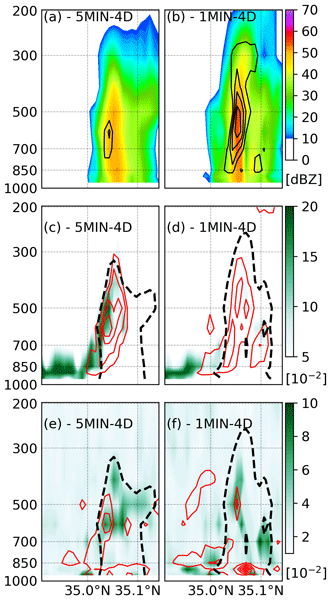
Impact of reduced non-Gaussianity on analysis and forecast accuracy by assimilating every-30 s radar observation with ensemble Kalman filter: idealized experiments of deep convection

Takemasa Miyoshi
Related authors

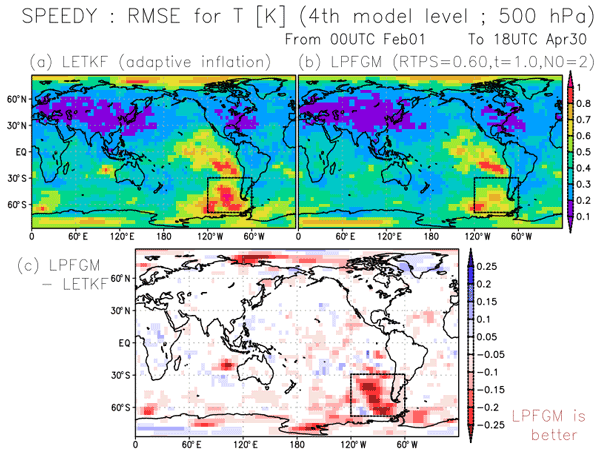
This work extends the Mapping Particle Filter to account for local dependencies. Two localization methods are tested: a global particle flow with local kernels, and iterative local mappings based on correlation radius. Using a two-scale Lorenz-96 truth and a one-scale forecast model, experiments with full/partial and linear/nonlinear observations show Root Mean Square Error reductions using localized Gaussian mixture priors, achieving competitive performance against Gaussian filters.
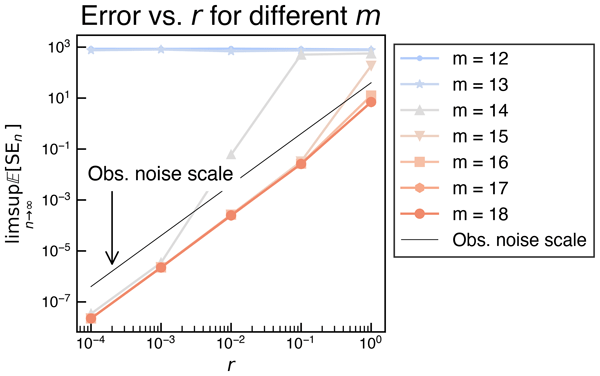
This work extends the Mapping Particle Filter to account for local dependencies. Two localization methods are tested: a global particle flow with local kernels, and iterative local mappings based on correlation radius. Using a two-scale Lorenz-96 truth and a one-scale forecast model, experiments with full/partial and linear/nonlinear observations show Root Mean Square Error reductions using localized Gaussian mixture priors, achieving competitive performance against Gaussian filters.
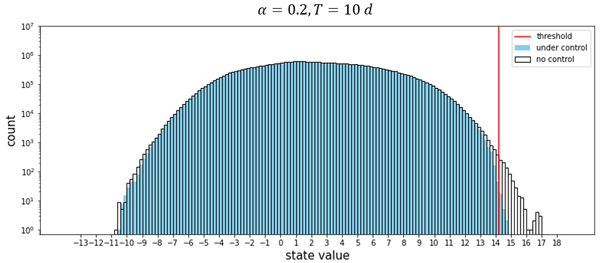

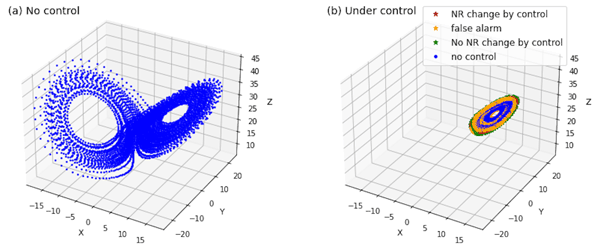
naturein a computational simulation. Idealized experiments with a low-order chaotic system show successful results by small control signals of only 3 % of the observation error. This is the first step toward realistic weather simulations.